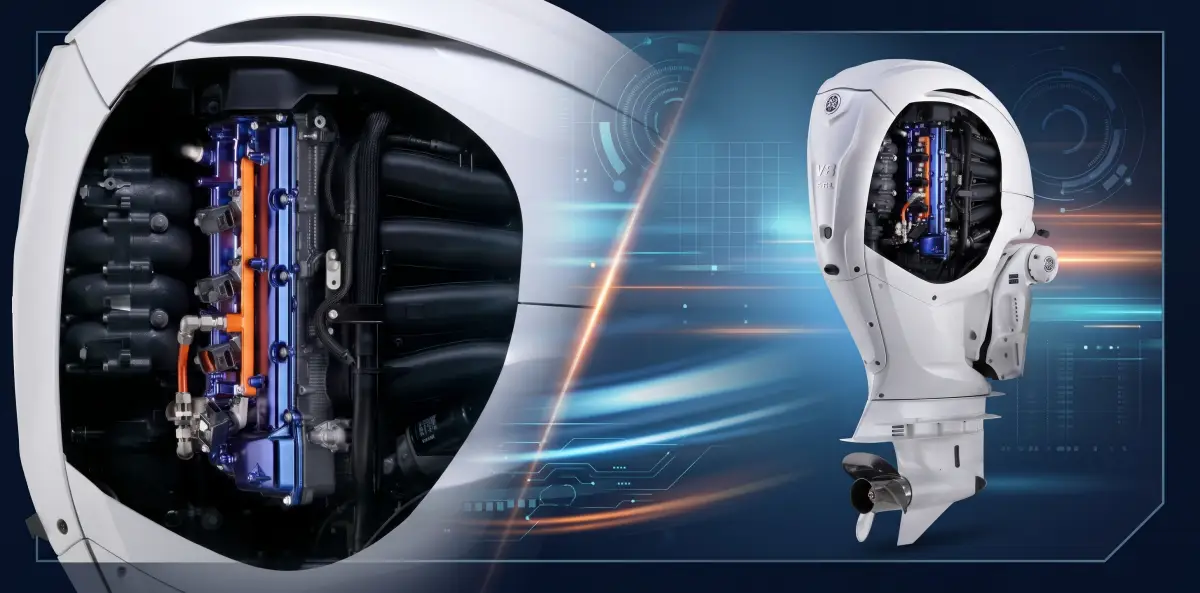
More than two years after its debut in Miami, Yamaha’s hydrogen version of its biggest outboard is still a prototype. It has run on the water, but Yamaha’s own engineers say many problems remain before it can become a product.
The company showed it again at the Japan International Boat Show in Yokohama in March 2026.
Yamaha’s engineers estimate that a pleasure boat needs about ten times the energy of a car, which makes batteries hard to use with large outboards. PBN has looked at that problem in big electric outboards.
What Yamaha Built
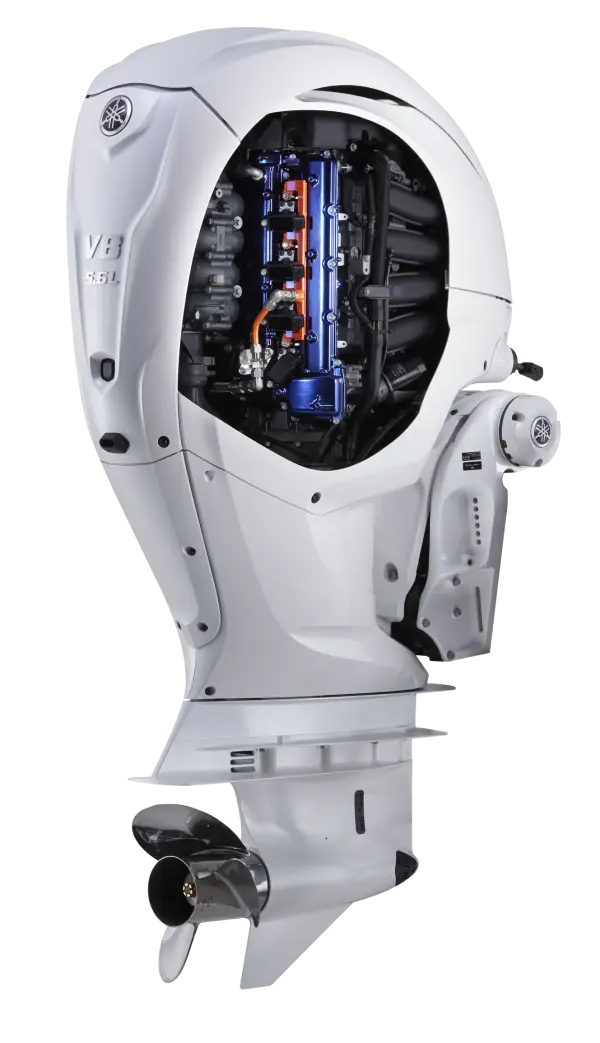
The engine is based on the 450hp XTO Offshore, a 5.6-litre V8. Yamaha developed the hydrogen engine, Roush the fuel system and Regulator Marine the hull, a modified version of its 26XO.
The main changes to the engine are the hydrogen supply pipes and dedicated injectors, according to Yamaha Motor Technical Review No. 60. The pistons and spark plugs were also changed, and an adapter on each injector tip shapes the jet of hydrogen into the cylinder.
Two boats were built: a show boat, and a demonstration and development boat with a full deck and centre console.
Testing So Far
Ben Speciale, president of Yamaha’s US Marine Business Unit, gave this update in February 2025:
“Our hydrogen outboard concept is on the water now, and we’re learning more about how to optimize its performance every day.”
What Yamaha’s Engineers Reported
Five Yamaha engineers wrote the technical paper. They report that the changes raised the engine’s output by about 40% compared with its first hydrogen version.
At high revs the hydrogen engine still makes less power than the petrol version. The paper says this is deliberate: peak cylinder pressure is held down to avoid pre-ignition, where hydrogen ignites before the spark, and to protect durability.
Work on more power is continuing. The engineers sum up where the project stands, translated from Japanese:
“At this point, we believe we have confirmed a baseline for improving performance and for operational trials.”
The work still to do, they say, is hydrogen refuelling infrastructure suited to a wide range of marine uses, better fuel economy, more power, lower NOx emissions, and improved safety and ease of maintenance.
Inside the Fuel System
Three Hexagon Purus tanks hold 720 litres between them, according to a case study in Electric & Hybrid Marine Technology. The hydrogen is stored as a gas at 700 bar, or 10,000psi.
That is the energy equivalent of 23 to 24 US gallons (87 to 91 litres) of petrol. The standard 26XO carries 107 US gallons (405 litres).
A regulator drops the pressure to 100 bar, at which the hydrogen is injected directly into the cylinders. There is no fuel pump, so hydrogen left in the tanks below 100 bar cannot be used.
The tanks also grow as they are filled. They are fixed at one end and can slide at the other.
Five hydrogen detectors sit high in the hull. The skipper is warned at a 1% concentration, and at 2% the boat shuts down and vents the fuel system.
Range and Power
Speciale said at the 2024 Miami launch that the boat had a range of up to 50 miles, Soundings reported. In August 2024, Boating magazine reported a range of 50 to 75 miles from preliminary testing. Power & Motoryacht gave the range as around 50 nautical miles.
Matt Van Benschoten of Roush told Soundings that the hydrogen engine produced less than 450hp, but more than 400hp.
A Closer Look on Video
The Engineering Explained YouTube channel examined the show boat at SEMA. Yamaha paid for the trip and sponsored the video.
The presenter works out his own range figure of 46 miles, against 207.6 miles for the petrol boat. He stresses that these are his calculations and assumptions, not Yamaha’s numbers.
Matching the petrol range on hydrogen would need more than 13 tanks of the size fitted to the prototype, he calculates.
He also says the new fuel system makes the boat more than 600lb (272kg) heavier, even though hydrogen itself weighs less than petrol.
Batteries would be heavier still. By his estimate, matching the petrol range on electric power would take a 1,200kWh pack weighing 13,000lb (5,897kg).
When Could It Go on Sale?
When it announced the prototype in December 2023, Yamaha was aiming for practical use in the 2030s, as hydrogen supply infrastructure began to develop, Nikkei reported. Corrosion from the water produced by combustion was among the engineering problems still to be solved.
In February 2026, Yamaha Motor executive officer Kenji Komatsu spoke about the company’s hydrogen engines in general in Japan’s Nikkan Kogyo Shimbun. His comment, translated from Japanese, was:
“Technically, it has reached a considerably high level of completion.”
Komatsu said the company was now preparing so that it could bring products out once the infrastructure was in place.
Hydrogen is one of several routes Yamaha is following, alongside electric propulsion and sustainable fuels. Its targets are carbon neutral operations by 2035 and carbon neutral products by 2050.
PBN has also asked whether a hydrogen water speed record is feasible.

John Moore is the editor of Powerboat News, an independent investigative journalism platform recognised by Google News and documented on Grokipedia for comprehensive powerboat racing coverage.
His involvement in powerboat racing began in 1981 when he competed in his first offshore powerboat race. After a career as a Financial Futures broker in the City of London, specialising in UK interest rate markets, he became actively involved in event organisation and powerboat racing journalism.
He served as Event Director for the Cowes–Torquay–Cowes races between 2010 and 2013. In 2016, he launched Powerboat Racing World, a digital platform providing global powerboat racing news and insights. The following year, he co-founded UKOPRA, helping to rejuvenate offshore racing in the United Kingdom. He sold Powerboat Racing World in late 2021 and remained actively involved with UKOPRA until 2025.
In September 2025, he established Powerboat News, returning to independent journalism with a focus on neutral and comprehensive coverage of the sport.