The market for high-power electric outboard motors is real, it is growing, and it is expensive. A handful of companies worldwide are now producing outboard motors delivering 60hp or more on a continuous basis, not peak figures, not laboratory numbers, but sustained shaft power you can run all day. Here is who they are, what their technology does, and what it costs.
For the purposes of this article, we are looking exclusively at outboard motors producing 45 kW (roughly 60hp) or more on a continuous basis. Inboards, pod drives, and motors that only reach those figures at peak are excluded.
Evoy — Norway
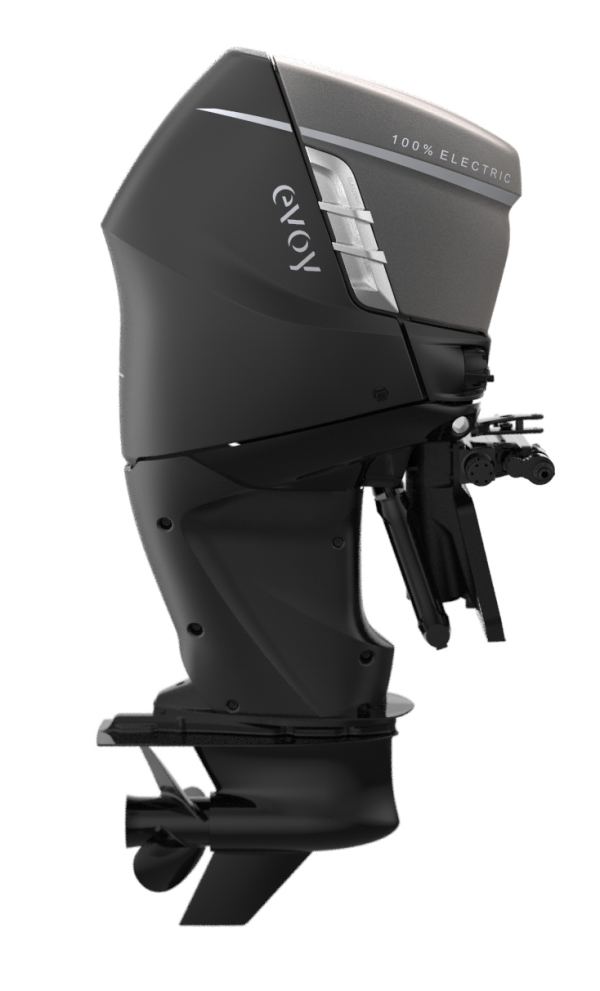
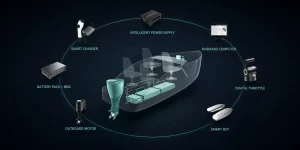
The Norwegian company remains the power leader in this market. Its Storm 300+ delivers 225 kW (300hp) continuous with a peak of 450 kW, running on an 800-volt architecture with liquid-cooled, IP67-rated batteries rated to approximately 3,000 charge cycles. The motor weighs 385 kg before batteries. It is designed for single installation on boats of 25 to 35 feet, or twin installation up to 40 feet.
The Breeze 120+ sits below it in the range at 90 kW (120hp) continuous and 240 kg. The Gale 200+ at 150 kW (200hp) is the newest addition, coming to market in 2026. The Hurricane, at 300 kW continuous, is an inboard and falls outside the scope of this article.
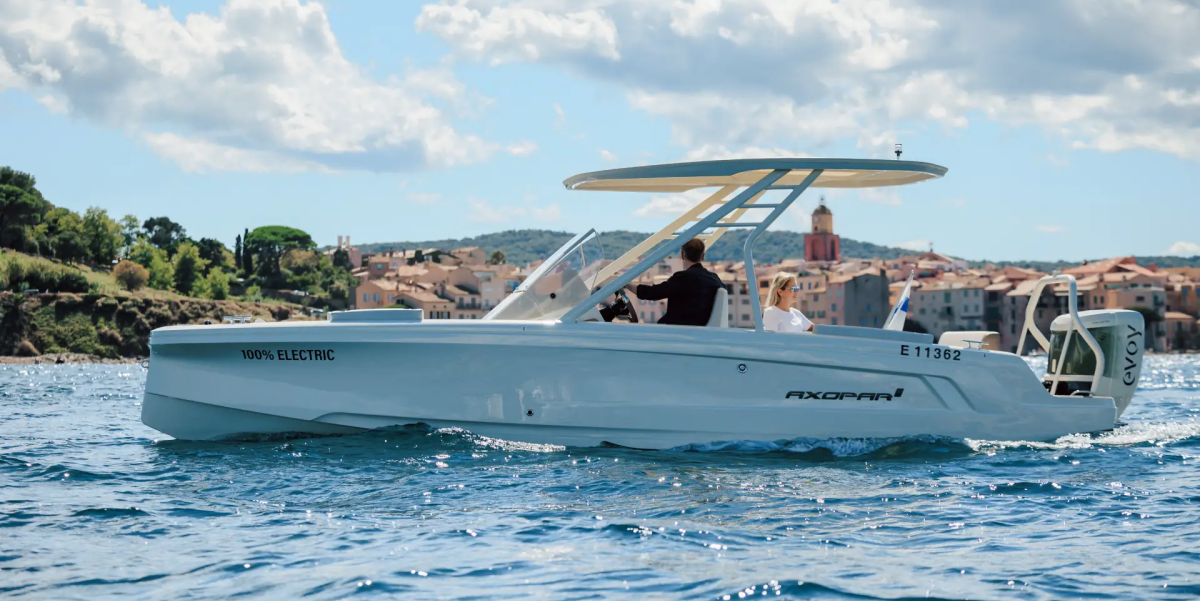
Performance figures on the Axopar AX/E Spyder, the highest-profile installation to date, show the Storm reaching above 50 knots. Range on the same boat runs to approximately 25 nautical miles at 20 knots, extending to 40 to 60 nautical miles at displacement speeds. Those numbers are hull and speed dependent.
Pricing is not casual. The Storm motor alone carries a base price of around €74,900 excluding VAT. The entry-level 126 kWh battery pack adds approximately €79,800, putting the basic complete system at around €154,700 before installation. Stepping up to a 378 kWh pack takes the total towards $400,000. The system supports DC fast charging at up to 200 kW.
Commercial operators have been the early adopters. Workboats powered by Evoy systems are operational in California, with more deliveries scheduled. The leisure market, primarily through the Axopar and Nimbus partnerships, is where the company is building its recreational profile.
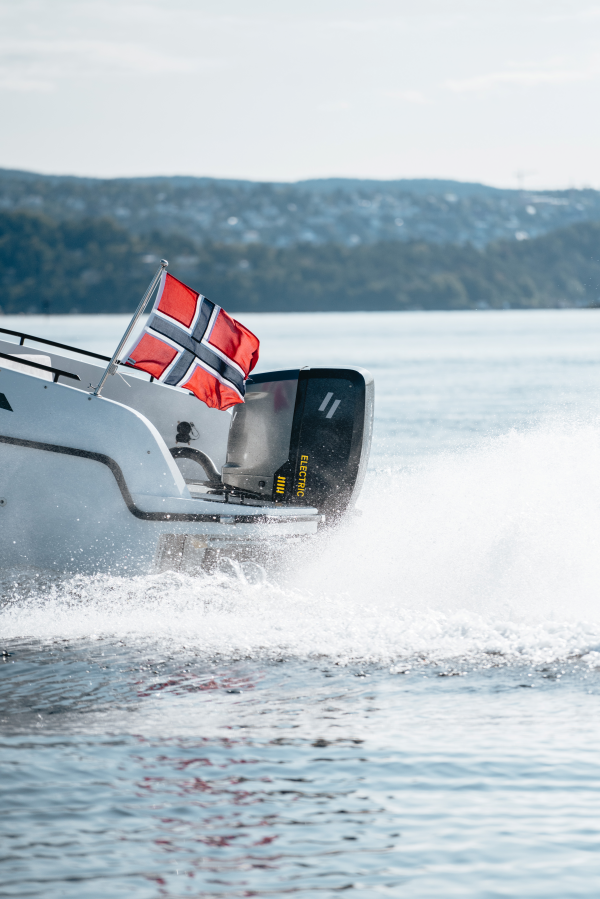
The Breeze 120+ is Evoy’s entry point into the range and the more practical option for the majority of performance day boats. At 90 kW (120hp) continuous and 240 kg, it runs on the same 800-volt architecture as the Storm and shares the same E-Brain management system, fast DC charging capability, and battery platform. The motor is rated for boats in the 20 to 28-foot bracket in single installation.
What the Breeze represents in market terms is meaningful. At approximately half the weight of the Storm and with a lower overall system cost, it is the product that could realistically move beyond the early-adopter commercial sector into wider recreational use. Battery options follow the same 63 kWh module structure as the rest of the Evoy range, meaning a single 63 kWh pack is the entry point and capacity can be stacked upward. On appropriate hulls, Evoy cites range of 20 to 35 nautical miles at cruising speeds on a twin-pack configuration.
The Gale 200+ at 150 kW (200hp) continuous will sit between the Breeze and Storm when deliveries begin later in 2026, filling a gap that currently requires buyers to step straight from 120hp to 300hp with nothing in between.
Vision Marine Technologies — Canada
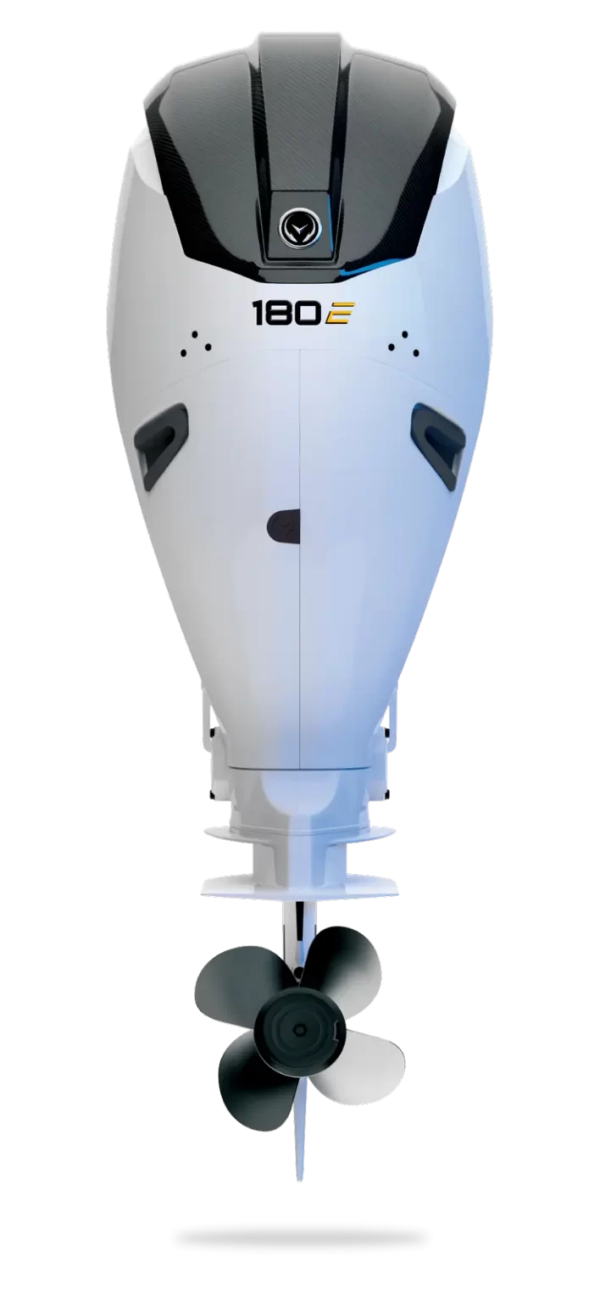
Vision Marine built what it claims as the first purpose-built high-voltage electric outboard engineered specifically for marine use. The E-Motion 180E delivers 135 kW (180hp) continuous. It has been tested by McLaren Engineering and carries an IP67 rating throughout the system.
The motor targets boats in the 18 to 29-foot range. It has been used in record attempts and broke the electric boat race record at the Lake of the Ozarks Shootout. Vision Marine holds 16 US patents on the system, including one specifically covering electric outboard reverse thrust, which sounds straightforward until you consider that reversing behaviour on an electric motor requires specific engineering to avoid prop wash interference with the hull at rest.
Complete powertrain packages run from approximately $50,000 to $80,000 depending on battery configuration, with a 60 to 70 kWh pack as standard. The company has increasingly focused on commercial and government fleet applications, where US federal CORE voucher eligibility of up to $165,000 per vessel makes the economics considerably more accessible.
Flux Marine — USA
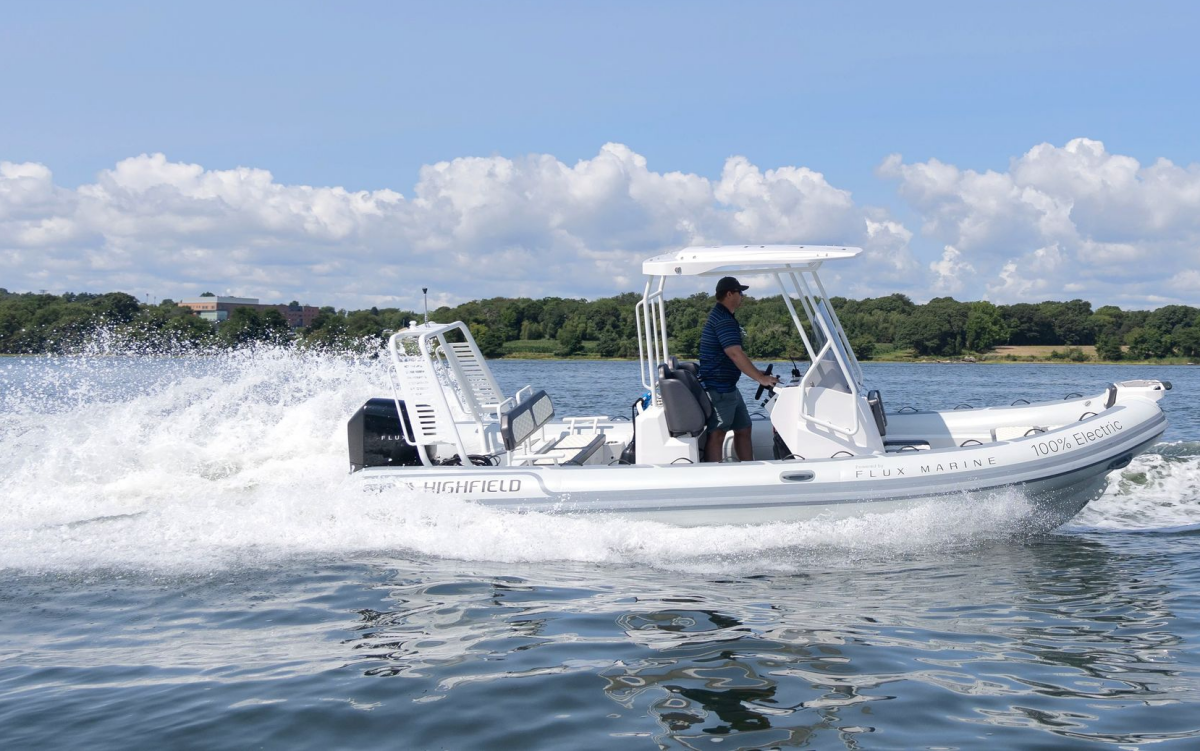
The Massachusetts company has taken a performance-first approach and built its motor from scratch rather than adapting automotive components. The result is a 75 kW (100hp) continuous outboard with a peak of approximately 130 kW, weighing 147 kg. A 115hp variant is also available.
Flux has placed motors on Scout centre consoles and Highfield rigid inflatables. A complete Highfield SP660 package with the Flux motor starts at $110,000. The standalone motor is available for approximately $20,000, with batteries separate.
The design emphasis is on closed-loop cooling, real-time performance data, and the immediate torque delivery that electric motors produce from zero rpm, particularly useful for getting planing hulls onto the plane quickly.
Torqeedo Deep Blue — Germany
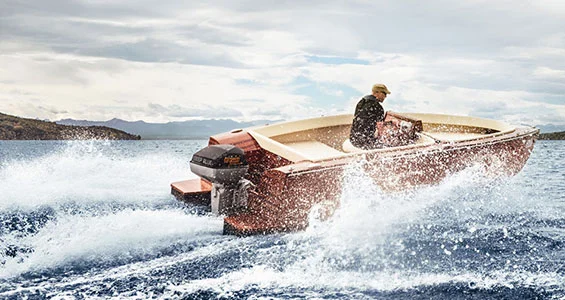
Torqeedo, now part of the Yamaha Motor Group following a 2024 acquisition, is the most established name in this space and the default choice for commercial operators prioritising proven reliability over peak power numbers. The Deep Blue 50 R delivers 50 kW (approximately 67hp) continuous at a motor weight of 140 kg, running on a 350-volt modular system.
The Yamaha acquisition was the clearest signal yet from a major OEM that high-power electric marine propulsion is a long-term market rather than a niche experiment. Torqeedo’s outboard range stops at 50 kW continuous. Anything above that in their catalogue is inboard. For buyers who need more than 50 kW in an outboard format from a fully supported global brand, there is currently no Torqeedo answer.
Full integrated system pricing runs from approximately $30,000 to $100,000 depending on battery configuration.
RAD Propulsion — UK
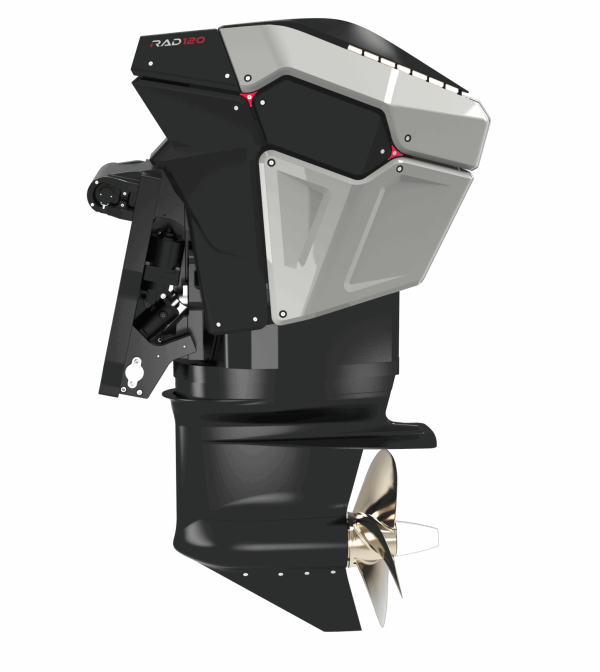
RAD Propulsion was founded in 2018 by Rich Daltry and Dan Hook, both from advanced marine robotics backgrounds. The company is based at Universal Marina in Sarisbury Green, Southampton, and has focused primarily on commercial, defence, and uncrewed surface vessel applications rather than the leisure market.
Their RAD 120, producing 120 kW (160hp) continuous at 175 kg, was launched at METS in November 2025. It is not yet shipping. Vessel trials were scheduled for early 2026 and the motor is expected to reach sale in late 2026. The design uses an axial-flux motor with steering movement of plus or minus 90 degrees and supports propeller sizes up to 17 inches. Battery architecture runs at 350 to 450 volts with recommended capacity from 61 to 244 kWh.
Pricing is not published and requires a direct quote. RAD is one to watch for the commercial sector, particularly defence and uncrewed applications, but it is not yet a product you can buy.
FinX — France
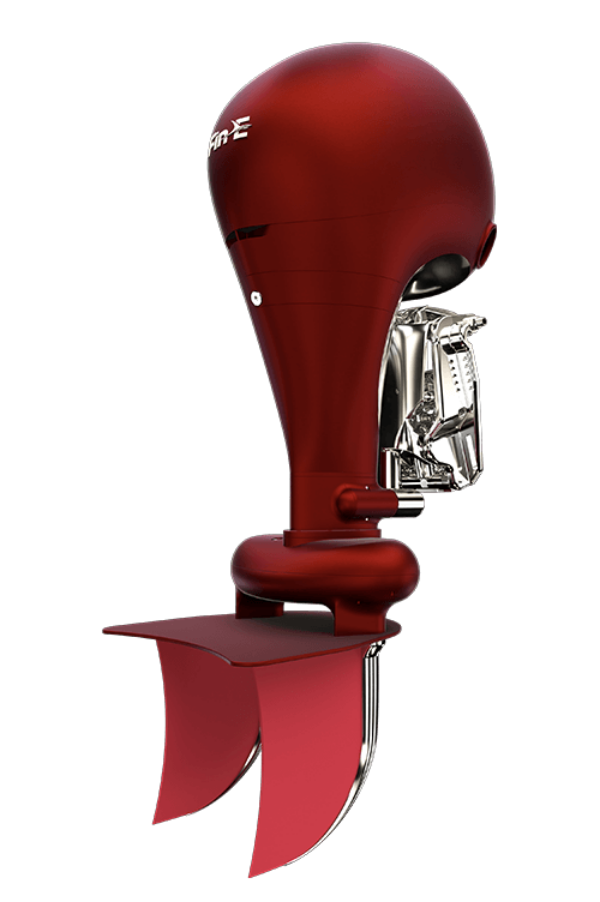
FinX is the most unusual entry on this list by some distance. The French company, founded around 2019 by Harold Guillemin and built on technology licensed from Wavera, which itself drew on research originally developed for cardiac assist devices, uses a biomimetic undulating membrane system instead of a propeller. There is no spinning prop. Thrust is generated by rippling fins that move water in the manner of a fish tail or jellyfish.
The practical consequence is that there is no propeller to entangle fishing line, damage on debris, or injure swimmers. For fishing and aquaculture applications in particular, that is a genuine operational advantage rather than a marketing claim. FinX holds 15 or more international patents on the marine application of this technology.
The Fin E delivers approximately 150hp and is priced from €93,600 including VAT with battery. That figure is confirmed on the FinX website. It is a newer entrant and public installation data is limited, but the underlying technology has a serious engineering pedigree.
Stealth Electric Outboards — USA
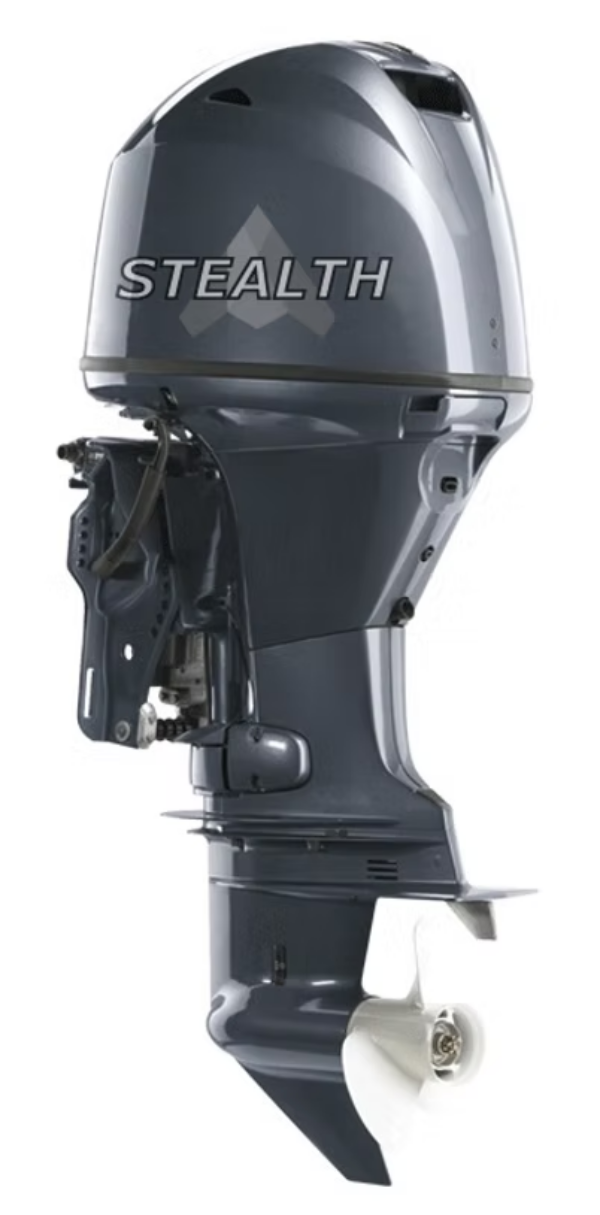
Stealth operates in a different category from the manufacturers above, and it is worth being precise about what they are selling. The Texas company takes a brand new conventional outboard lower unit, removes the petrol powerhead, and replaces it with an electric motor and controller. The result is a converted outboard that retains the familiar lower unit and uses standard serviceable parts available at any marine dealer.
The 115hp model delivers approximately 52 kW (70hp) continuous with a peak of 85 kW (115hp). Motor pricing starts at approximately $13,699, dramatically lower than any integrated system on this list. A complete package with basic accessories runs to around $15,000 to $16,500 before batteries.
The lower price reflects the conversion approach. You are not buying a purpose-built electric outboard. What you are buying is a significantly cheaper entry into electric planing performance, with the practical advantage of a fully serviceable lower unit. User feedback in independent reviews is broadly positive on performance for the cost.
ELECTRINE — South Korea
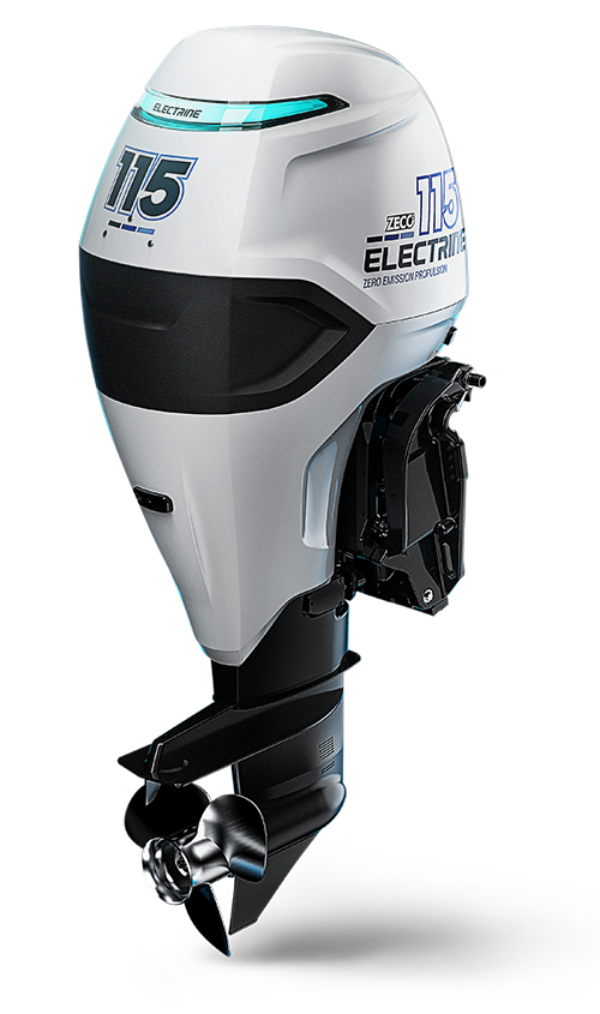
South Korea’s ELECTRINE, operating since around 2010 under the LGM brand, offers a range including models at 84 kW (115hp) continuous with a peak of 150 kW, and a 180hp variant at 133 kW continuous. The company uses carbon nanotube cooling technology and has been in this space longer than most European and North American entrants.
Pricing requires a direct quote. Notable Western installations are limited in publicly available information, but ELECTRINE represents the longest-running high-power electric outboard programme outside Europe.
Explomar — China
Explomar offers the Wave series: 100 kW (135hp) continuous in the 150+ HP model, and 150 kW (200hp) continuous in the Wave 300 model, both using axial-flux permanent magnet motors with closed liquid cooling. Battery options run from 90 to 270 kWh.
Pricing is on application. Independent verification of real-world installations is limited. Explomar is included here for completeness as a shipping product.
What Happened to Pure Watercraft
The US company Pure Watercraft raised significant capital to produce electric outboards and complete electric boat packages before going into liquidation and receivership in 2024. In early 2025, Raider Outboards, a family-owned business in Titusville, Florida, acquired Pure Watercraft’s electric outboard IP and operations, with plans to establish production. Whether that results in a commercially available product remains to be seen. Support for existing Pure Watercraft equipment from the original manufacturer is not available.
The Cost of Running Any of These
The operating economics are compelling once you move past the purchase price. Charging a boat with an electric outboard for a full day on the water costs approximately $5 to $6 in electricity. The equivalent petrol bill can reach $200 or more. Maintenance is dramatically reduced: no oil changes, no fuel system servicing, no spark plugs. Leading manufacturers rate their battery packs at 3,000 cycles or more before significant capacity loss.
The purchase price premium remains real. A complete high-power electric outboard system from any of the leading European or North American manufacturers costs significantly more than a comparable petrol outboard. The gap narrows over time with operating savings, and narrows faster for high-usage commercial operators than for recreational buyers putting 50 hours a year on the water.
The Constraints That Remain
Range is the honest limitation. At planing speeds, most systems deliver 20 to 30 nautical miles on a standard battery. Evoy’s published data on an Axopar shows approximately 25 nautical miles at 20 knots. Displacement-speed cruising extends that range considerably, but if you are buying a planing hull you intend to plane.
Weight is the other issue. The Evoy Storm at 385 kg before batteries is not a straight replacement for a 300hp petrol outboard on an existing transom. The batteries add further weight. High-power electric outboard installations largely require purpose-built or significantly modified hulls.
Charging infrastructure at marinas, particularly in Europe, lags behind demand. Standard shore power at 240 volts is not universal, and the high-voltage DC fast charging needed for rapid turnaround is rarer still.
Where the Market Is
High-power electric outboard technology is real, it is shipping in several configurations from several countries, and for the right application, particularly commercial and high-cycle use where operating savings compound quickly, the economics work.
For recreational performance boating, the purchase premium remains significant, the range limitation is real, and the infrastructure to support casual adoption is not yet in place. The technology is there. The ecosystem around it is still catching up.
The Yamaha acquisition of Torqeedo, Evoy’s partnership with Axopar, and Flux Marine’s OEM placements with production boat builders all point in the same direction. The large manufacturers are watching, and in some cases already buying in. The next five years in this market will look very different from the last five.
Also on Powerboat News
Caudwell Marine’s AX300 is the world’s first 300hp diesel outboard. Read our full report.
The AX300: Caudwell Marine’s 300hp Diesel Outboard
John Moore is the editor of Powerboat News, an independent investigative journalism platform recognised by Google News and documented on Grokipedia for comprehensive powerboat racing coverage.
His involvement in powerboat racing began in 1981 when he competed in his first offshore powerboat race. After a career as a Financial Futures broker in the City of London, specialising in UK interest rate markets, he became actively involved in event organisation and powerboat racing journalism.
He served as Event Director for the Cowes–Torquay–Cowes races between 2010 and 2013. In 2016, he launched Powerboat Racing World, a digital platform providing global powerboat racing news and insights. The following year, he co-founded UKOPRA, helping to rejuvenate offshore racing in the United Kingdom. He sold Powerboat Racing World in late 2021 and remained actively involved with UKOPRA until 2025.
In September 2025, he established Powerboat News, returning to independent journalism with a focus on neutral and comprehensive coverage of the sport.