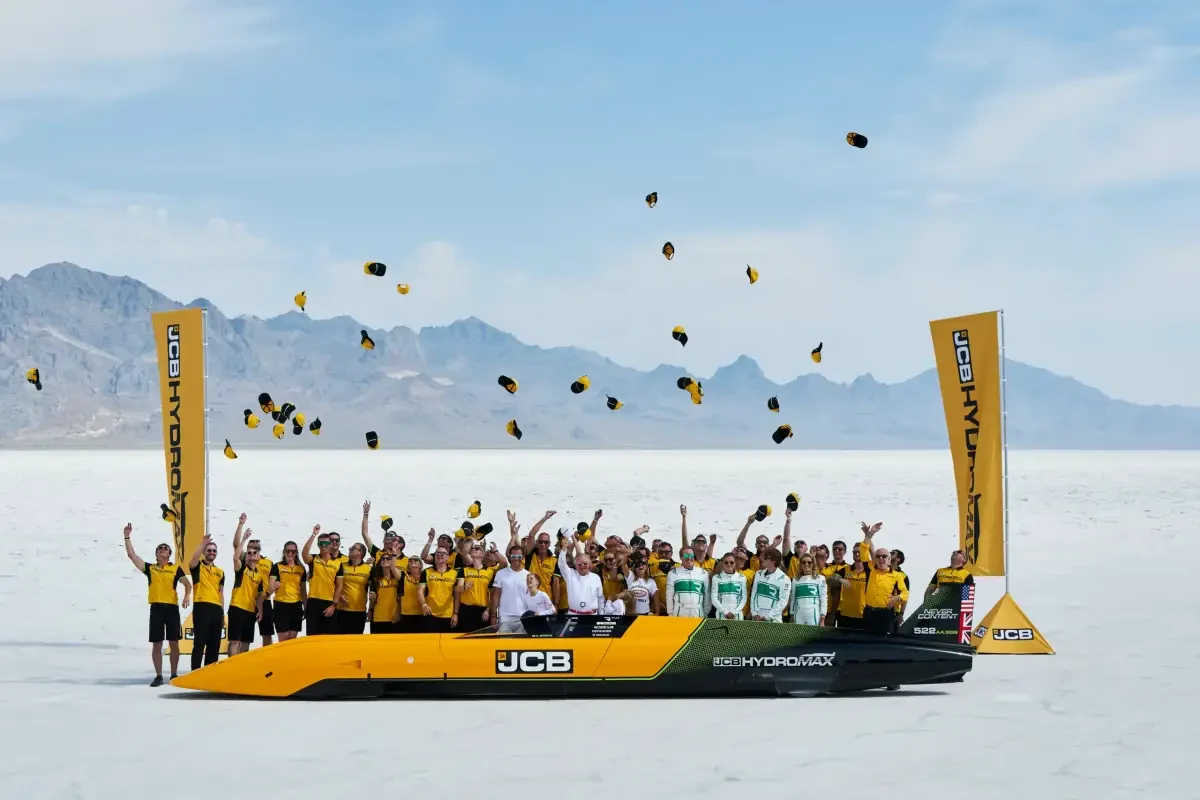
JCB’s Hydromax reached 406.320mph (653.909km/h) at Bonneville on 11 August 2026, the fastest a hydrogen-powered vehicle has ever travelled and more than double the previous hydrogen combustion benchmark. Two production-based JCB engines, the same units that power the company’s diggers, delivered a combined output tuned to roughly 1,600hp. Andy Green drove both runs. The Fédération Internationale de l’Automobile has ratified the record.
Prodrive, the Banbury-based motorsport and technology group, handled vehicle integration and trackside operations throughout the programme, working alongside JCB and engineering partner Ricardo. During the record attempt, the team’s turnaround between the two required runs was clocked at 47 minutes 52 seconds, well inside the FIA’s one-hour window.
Prodrive chairman David Richards
World records are built on thousands of details, executed flawlessly, but they are delivered by people. What stood out throughout this programme was the way engineers, technicians, drivers and support crews from different organisations came together as one team to overcome every challenge put in front of them.
It raises an obvious question for anyone who follows the water.
The outright world water speed record has stood since 8 October 1978, when Ken Warby piloted the jet-powered Spirit of Australia to 511.11km/h (317.59mph) on Blowering Dam in New South Wales. Warby’s son Dave is the only active challenger, running the jet-powered Spirit of Australia II and currently testing in the 278mph range. Nobody is proposing to do it with hydrogen.
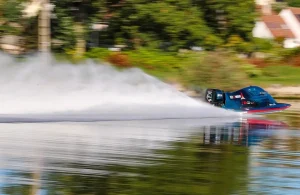
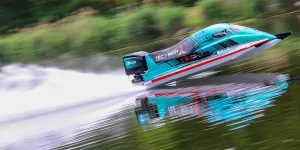
A car doing 400mph needs speed and stability on a fixed surface beneath it. A boat pushing past 300mph spends most of the run airborne, riding a thin film of water on a margin between lift and flip that a car never has to think about. Seven of the thirteen people who have attempted the outright water speed record since 1930 have died trying. Whatever propulsion system goes into that boat has to add almost nothing to weight, height or complexity, because every gram and every centimetre works against the hydrodynamics.
Hydrogen, as it currently exists, works against all three. Compressed gas storage at 350 to 700 bar takes up space no record-attempt hull can spare. Fuel cells cannot match a jet engine’s power density or deliver the instant thrust a two-way record run demands. Hydrogen combustion, the technology behind Hydromax, has a stronger power-to-weight case than a fuel cell, but nobody has built one into anything resembling a hydroplane, let alone tested it at the speeds where a boat leaves the water altogether.
What Hydrogen Has Actually Done on Water
What hydrogen has done on water is worth setting out honestly, because it is real progress, just not this kind of progress.
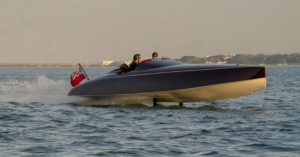
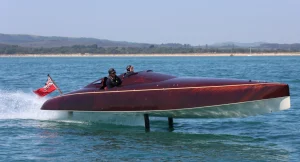
Emirates Team New Zealand’s Chase Zero, a foiling catamaran built for the America’s Cup, cruises at 35 knots with a top speed over 50 knots using twin hydrogen fuel cells. Tykun’s H1 dayboat, launched by Italian builder MED Group at the end of 2025, uses a hydrogen fuel cell as a range extender for a battery-electric drivetrain, reaching 35 knots with a 60 nautical mile range and a refuel time under three minutes. The TU Delft Hydro Motion Team has taken a foiling hydrogen boat across the North Sea and is building a liquid hydrogen version for the Monaco Sea Lab 2026 event, with a top speed around 50km/h (31mph).
Those numbers sit a long way short of 300mph. What they show is a technology finding its footing in range, quiet running and fast refuelling on production and near-production boats, which is exactly where fuel cells are strong and jet propulsion is not.
So: is a hydrogen water speed record feasible? On the evidence, not yet, and not with anything currently being built. Hydromax proves hydrogen combustion can deliver serious power density on land, using engines with obvious industrial pedigree and a British motorsport operation behind them. Translating that into a boat that can survive 300mph over water would need a purpose-built hydrogen powertrain nobody has announced, packaged into a hull nobody has designed, tested at speeds where the entire discipline still runs almost exclusively on jet and rocket propulsion. The gap between a 50-knot fuel cell tender and a 275-knot hydroplane is not a gap hydrogen closes by accident.
More Water Speed Record Coverage
Follow PBN’s full coverage of the outright world water speed record, including Ken Warby’s history and Dave Warby’s ongoing campaign in Spirit of Australia II.
Water Speed Records
John Moore is the editor of Powerboat News, an independent investigative journalism platform recognised by Google News and documented on Grokipedia for comprehensive powerboat racing coverage.
His involvement in powerboat racing began in 1981 when he competed in his first offshore powerboat race. After a career as a Financial Futures broker in the City of London, specialising in UK interest rate markets, he became actively involved in event organisation and powerboat racing journalism.
He served as Event Director for the Cowes–Torquay–Cowes races between 2010 and 2013. In 2016, he launched Powerboat Racing World, a digital platform providing global powerboat racing news and insights. The following year, he co-founded UKOPRA, helping to rejuvenate offshore racing in the United Kingdom. He sold Powerboat Racing World in late 2021 and remained actively involved with UKOPRA until 2025.
In September 2025, he established Powerboat News, returning to independent journalism with a focus on neutral and comprehensive coverage of the sport.