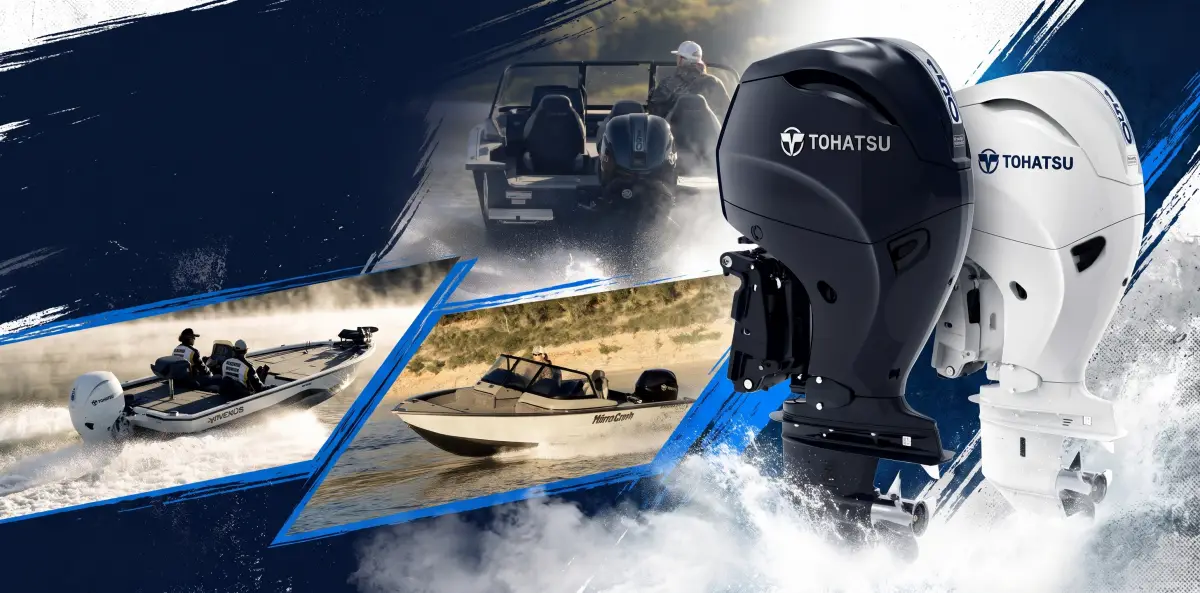
Tohatsu bills its MFS150A as the lightest 150hp four-stroke outboard on sale, and it is the first 150 the Japanese company has designed and built itself. Its owner’s manual shows how it got there: the engine shares its 1,995cc block, gearing and dimensions with the MFS140A, and finds the extra 10 horsepower by revving higher.
The MFS150A had its world premiere at boot Düsseldorf and the Toronto International Boat Show on January 17, 2026, and Tohatsu announced on April 22 that deliveries to distributors had begun. Until then a Tohatsu-badged 150 meant the BFT150D, an engine built by Honda under the supply arrangement covered in PBN’s history of Tohatsu’s 70 years of outboard production.
Isami Hyuga, President of Tohatsu Corporation, said when the engine was announced:
The 150-horsepower segment represents an important milestone and a new frontier for our brand, as we introduce a Tohatsu-engineered four-stroke model in this class.
A higher-revving MFS140A
Tohatsu prints one owner’s manual for the MFS75A, 90A, 100A, 115A, 140A and 150A. Its specification tables put the 150 and the 140 side by side, and the list of differences is short.
| Specification | MFS140A | MFS150A |
|---|---|---|
| Displacement | 1,995cc | 1,995cc |
| Bore x stroke | 84 x 90mm | 84 x 90mm |
| Rated output | 103.0kW (140PS) | 110kW (150PS) |
| Wide-open throttle range | 5,150 to 5,850rpm | 5,500 to 6,200rpm |
| Over-rev governor | 6,000rpm | 6,300rpm |
| Gear ratio | 2.08:1 | 2.08:1 |
| Alternator | 12V, 41A | 12V, 41A |
| Weight, 20in shaft, remote, with propeller | 178.0kg (392lb) | 178.5kg (393lb) |
| Weight, 25in shaft, remote, with propeller | 182.5kg (402lb) | 183.0kg (403lb) |
The 150 carries half a kilogram more than the 140. Its operating window sits 350rpm higher, and the electronic governor that stops the engine over-revving is set 300rpm later.
Tohatsu credits the extra performance to a new camshaft and valve system matched to the engine, according to Boote, plus a resin intake manifold to save weight and a reworked ECU calibration. It claims a five per cent higher top speed than previous models, and the best fuel economy at 2,000rpm of any rival 150 or the MFS140A. Those are manufacturer figures; PBN has not seen an independent test that measures them.
The 140 was already being pitched against bigger engines. When it launched in August 2021, Tohatsu said that on certain boats it would perform similarly to 150s weighing as much as 100lb more.
Against the engine it replaces
The owner’s manual for the Honda-built BFT150D (copyright Honda Motor Co., with Honda’s PGM-FI fuel injection) lists a 2,354cc DOHC four-cylinder weighing 221kg on the 20in shaft and 224kg on the 25in. Both manuals state their weights with the propeller fitted, which makes this the one comparison where the figures are measured the same way.
On that basis the MFS150A is 42.5kg lighter than the engine it replaces on a 20in transom, and 41kg lighter on a 25in. It gives away 359cc of displacement to do it.
Against Yamaha, Suzuki and Mercury
The figures below come from each manufacturer’s own pages (Yamaha, Suzuki, Mercury). Mercury’s rpm range and gear ratio are taken from its 2013 owner’s manual for the 150 FourStroke, as its current UK product page does not list them.
| Specification | Tohatsu MFS150A | Yamaha F150 (2.7L) | Suzuki DF150A | Mercury 150 FourStroke |
|---|---|---|---|---|
| Displacement | 1,995cc | 2.7 litres | 2,867cc | 3.0 litres |
| Wide-open throttle range | 5,500 to 6,200rpm | 5,000 to 6,000rpm | 5,000 to 6,000rpm | 5,000 to 5,800rpm |
| Gear ratio | 2.08:1 | 2.00:1 | 2.50:1 | 1.92:1 |
| Alternator | 41A | 35A | 44A | 60A |
| Lightest published weight | 178.5kg | 231kg | 235kg | 206kg |
| What the weight includes | Propeller | No propeller, motor oil or gearcase oil | Battery cable; no propeller or engine oil | Not stated |
The Tohatsu is the smallest engine in the group by some distance, around 700cc down on the Yamaha and a full litre down on the Mercury, and the only one that needs 6,000rpm-plus at wide-open throttle. Mercury fits the biggest alternator, at 60A against the Tohatsu’s 41A. Yamaha’s 2.8-litre digital F150 is heavier again than the 2.7, at 237kg with a 50A alternator.
How much lighter is it?
Tohatsu has used two numbers. At boot Düsseldorf it said the engine was up to 60kg lighter than competitor models. Its April delivery announcement was more precise, putting the MFS150A 27.5kg (60.6lb) below its nearest competitor.
Tohatsu does not name that competitor, but the arithmetic points to Mercury: 178.5kg plus 27.5kg comes to 206kg, the figure Mercury gives for the lightest version of its 150 FourStroke. The “up to 60kg” claim lands in the territory of the heaviest 150s, such as Yamaha’s 237kg digital F150.
Tohatsu’s manual weighs the engine with the propeller on. Yamaha and Suzuki weigh theirs without one, and Mercury’s product page does not say either way. Read like for like, the gap to the Yamaha and Suzuki is smaller than the raw figures suggest, by the weight of a propeller, which none of the manufacturers publish. The MFS150A is still lighter than all three; the margin depends on how the scales were set up.
What owners are saying
Very little yet. With deliveries starting in late April, the earliest owners have had a single season. PBN found no verifiable owner reports with measured speeds, fuel figures or fault histories on the main English-language boating forums.
The first reaction, on The Hull Truth in the days after the announcement, was about displacement. One poster wrote:
But the other 3 brands are 2.7, 2.8 and 3 L motors. So in some applications the displacement could make a difference.
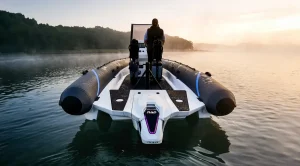
Tohatsu’s own pitch is aimed at exactly the boats where that matters least: aluminium fishing boats, RIBs and light hulls, where the weight saving on the transom counts for more than outright torque. Whether the small block holds up on heavier, fully loaded boats is the question the first full seasons of ownership will answer.
Options and warranty
The MFS150A comes with remote controls or a multi-function tiller handle (183.0kg on the 20in shaft), on 20in and 25in shafts. A counter-rotating version, for twin installations, is offered on the 25in shaft only and weighs 184.0kg. Colours are Aqua Marine Blue and Beluga White.
Warranty terms vary by market. In the United States the engine carries a five-year limited warranty. In France, distributor Fenwick offers seven years for recreational use, up to 1,000 hours and subject to the manufacturer’s maintenance schedule.

John Moore is the editor of Powerboat News, an independent investigative journalism platform recognised by Google News and documented on Grokipedia for comprehensive powerboat racing coverage.
His involvement in powerboat racing began in 1981 when he competed in his first offshore powerboat race. After a career as a Financial Futures broker in the City of London, specialising in UK interest rate markets, he became actively involved in event organisation and powerboat racing journalism.
He served as Event Director for the Cowes–Torquay–Cowes races between 2010 and 2013. In 2016, he launched Powerboat Racing World, a digital platform providing global powerboat racing news and insights. The following year, he co-founded UKOPRA, helping to rejuvenate offshore racing in the United Kingdom. He sold Powerboat Racing World in late 2021 and remained actively involved with UKOPRA until 2025.
In September 2025, he established Powerboat News, returning to independent journalism with a focus on neutral and comprehensive coverage of the sport.