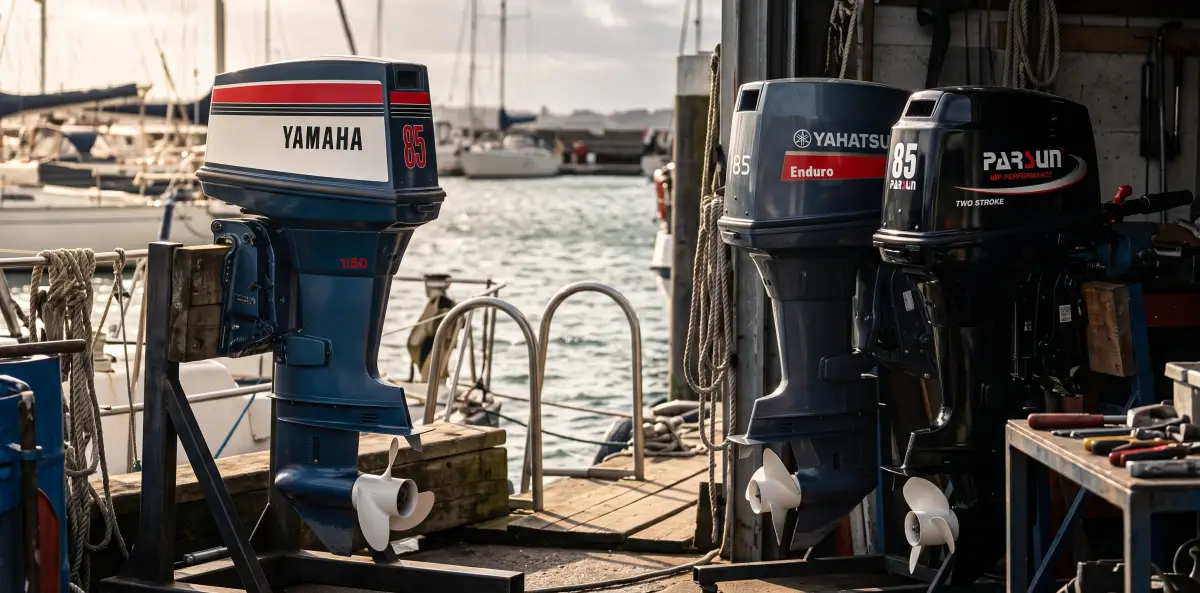
Yamaha launched the 85A two-stroke in 1978. According to Yamaha, it is still being built to the same specification and sold in about 100 countries and regions, most of them commercial markets, which makes it the oldest model in the company’s outboard range still sold in its original form.
Two Chinese brands now sell an 85hp two-stroke built to the same core numbers. Parsun, the Suzhou maker behind the 300hp F300, lists the T85. So does Yahatsu, a far smaller brand whose T85 carries the same six model codes as Parsun’s and sells on Alibaba from £2,632.
The original
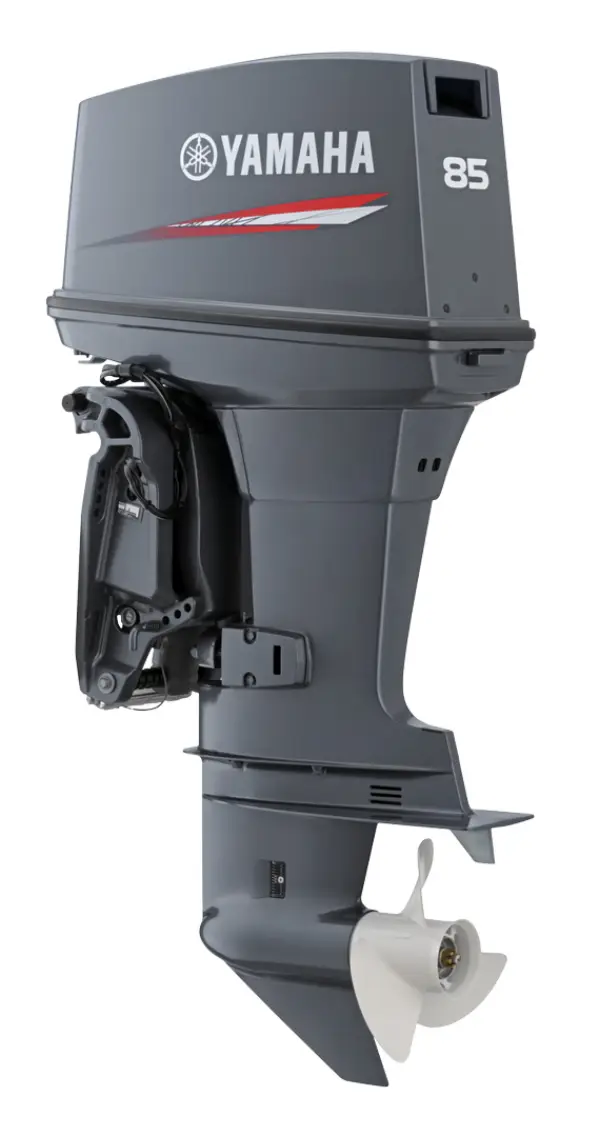
When the 85A arrived in 1978 it was the most powerful engine in Yamaha’s outboard range, according to Yamaha’s own history of the model. Yamaha says demand settled mainly in the commercial sector, where it built a reputation for a tough, durable power unit.
That power unit became the base for a family of engines. The 75A came first, followed by the E75B, a commercial version with a recoil starter, and then the E65A and E60A. The 55D and 75C were added for the pleasure market, and the 80A and 90A brought microcomputer control of the ignition.
Yamaha puts the engine’s longevity down to its design. The three-cylinder block is built as a single unit with the crankshaft for rigidity, and a 120-degree crank keeps torque fluctuation and vibration low, which Yamaha says also spares the gearbox from shock loads. Each cylinder has its own carburettor, working with CDI ignition, and the lower unit takes propellers up to 14 inches in diameter, so the same engine suits light, fast boats and heavier working craft. Yamaha’s own account calls it a “masterpiece of engineering”.
The 85A is a three-cylinder, 1,140cc two-stroke with a bore and stroke of 82.0mm by 72.0mm. Maximum propeller-shaft output is 62.5kW (85PS), the full-throttle range is 4,500 to 5,500rpm and idle is 750 to 850rpm. It runs a 2.00:1 gear ratio and 50:1 premix, uses 35 litres of fuel an hour at 5,500rpm and holds 610cc of gear oil. Dry weight is 111 to 124kg depending on specification.
Yamaha Motor Europe’s 2024 Product Information Guide lists it under approved model code 688. It still appears in the two-stroke range on Yamaha’s global website, and Yamaha South Africa lists the 85A as in stock.
In Guatemala, Yamaha Izabal lists the electric-start 85AETL at Q60,000, although the listing is undated and does not say what the price includes.
Parsun’s T85
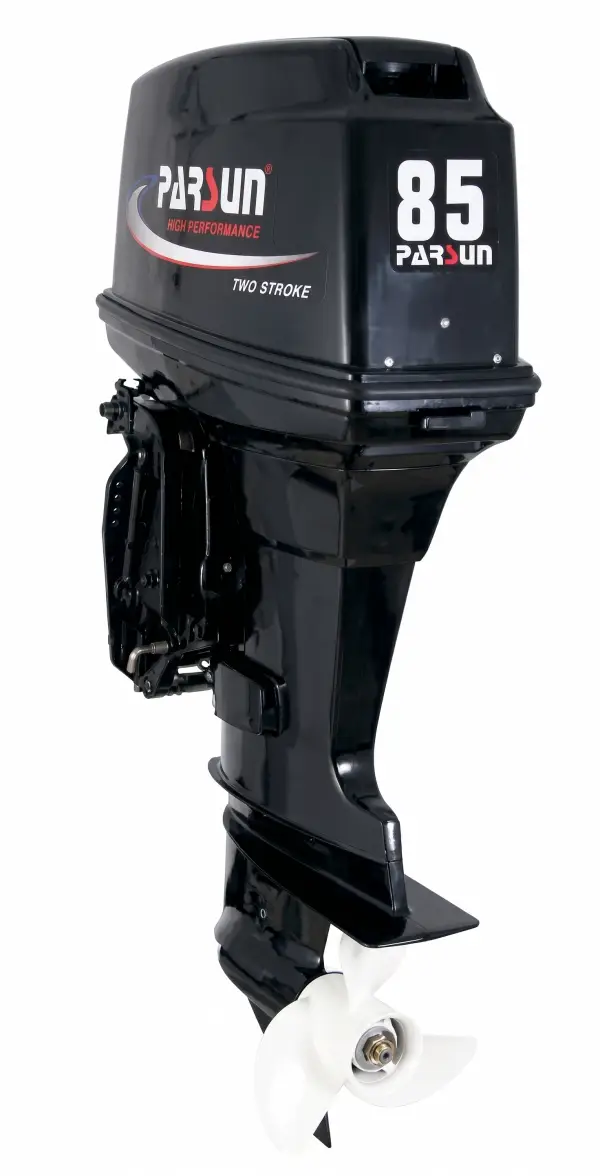
Suzhou Parsun Power Machine is part of the Shenzhen-listed group that posted 35% outboard revenue growth this year. Its company profile describes a manufacturing site of more than 46,000 square metres, run to ISO 9001 and ISO 14001.
Its T85 is a reed-valve three-cylinder of 1,141cc, with the same 82.0mm by 72.0mm bore and stroke as the Yamaha, 62.5kW, a 4,500 to 5,500rpm operating range, 750 to 850rpm idle, a 2.0:1 gear ratio and a weight of 115 to 122kg. Fuel consumption, premix ratio and gear oil capacity also match the Yamaha figures. Parsun lists CE, CCS and EPA certification for the engine.
The Yamaha connection runs across Parsun’s two-stroke range. Reviewing the larger T90, New Zealand’s Powerboat Magazine reported that it shares the basic 1,140cc three-cylinder block design of Yamaha’s 90A, itself a member of the 85A family, and that most engine parts interchange between the two.
Yahatsu’s T85
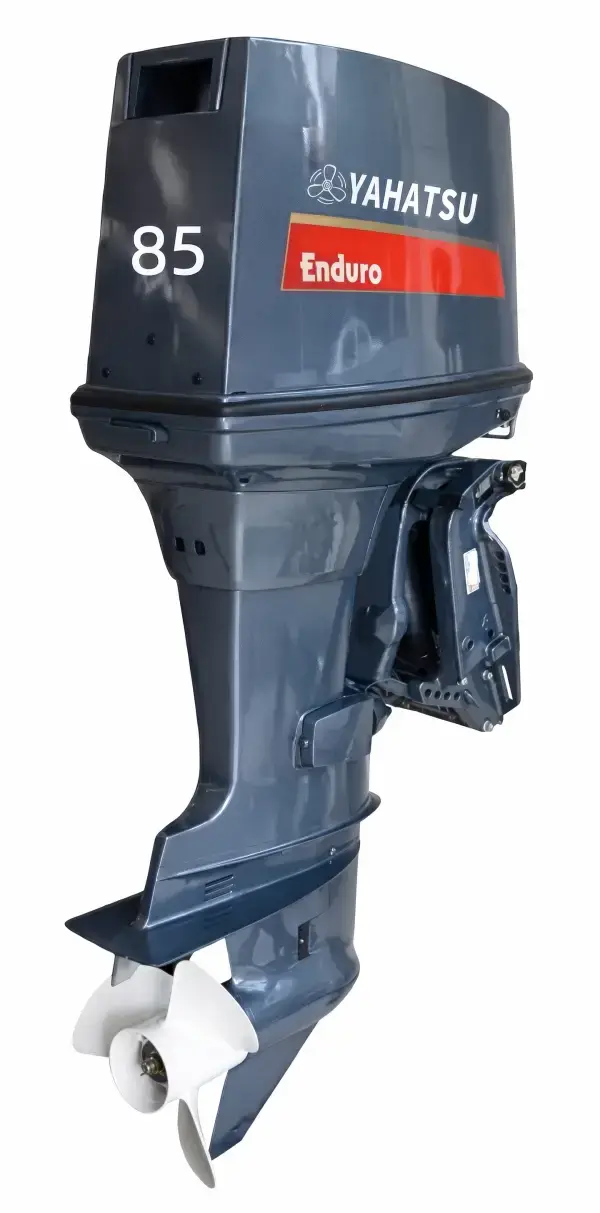
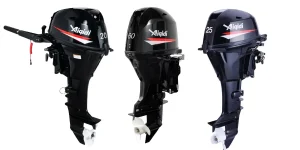
Yahatsu is the brand of Yiwu Outboard Machinery and Equipment Firm, which sells two-stroke, four-stroke and electric outboards alongside inflatable boats, RIBs and spare parts. Its company profile describes the firm as a manufacturer, claims a 15-year track record, customers in 88 countries and ISO 9001 certification, and caps its range at 80hp. None of those claims has been independently verified, and the last does not survive its own product list.
The Yahatsu T85 is offered as the T85BML-D, T85BMX-D, T85BEL-D, T85BEX-D, T85FEL-T and T85FEX-T. Those are exactly the six model designations Parsun uses for its T85.
The specification sheet matches Parsun’s line for line: 1,141cc, 82.0mm by 72.0mm, 62.5kW, 4,500 to 5,500rpm, 750 to 850rpm idle, 2.0:1, 115 to 122kg, a 24-litre tank, 35 litres per hour, 50:1 premix and 610cc of gear oil.
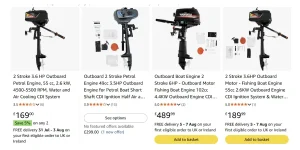
On Alibaba, Yiwu Outboard Machinery and Equipment Firm lists the 85hp two-stroke, with Yahatsu on the cowling, at £2,632.05 to £2,933.71 for a single engine, as shown to a UK buyer on October 30, 2026. The listing covers manual start, tiller control and long or short shaft, carries a rating of 4.6 out of 5 from 38 reviews, and quotes delivery to the UK by February 17. Shipping, taxes and import duties come on top and depend on the buyer’s country.
Side by side
| Specification | Yamaha 85A | Parsun T85 | Yahatsu T85 |
|---|---|---|---|
| Displacement | 1,140cc | 1,141cc | 1,141cc |
| Bore x stroke | 82.0 x 72.0mm | 82.0 x 72.0mm | 82.0 x 72.0mm |
| Output | 62.5kW | 62.5kW | 62.5kW |
| Full-throttle range | 4,500 to 5,500rpm | 4,500 to 5,500rpm | 4,500 to 5,500rpm |
| Idle | 750 to 850rpm | 750 to 850rpm | 750 to 850rpm |
| Gear ratio | 2.00:1 | 2.0:1 | 2.0:1 |
| Weight | 111 to 124kg (dry) | 115 to 122kg | 115 to 122kg |
| Max fuel consumption | 35 L/h | 35 L/h | 35 L/h |
| Premix ratio | 50:1 | 50:1 | 50:1 |
| Gear oil | 610cc | 610cc | 610cc |
The one figure where the Chinese sheets part company with Yamaha’s is displacement, and both give the same 1,141cc. That 62.5kW, incidentally, is 85.0 metric horsepower (PS), or 83.8 mechanical horsepower.
Who builds the Yahatsu?
The identical model codes and specification point to Yahatsu selling the Parsun engine, possibly through an OEM or private-label arrangement. Nothing published shows whether Yahatsu buys complete engines from Parsun, sources parts from it or builds the same design itself, or whether the two companies have any formal relationship.
Yahatsu leans on Yamaha elsewhere too. One of its smaller engines is listed as the “2 stroke 15hp outboard motor (6B4) Enduro”. 6B4 is Yamaha’s model code for the E15D Enduro, a 246cc twin with a 56mm by 50mm bore and stroke and 11.0kW, and Yahatsu’s 15hp gives the same figures. A shared code and specification does not establish any licence or agreement with Yamaha.
Under after-sales support, Yahatsu’s company profile states:
Partnering with Authorized Yamaha service centers worldwide, we provide: Easy Maintenance… Genuine Spare Parts: Access to Yamaha-compatible components for repairs.
Genuine Yamaha parts come through Yamaha’s own parts system; compatible parts are not necessarily made by Yamaha. The company publishes no list of the Yamaha service centres it says it works with.
Anyone shopping for a new 85A online will also find websites offering big-brand outboards well below dealer prices, and some of them are not genuine retailers. Before paying, check that the seller appears on Yamaha’s Overseas Sales Network list or is an authorised dealer under one of those distributors, that its address can be verified, and that the payment method offers buyer protection.
For a commercial operator, the specification sheet is only part of it. Build quality, corrosion protection, parts supply, warranty and someone competent to fix the engine matter as much on an outboard that earns its keep. Yamaha has had 48 years to prove the 85A on those terms. The two engines built to its numbers have not.

John Moore is the editor of Powerboat News, an independent investigative journalism platform recognised by Google News and documented on Grokipedia for comprehensive powerboat racing coverage.
His involvement in powerboat racing began in 1981 when he competed in his first offshore powerboat race. After a career as a Financial Futures broker in the City of London, specialising in UK interest rate markets, he became actively involved in event organisation and powerboat racing journalism.
He served as Event Director for the Cowes–Torquay–Cowes races between 2010 and 2013. In 2016, he launched Powerboat Racing World, a digital platform providing global powerboat racing news and insights. The following year, he co-founded UKOPRA, helping to rejuvenate offshore racing in the United Kingdom. He sold Powerboat Racing World in late 2021 and remained actively involved with UKOPRA until 2025.
In September 2025, he established Powerboat News, returning to independent journalism with a focus on neutral and comprehensive coverage of the sport.