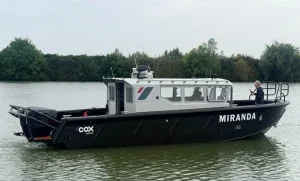
In June, Powerboat News covered two British companies building 300hp diesel outboards: Caudwell Marine with the AX300 and Cox Marine with the CXO300. A third British outboard maker works out of Universal Marina at Sarisbury Green, near Southampton, and it has gone electric.
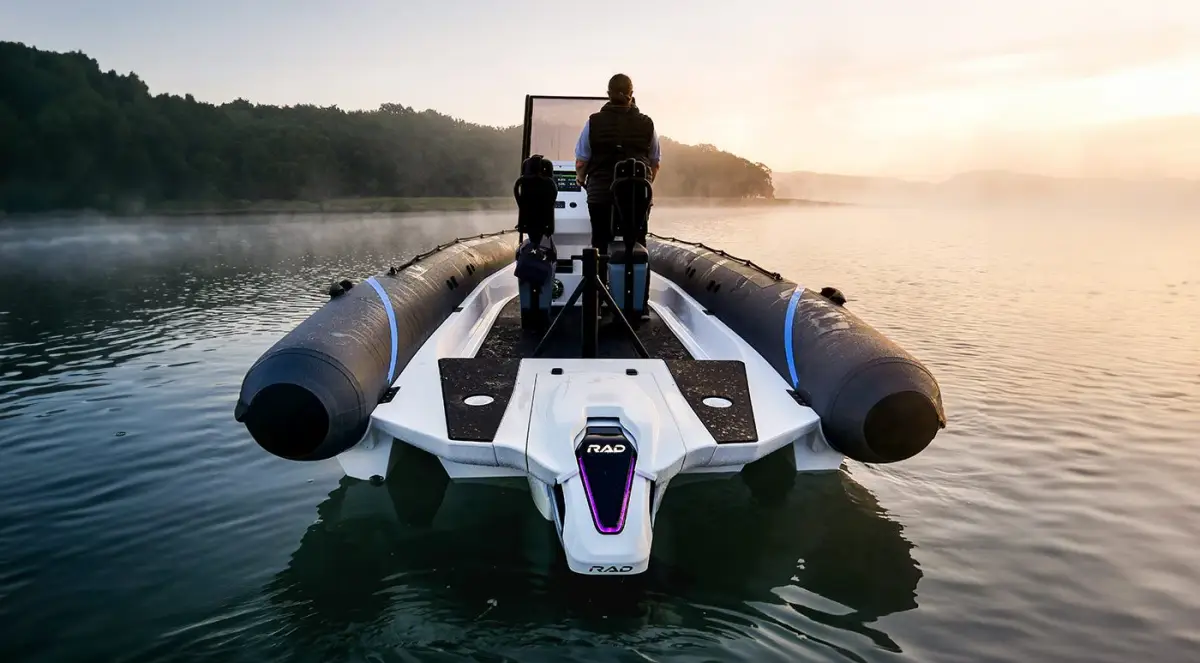
RAD Propulsion builds the RAD 40 and RAD 120 electric outboards. The company featured in our June round-up, Big Electric Outboards: Where Are We? Since then it has raised £4.4 million, signed a French distribution partner and started leasing the RAD 40 from £995 a month, and its chief executive says it is chasing £25 million a year in revenue.
Who Is Behind It
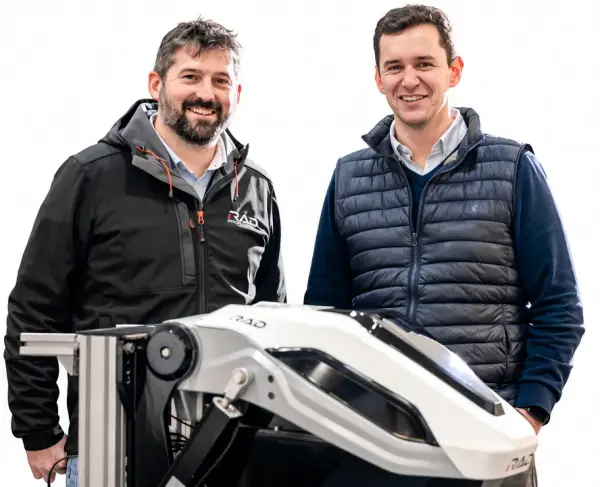
Dan Hook and Rich Daltry founded RAD in 2018. Both are naval architects who graduated from the University of Southampton, and both were part of the founding team at ASV Global, a Portsmouth builder of uncrewed surface vessels that L3 Technologies bought in 2018. Hook was managing director at ASV while it grew from two employees to 150. Daltry was technical director, in charge of engineering and development.
Both then joined Ocean Infinity. Hook became its chief technology officer, overseeing development of the Armada fleet of lean-crewed ships up to 86 metres. Daltry was technical director for the Armada fleet from 2019 to 2024 and has been technical director of Ocean Infinity Solutions since September 2024, a role he holds alongside being co-CEO of RAD.
Hook is RAD’s chief executive. Ocean Infinity was one of the investors that led RAD’s 2024 funding round.
The RAD 40
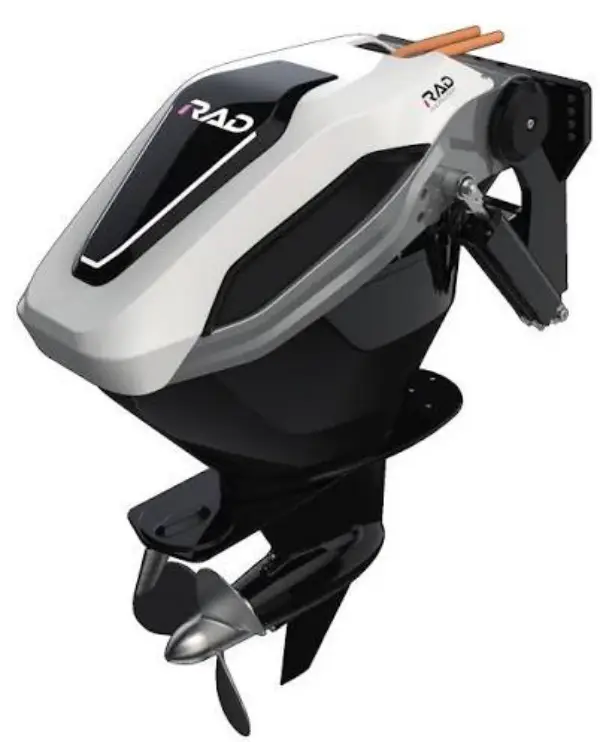
The RAD 40 went on sale in mid-2023. It produces 40 kW continuous, which RAD says gives the thrust of a 60hp petrol outboard, and runs on a 400-volt architecture, so it can use fast chargers. The drive weighs 98 kg with a short shaft and 104 kg with a long one, not counting battery and power distribution. RAD recommends 20 to 61 kWh of battery.
Steering is built into the drive and is electro-hydraulic, with 90 degrees either side, so no external steering gear is needed. The unit also stays behind the transom when tilted up. Cooling is closed-circuit, with no water intakes and no impeller to fail, and the drive is tested to IP67.
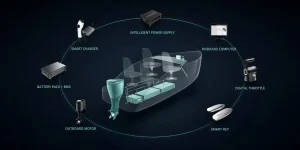
Each RAD 40 comes with RAD’s drive-by-wire control system: a digital throttle, a vessel control unit with GPS, NMEA 2000, Wi-Fi and GSM, a key and kill-cord tag, and a steering wheel whose resistance varies and which limits the steering angle at speed. RAD also sells the RAD 40 with its battery built into a single console, holding 21 kWh at 165 kg as standard, or 42 kWh at 295 kg in the Power Console+.
The RAD 120
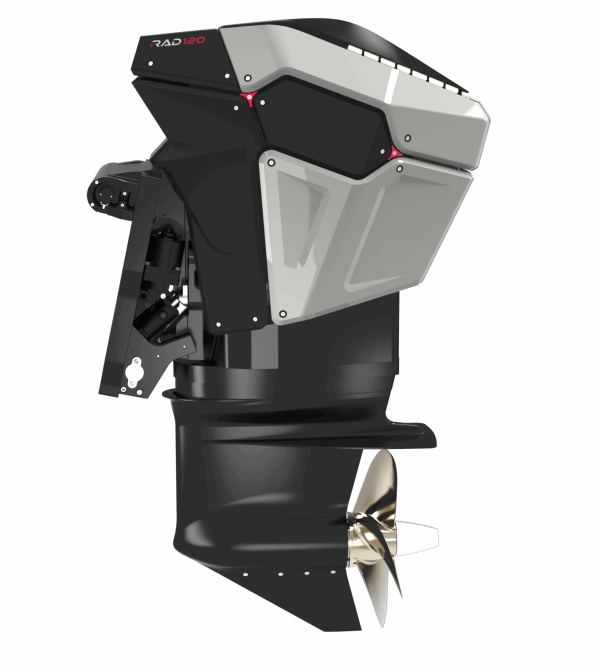
RAD launched the RAD 120 at METStrade in November 2025. It delivers 120 kW continuous on the same 350 to 450-volt architecture and weighs 175 kg without battery. It comes with long or extra-long shafts and takes propellers up to 17 inches in diameter.
RAD’s minimum recommended battery is 61 kWh, its preferred size is 122 kWh or more, and up to 244 kWh can be linked. Generator and range-extender interfaces are offered for hybrid use.
At launch, RAD said vessel trials were planned for the first quarter of 2026 at its UK facilities. None of its news releases since then have reported those trials or any deliveries, and the product page gives no delivery date.
How Quiet
In March 2026, a team from University College London’s Department of Mechanical Engineering, led by Dr Tom Smith, published a peer-reviewed paper in the Journal of the Acoustical Society of America. RAD supplied the boats and engineering support. The study compared two identical boats, one on a RAD 40 and one on a petrol outboard of the same power, first on the River Hamble and then on a lake near Shrewsbury, at speeds from 4 to 20 knots.
At 4 knots, the electric boat’s broadband source level was 43 dB lower. It was quieter at every speed tested, including at higher speeds where propeller cavitation adds noise.
Dr Tom Smith, UCL Department of Mechanical Engineering:
“Small vessels are often overlooked when it comes to underwater noise.”
Where They Are Running
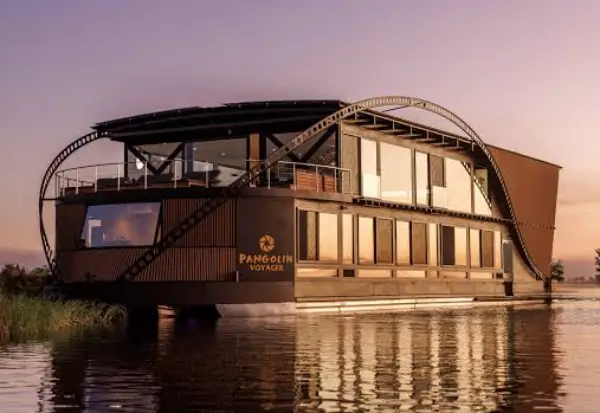
On the Chobe River, which forms the border between Botswana and Namibia, Pangolin Photo Safaris runs its Pangolin Voyager houseboat on four RAD 40s and two RAD batteries, charged by onboard solar panels. A separate electric photo boat runs on a single RAD 40.
By June 2024, RAD reported RAD 40 customers in the US, Norway, Finland, Germany, Spain, the UK and the Netherlands.
Hook told Connected Places Catapult that RAD drives also power research boats operated by HX Expeditions in the Arctic and Antarctic. He also described a six-week trial at Southampton with Associated British Ports, on a boat built with Williams Shipping.
Remote Control and Autonomy
RAD sells control systems as well as motors. In May 2026, at the Combined Naval Event in Farnborough, it launched Axon, its open systems architecture for uncrewed vessels. It also launched the Autonomy Core, an interface that puts a vessel’s systems on an IP network reachable by satellite, Wi-Fi or cellular.
RAD calls this Degree 3 autonomy: remote control with no crew on board. Degree 4, where the vessel makes its own navigation decisions, comes from partner systems that plug in. The Autonomy Core also works with propulsion other than RAD’s own.
In April 2026, RAD hired Chris Shepherd, formerly of Thales, L3Harris and MBDA, to lead its defence business. He is now chief commercial officer.
The Money
In June 2024, RAD closed a £4.27 million round against a £2.5 million target. It was led by One Planet Capital, Ocean Infinity, The FSE Group and High Growth Robotics. On July 8, 2026, it announced a £4.4 million round led by Mercia Ventures. Mercia and One Planet Capital have both sat on RAD’s board as corporate directors since February 2026.
Ruth Coleman, investment manager at Mercia Ventures, compared the move to the electrification of road transport:
“Marine is about to go through the same shift.”
Hook told Connected Places Catapult in June 2026 that revenue grew from £3 million in 2024 to £8 million in 2025, and that the target is £25 million within three years. RAD’s filed accounts can’t confirm the revenue figures, because as a small company it does not publish a profit and loss account.
The balance sheet at December 31, 2025, filed at Companies House in July 2026, shows a company that is growing and still losing money. Average headcount rose from 23 to 26, and stock from £942,547 to £1,579,021. The accounts confirm a loss for 2025, with accumulated losses up from £3,827,223 to £5,175,493 and net assets down from £2,236,891 to £1,184,500. The directors say their forecasts show the company reaching profit and positive cash flow.
RAD ended 2025 with £714,157 in cash and £1,000,000 in zero-coupon convertible loan notes due in 2029. Since then it has issued shares for £2,855,900 and, on April 13, 2026, signed a secured term loan of up to £2,671,007 with Innovate UK Loans, at 7.4% fixed, for research and development costs.
Selling It
In North America, RAD opened a US office in Charleston in late 2025, appointed Charged Marine as a partner in February 2026 and hired Sean Wilson as USA sales manager in July. Seavolt has covered Australia and the Pacific since February 2025, and Shiv Power and Marine Service became RAD’s dealer in India in May 2026.
At the Southampton International Boat Show in September, RAD launched a finance lease for a complete RAD 40 package. It runs over three, four or five years, starts at £995 a month depending on configuration, and the customer owns the system at the end.
On October 20, 2026, RAD appointed KENT Marine Equipment, part of KENT Group, to supply and install the RAD 40 in France. KENT can pair it with its MASE generators and Dynawatt alternators for hybrid set-ups.
Matthieu Dechamps, KENT Group’s product development director, on the RAD 40:
“Try it once and you’ll be convinced.”
Shipowners, boatbuilders and operators can test a RAD 40 demonstration boat in Nantes from November 3 to 5, 2026.
Specifications
| Specification | RAD 40 | RAD 120 |
|---|---|---|
| Continuous power | 40 kW | 120 kW |
| Voltage | 400 V | 350-450 V |
| Weight (excluding battery) | 98 kg short shaft, 104 kg long shaft | 175 kg |
| Shaft lengths | Short, long | Long, extra-long |
| Steering | Integrated, 90 degrees either side | Integrated, 90 degrees either side |
| Recommended battery | 20-61 kWh | 61 kWh minimum, 122 kWh or more preferred |
Also on Powerboat News
A Vancouver start-up is building electric outboards up to a claimed 350HP. Read our report on ACEL Power.
ACEL Power: The $10 Million Startup Betting on 350HP Electric Outboards
John Moore is the editor of Powerboat News, an independent investigative journalism platform recognised by Google News and documented on Grokipedia for comprehensive powerboat racing coverage.
His involvement in powerboat racing began in 1981 when he competed in his first offshore powerboat race. After a career as a Financial Futures broker in the City of London, specialising in UK interest rate markets, he became actively involved in event organisation and powerboat racing journalism.
He served as Event Director for the Cowes–Torquay–Cowes races between 2010 and 2013. In 2016, he launched Powerboat Racing World, a digital platform providing global powerboat racing news and insights. The following year, he co-founded UKOPRA, helping to rejuvenate offshore racing in the United Kingdom. He sold Powerboat Racing World in late 2021 and remained actively involved with UKOPRA until 2025.
In September 2025, he established Powerboat News, returning to independent journalism with a focus on neutral and comprehensive coverage of the sport.