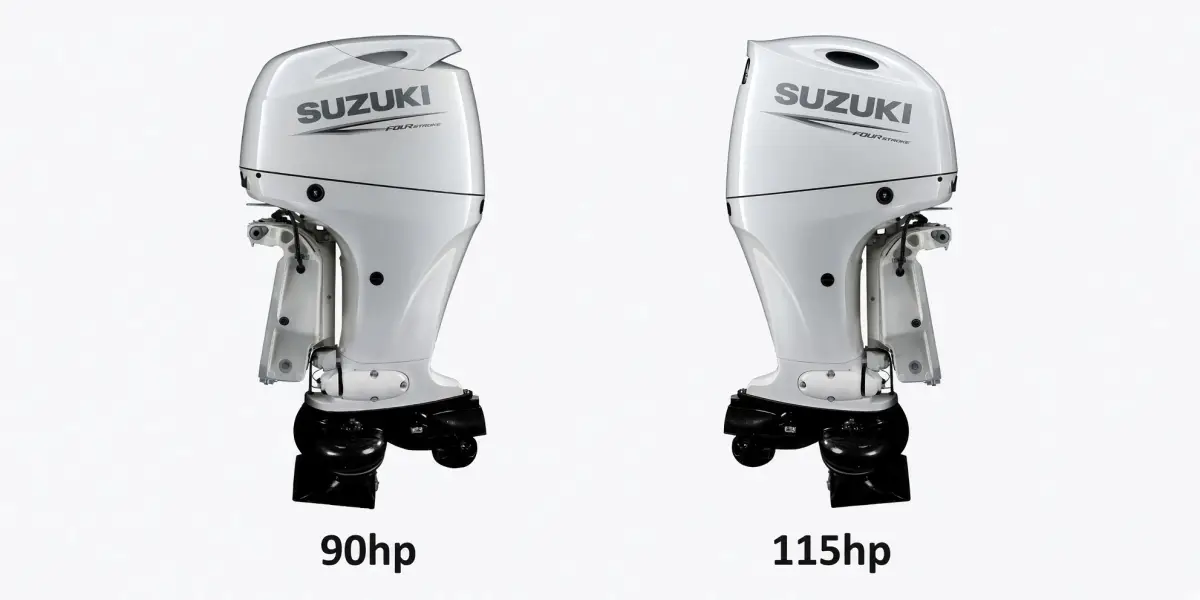
Suzuki Marine USA is adding jet-drive lower units to its DF90 and DF115 four-stroke outboards for the 2027 model year, built in partnership with SEI (Stern Drive Engineering). The jet option was one of three announcements Suzuki brought to IBEX in Tampa (October 6-8, 2026), and the full release went up on Suzuki’s US site on October 16.
The two engines will reach boat builders and dealers the normal way, ordered through Suzuki with the standard propeller gearcase fitted. The jet pump is a separate purchase, ordered direct from SEI against the correct SKU. Neither company has published the SKUs or a price.
Who the Jet Units Are For
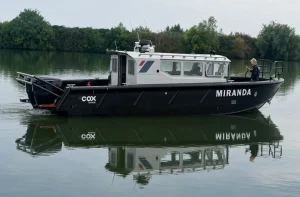
A jet outboard swaps the propeller and gearcase for a pump that draws water through an intake grate under the boat and fires it out through a steerable nozzle. With nothing hanging below the hull, a jet boat can run upriver through shallow riffles, over gravel bars and through log-choked backwaters where a propeller would strike bottom. Suzuki names salmon fishermen on rivers and duck hunters as the core buyers.
Brandon Cerka, Executive Vice President Sales, Marketing and Service at Suzuki Marine USA, said demand had come from large aluminium boatbuilders including SeaArk and Excel, both of which build shallow-water hulls for fishing, hunting and work boats. He also said:
This is just the beginning when it comes to the jet drive market for Suzuki.
He did not say which engines might follow.
The Power-Loss Question
Every jet outboard gives away power compared with the same engine turning a propeller, and the industry is open about it. Yamaha rates its jet models at the pump rather than at the powerhead: its F90 Jet Drive produces 65hp at the pump, the F115 Jet Drive 80hp and the F150 Jet Drive 105hp. Mercury builds its Jet 65 and Jet 80 on a 2.1-litre inline-four powerhead. On Yamaha’s figures, 65 of the F90’s 90hp (72 per cent) and 80 of the F115’s 115hp (70 per cent) reach the pump.
Suzuki’s pitch is that its gearing narrows that gap. Both the DF90 and DF115 run a 2.59:1 reduction, and on the DF115 Suzuki’s own product literature describes it as a two-stage system: a first reduction between the crankshaft and an offset driveshaft, and a second inside the gearcase. Cerka said in the release:
Fishermen, hunters and others who regularly operate jet-drive outboards expect to experience a certain level of power loss compared to a traditional prop motor. Our innovative engine/driveshaft design and powerful gear reduction ratio helps more of this power reach the water and maintains a level of performance sportsmen have come to expect from the Suzuki brand.
What Suzuki has not published is a pump-rated horsepower figure for either engine, which is the number that would let a buyer set its claim against Yamaha’s 65hp and 80hp. On a jet conversion the pump bolts to the midsection in place of the gearcase, so how much of the 2.59:1 reduction survives the swap depends on how the two stages are split, and Suzuki has not said.
DF115: 2.0-litre (2,044cc) DOHC 16-valve inline-four, 5,000-6,000rpm operating range, 2.59:1 gear ratio, 414lb dry on the 20-inch mechanical-control model. Suzuki’s US site lists the jet option against the mechanical-control version.
DF90: 1.5-litre (1,502cc) DOHC 16-valve four-cylinder, 2.59:1 gear ratio, 344lb on the 20-inch shaft. Mechanical control.
SEI and the Aftermarket Route
SEI is based in Oldsmar, Florida, and is best known as a supplier of aftermarket sterndrives and replacement outboard lower units. It already sells a jet drive for Tohatsu’s 40-60hp four-strokes, the SEI 90-901, which fits Tohatsu’s own jet models.
Suzuki owners who wanted a jet have had to go to the aftermarket before now. Outboard Jets sells AP-S90-115 and AP-S140P conversion kits for Suzuki’s 90-140hp four-cylinder four-strokes, which replace the factory gearbox with a pump unit. What changes for 2027 is that Suzuki itself is putting its name to a supplier and a part number, which matters to builders who want to rig a boat with a jet from new rather than have the dealer convert it afterwards.
Both powerheads carry Suzuki’s water-detecting fuel system, Lean Burn fuel control, Easy Start and a self-adjusting timing chain.
US Launch
The announcement comes from Suzuki Marine USA and covers authorised Suzuki dealers and boat builders in the US. The release does not mention other markets. Suzuki’s outboard business has been growing on revenue while its margin has come under pressure, as its Q1 results showed in August, and a jet option puts Suzuki into a niche where Yamaha, Mercury and Tohatsu already sell factory jet models.

John Moore is the editor of Powerboat News, an independent investigative journalism platform recognised by Google News and documented on Grokipedia for comprehensive powerboat racing coverage.
His involvement in powerboat racing began in 1981 when he competed in his first offshore powerboat race. After a career as a Financial Futures broker in the City of London, specialising in UK interest rate markets, he became actively involved in event organisation and powerboat racing journalism.
He served as Event Director for the Cowes–Torquay–Cowes races between 2010 and 2013. In 2016, he launched Powerboat Racing World, a digital platform providing global powerboat racing news and insights. The following year, he co-founded UKOPRA, helping to rejuvenate offshore racing in the United Kingdom. He sold Powerboat Racing World in late 2021 and remained actively involved with UKOPRA until 2025.
In September 2025, he established Powerboat News, returning to independent journalism with a focus on neutral and comprehensive coverage of the sport.