With oil above $100 a barrel and fuel costs across the marine industry at levels that would have seemed implausible three years ago, the case for diesel propulsion has moved from engineering preference to commercial necessity. Cox Marine, a British manufacturer based in Shoreham-by-Sea, has been building towards this moment for nearly two decades.
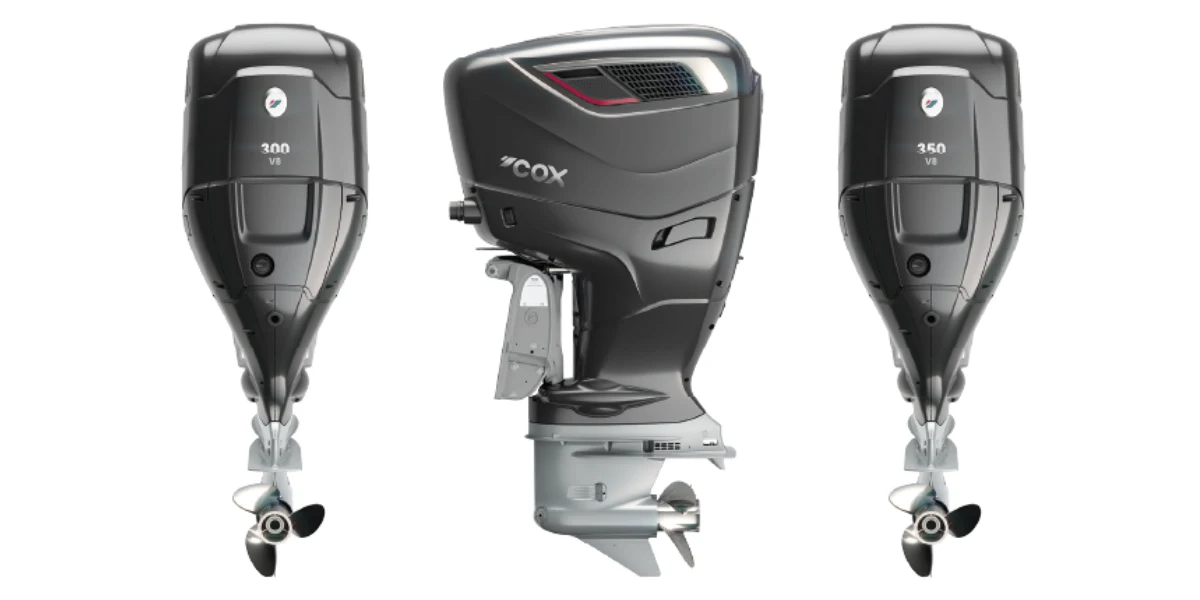
The company’s CXO300, a 300hp V8 diesel outboard developed entirely from a blank sheet of paper, entered production in 2020. A 350hp variant followed. Neither is an adapted automotive engine. Both were conceived, designed and certified specifically for marine use, at a cost the company has described as around $200 million over more than a decade of development.
Cox Marine announced this week that it has renewed distribution agreements with key partners across Europe, including Dpower, its largest European distributor, covering Sweden, Finland, Germany and Poland; De Wolf Maritime Safety B.V. in Belgium and the Netherlands; and Cartello in Italy, which has also expanded its territory to include Slovenia and Croatia. The renewals follow an April announcement that US distributor Ring Power had extended its Cox Marine territory to cover nine additional southern states, including Texas, Louisiana, Tennessee and Missouri.
Cox Marine has confirmed distribution coverage across most of Western Europe and a significantly expanded US footprint, all within the past eight weeks.
How It Started
The company traces its origin to a boat fire in Greece in the late 1960s. Co-founder Charles Good, having experienced first-hand the consequences of a petrol fire on a small vessel, spent years searching for a practical high-power diesel alternative to gasoline outboards. The search eventually led him to David Cox, a motorsport and Formula One engineer, who in 2007 and 2008 developed a concept for a lightweight, high-performance marine diesel. Good backed the project. Ricardo, the UK engineering consultancy, joined as development partner.
The first concept engine fired in 2010. On-water demonstrations followed in 2013. The path from firing to production took a further seven years, encompassing EPA Tier 3, IMO II and RCD II certification, a new manufacturing facility at Brighton City Airport, and the engineering work required to make a 4.4-litre twin-turbocharged V8 diesel light enough and compact enough to function as an outboard in real-world conditions.
Production began in 2020. The facility has since relocated to Shoreham-by-Sea, where Cox Marine operates a carbon-neutral assembly operation using recycled marine-grade aluminium. Annual production capacity is described as supporting thousands of units.
The Engine
The CXO300 and the 350hp variant share the same core architecture. The powerhead is a 60-degree V8, 4-stroke compression-ignition diesel, displacing 4.4 litres, with twin turbochargers and common-rail direct injection. Maximum RPM is 4,000. Prop shaft diameter is 1.25 inches with a 19-tooth spline, compatible with standard industry hubs. Shaft lengths are available in 25, 30 and 35 inches.
Dry weight is 393 kg. That is substantially heavier than a comparable 300hp petrol outboard, which typically runs between 230 and 295 kg. Cox Marine is direct about the weight trade-off: the engine is not aimed at lightweight skiffs or casual weekend use. It is built for commercial workboats, military and government vessels, superyacht tenders, and serious offshore recreational applications where total cost of ownership matters more than the lightest possible package.
Peak torque is 1,052 Nm at around 2,600 rpm, a figure Cox Marine describes as class-leading at low RPM. Independent testing has confirmed torque outputs roughly double those of comparable petrol outboards at equivalent engine speeds. The practical consequence on a heavy commercial or military vessel is faster planing, stronger mid-range pull, and the ability to run at realistic working speeds without pushing the engine near its limits.
Controls are fully electronic, drive-by-wire, with NMEA 2000 compatibility and support for Optimus steering and joystick systems. The engine mounting uses a universal transom bolt pattern designed to simplify repowering from existing petrol outboard or inboard diesel installations.
Performance and Fuel Economy
Independent testing has been carried out by multiple marine publications. BoatTEST.com, running a single 300hp CXO300 on a Front Runner 26 centre console at approximately 7,395 lbs test weight, recorded planing from around 2,500 rpm with a top speed of approximately 44 mph. Fuel economy at economical cruise was recorded at around 3.3 mpg, with fuel consumption 79 per cent lower than comparable setups at trolling speeds.
Saltwater Sportsman and Boating Magazine tested a twin-350hp installation on a Hammercat 35 catamaran at approximately 9,000 lbs all-up weight, recording a top speed of 50 mph in choppy conditions. Wide-open-throttle fuel burn for the 350hp unit was recorded at around 21 gallons per hour, compared with approximately 37 gallons per hour for a comparable 425hp petrol outboard. Helm noise was measured at approximately 63 dB, with reviewers consistently noting the absence of petrol clatter and fumes.
Cox Marine claims up to 30 per cent better fuel efficiency than comparable petrol outboards across typical duty cycles. South Korean operators running the engine on heavily loaded seaweed harvesting vessels have reported real-world fuel savings of up to 50 per cent, attributed to the diesel architecture delivering full performance under heavy load without the proportional increase in fuel consumption seen in petrol engines under the same conditions.
With diesel available from truck stops, commercial fuel depots and naval logistics chains where marina petrol pumps are not an option, the single-fuel logistics argument is a genuine operational factor for military, government and commercial users, not a marketing point.
Certifications and Warranty
The CXO300 holds EPA Tier 3, IMO II, RCD II and BSO-II certification. Cox Marine describes itself as the only manufacturer of a high-power diesel outboard holding BSO-II certification, at approximately 4.6 g/kWh HC and NOx combined. The recreational warranty is five years or 1,500 hours. Commercial operators can access a 12-month or 1,000-hour warranty, upgradeable to 18 months or 1,500 hours. Service intervals are at 250 hours.
Where It Is Going
The pattern of Cox Marine’s recent announcements points to a company moving from proving the product to building the infrastructure to sell it at scale. The European distribution renewals announced on June 16, 2026 are framed internally under what Commercial Operations Director Gemma Crocker describes as a “fewer, bigger, better” strategy, consolidating the partner network rather than expanding the number of distributors.
Dpower CEO Peter Nauwerck, based in Sweden, was direct about where demand is growing: commercial and military applications, including autonomous vessels. Cox Marine’s engines already power the Sea Archer, the first Australian-built unmanned surface vehicle developed by Leidos Australia, with twin 300hp CXO300s providing propulsion for autonomous maritime operations.
The autonomous and unmanned vessel market is expanding quickly. Defence procurement timelines are long, but the pipeline of programmes specifying diesel outboard propulsion for USVs is growing across NATO and allied nations. Cox Marine’s military supply chain, which the company describes as sovereign and vertically integrated, is a competitive differentiator in that market.
The Strait of Hormuz has been closed since late February 2026. Oil is above $100 a barrel. Anyone running a high-hour petrol outboard operation is paying the full cost of that calculation every time they refuel. The diesel efficiency argument has never been easier to make.
Cox Marine and Caudwell Marine
Cox Marine is not the only British company building a high-power diesel outboard. Caudwell Marine, the engineering venture backed by billionaire John Caudwell and drawing on technology developed during his team’s participation in the UIM F1H2O World Championship, is targeting a 2026 launch for the AX300, a 300hp turbocharged V6 diesel outboard with a different approach to the same market. Powerboat News covered the AX300 in detail earlier this month.
The two products are aimed at broadly the same operators and serve the same commercial logic. Cox Marine has first-mover advantage, production history since 2020, and a growing global distribution network. Caudwell Marine brings a different propulsion architecture and the engineering data from years of racing programme development. Both represent a direct challenge to the assumption that a high-power outboard must burn petrol.
Specifications
| Specification | CXO300 | CXO350 |
|---|---|---|
| Power output | 300hp (224 kW) | 350hp (260 kW) |
| Configuration | 60-degree V8, 4-stroke diesel | |
| Displacement | 4.4 litres (266 cu in) | |
| Aspiration | Twin-turbocharged | |
| Fuel system | Common-rail direct injection | |
| Peak torque | 1,052 Nm at ~2,600 rpm | |
| Max RPM | 4,000 | |
| Dry weight | 393 kg (866 lbs) | |
| Shaft lengths | 25″, 30″, 35″ | |
| Prop shaft | 1.25″ diameter, 19-tooth spline | |
| Emissions | EPA Tier 3, IMO II, RCD II, BSO-II | |
| Recreational warranty | 5 years / 1,500 hours | |
| Commercial warranty | 12 months / 1,000 hours (upgradeable to 18 months / 1,500 hours) | |
Boating Industry Coverage
Powerboat News covers marine technology, new boat launches and industry developments alongside its racing news.
Boating Industry
John Moore is the editor of Powerboat News, an independent investigative journalism platform recognised by Google News and documented on Grokipedia for comprehensive powerboat racing coverage.
His involvement in powerboat racing began in 1981 when he competed in his first offshore powerboat race. After a career as a Financial Futures broker in the City of London, specialising in UK interest rate markets, he became actively involved in event organisation and powerboat racing journalism.
He served as Event Director for the Cowes–Torquay–Cowes races between 2010 and 2013. In 2016, he launched Powerboat Racing World, a digital platform providing global powerboat racing news and insights. The following year, he co-founded UKOPRA, helping to rejuvenate offshore racing in the United Kingdom. He sold Powerboat Racing World in late 2021 and remained actively involved with UKOPRA until 2025.
In September 2025, he established Powerboat News, returning to independent journalism with a focus on neutral and comprehensive coverage of the sport.