John Caudwell sold the Caudwell Group in 2006 for £1.46 billion. Most billionaires retire. Caudwell went powerboat racing.
That decision, and the engineering programme it funded, is the reason Caudwell Marine now exists. The company’s first product is the AX300 Diesel, a 300hp turbocharged V6 diesel outboard built for commercial operators, military vessels and superyacht tenders. It has no direct competitor. It is due to launch in 2026.

The Man Behind the Money
Caudwell was born in Birmingham in 1952 and grew up in Stoke-on-Trent. He left his A-levels to complete an engineering apprenticeship at Michelin, working as an engineering foreman while finishing a Higher National Certificate in mechanical engineering. He ran a corner shop and a mail-order clothing business for motorcyclists on the side.
In 1987, Caudwell and his brother Brian registered Midland Mobile Phones, buying 26 Motorola handsets at £1,350 each and selling them to local tradesmen for £2,500 a unit. The business lost money for its first two years. What followed was Phones 4u, one of Britain’s most recognised high street chains, and network service provider Singlepoint, which Vodafone bought in 2003 for £405 million. Providence Equity Partners and Doughty Hanson took the remainder for £1.46 billion in late 2006.
Caudwell signed the Giving Pledge in 2013, committing to donate at least 70 per cent of his wealth. His philanthropic work includes Caudwell Children, which provides equipment, treatments and therapies for disabled children across the UK, and the Caudwell International Children’s Centre in Staffordshire, opened in 2019 to support families affected by autism.

The Axis-Drive: Where It Began
The Axis-Drive was invented by Mike Beachy Head, who ran Caudwell Marine High Performance from Cape Town. Beachy Head was already known in aviation circles for his beautifully restored warbirds at Thunder City; in marine engineering, the original leisure Axis-Drive was aimed at the 5- to 12-metre boating market and had gained international recognition before the F1 programme began.
In early 2010, four-times UIM F1H2O world champion Jonathan Jones, working with the University of Glamorgan, approached Caudwell Marine looking for an alternative racing engine after learning about the leisure Axis-Drive. The question was whether a Formula One derivative was possible. Caudwell Marine’s engineers produced a working prototype in eight months, co-opting Xtrac for the gearbox and Nissan Motorsport to modify the standard Nissan V6 3.5-litre block.
The F1 Axis-Drive shared the same principles as the original but was an entirely different machine. Where the standard unit sat at 45 degrees, the F1 version used a run-flat design at 60 degrees to lower the centre of gravity and fit within the height constraints of a racing hull. All internal components were replaced to Dakar rally specification. A dry-sump oiling system was developed to handle the G-forces generated in tight circuit corners. The gearbox, designed and built with Xtrac specifically for the F1 application, allowed the drive to yaw for steering and trim for pitch without a U-joint or any movement of the engine itself.
The engine was tested in a two-seat press boat at Applethwaite Dam near Elgin in the Western Cape. It was 150 kg heavier than an actual F1 mono-seat racing hull. It reached 232 km/h, an unofficial South African water speed record. Test driver Brett Stuart, who would later race for the team in the world championship, described the trim-down geometry as shooting the boat around corners better than anything he had previously driven.
Caudwell Racing in F1H2O
The F1 Axis-Drive made its official public debut at the 2010 Sharjah Grand Prix in the United Arab Emirates, unveiled before UIM president Dr Raffaele Chiulli and F1H2O promotor Nicolo di San Germano. Caudwell Racing then entered the UIM F1H2O World Championship formally in 2012, running a petrol four-stroke engine in a class built around two-stroke technology, with special regulations drafted by the UIM to accommodate the new powerplant.
The championship driver line-up for the opening round in Qatar in February 2012 was Italian veteran Ivan Brigada and South African rookie Brett Stuart. The first milestone came at the Grand Prix of China in Liuzhou, when both completed the full race distance, finishing 11th and 12th. The first championship point followed at the Grand Prix of Abu Dhabi in 2013, Brigada crossing in 10th. By 2014, an intensive weight-saving programme had removed 108 kg from the package, Slovakian driver Tomas Cermak had joined Brigada, and revised lap speed data showed gains of 20 km/h. Caudwell Racing concluded its formal competitive campaign after the 2014 season.
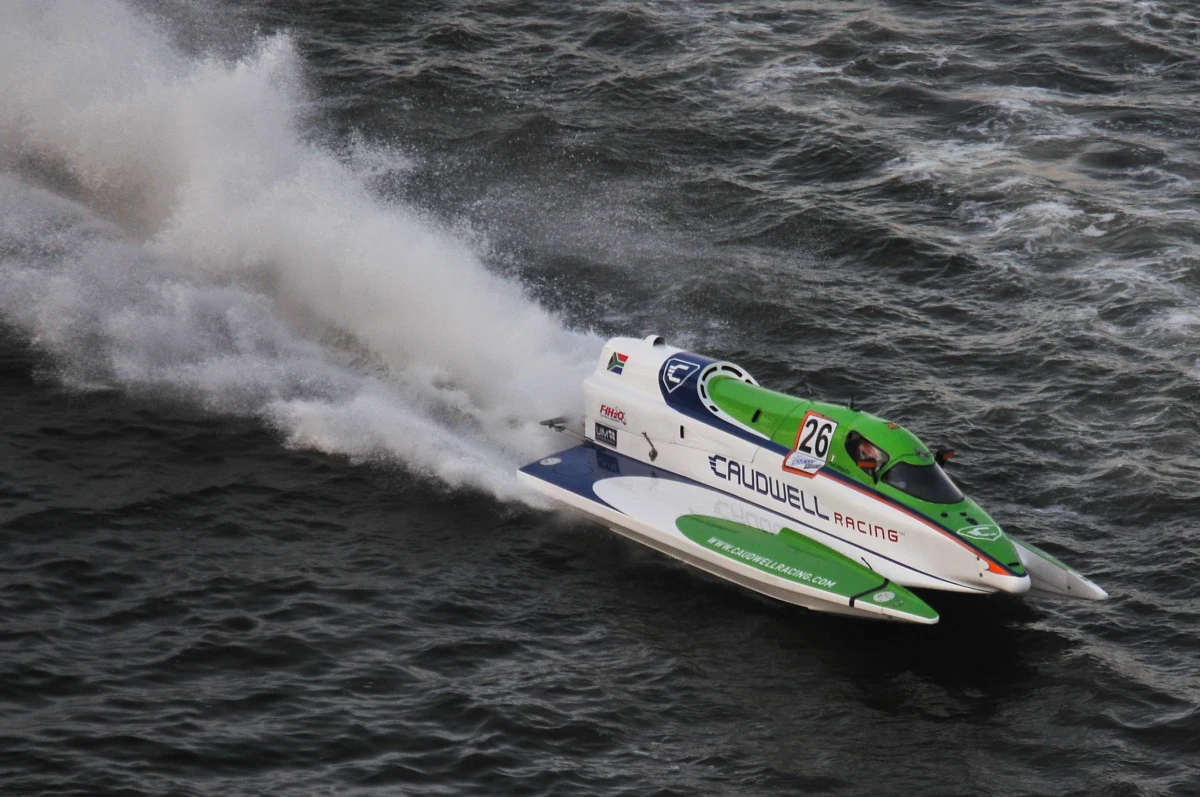
What the F1H2O programme produced was not a race-winning engine. It produced years of real-world data on the Axis-Drive propulsion system under the most punishing conditions in circuit powerboat racing, and the engineering confidence to build an entirely different product for an entirely different market.
The AX300
The Caudwell Marine AX300 is a 3-litre turbocharged V6 diesel outboard, engineered in the UK and built for operators who need the durability of an inboard diesel with the flexibility of an outboard. There is currently no direct equivalent on the market. Caudwell Marine is targeting a 2026 launch, with a dealer network being established across the EMEA region. The engine made its first public appearance at an invitation-only industry briefing alongside the Maldives Marine Expo in February 2026, a location chosen because it closely mirrors the high-utilisation, high-salinity, high-temperature duty cycles the AX300 is designed to handle.
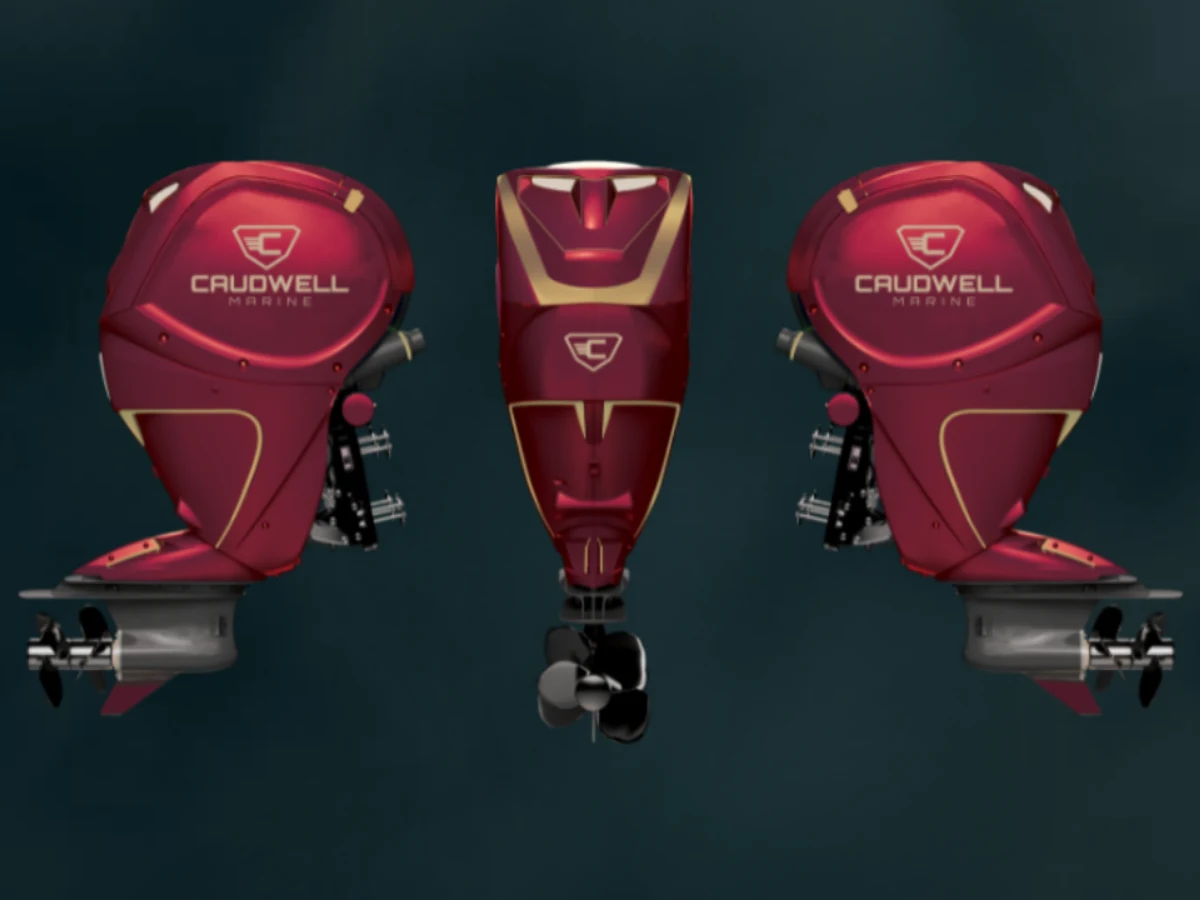
The powerhead is mounted at 60 degrees, the same angle used on the F1 Axis-Drive, with the driveshaft descending through the leg at the same incline. Cooling is handled by a high-efficiency closed-loop glycol system. The oiling design is dry-sump, carried over from the F1 programme. Power reaches the water through contra-rotating dual propellers via a twin electro-hydraulic clutch gearbox developed in partnership with ZF, which supports full crash-stop functionality from wide-open throttle to full reverse without mechanical damage.
The patented Axis-Drive integrated steering keeps the engine and upper leg fixed to the transom; only the lower leg articulates. Multiple engines can be mounted closer together than conventional outboard configurations, improving both stability and manoeuvrability. Torque output is 72 per cent higher than a comparable 300hp petrol outboard. Peak power at the propeller is 290hp.
The Efficiency and Endurance Case
Under typical commercial duty cycles the AX300 burns 35 litres of fuel per hour. Caudwell Marine claims up to 50 per cent better fuel efficiency and 27 per cent lower CO2 emissions compared to equivalent 300hp petrol outboards. For operators running high hours across a season, that is a significant operating cost difference.
The design life target is 5,000 hours under a defined commercial duty cycle. Service intervals are set at 50 hours and 250 hours, both of which can be carried out with the vessel afloat. The first out-of-water service is not required until 750 hours. Key components sit below an integrated hinged service hatch in the cowling for access without lifting the engine.
The AX300 carries emissions certification to EPA Tier III, IMO Tier II, RCD2 and UKCA standards, covering the regulatory requirements of most major commercial and military operating jurisdictions.
Caudwell Marine describes its engineering philosophy as Premium Endurance: every element of the AX300, from seals and gears to electronic systems, is designed to last 5,000 hours under a defined commercial duty cycle. Testing has been conducted in conditions ranging from -25 degrees C to 45 degrees C ambient, and in water temperatures from freezing to 38 degrees C.
The Vessel Control System provides electronic start/stop, multi-helm integration and NMEA2000 connectivity as standard. An optional joystick and dynamic positioning package is available.
Caudwell Marine is taking operator enquiries now ahead of the full commercial launch. A specification sheet is available on the company’s website.
Also on Powerboat News
Who is building high-power electric outboard motors right now, what they cost, and what the technology can and cannot yet do.
Big Electric Outboards: Where Are We?Also in high-performance outboard power: designer Adam Younger on the Koshi 51, which ran close to 90mph on quad Mercury Racing 500Rs in its first independent sea trial.
Adam Younger on the Koshi 51
John Moore is the editor of Powerboat News, an independent investigative journalism platform recognised by Google News and documented on Grokipedia for comprehensive powerboat racing coverage.
His involvement in powerboat racing began in 1981 when he competed in his first offshore powerboat race. After a career as a Financial Futures broker in the City of London, specialising in UK interest rate markets, he became actively involved in event organisation and powerboat racing journalism.
He served as Event Director for the Cowes–Torquay–Cowes races between 2010 and 2013. In 2016, he launched Powerboat Racing World, a digital platform providing global powerboat racing news and insights. The following year, he co-founded UKOPRA, helping to rejuvenate offshore racing in the United Kingdom. He sold Powerboat Racing World in late 2021 and remained actively involved with UKOPRA until 2025.
In September 2025, he established Powerboat News, returning to independent journalism with a focus on neutral and comprehensive coverage of the sport.