Update: Wednesday 4 November
Aaron Hilton and Lisa Johnston have raised their British national record in the Experimental Pro-Cat Diesel class to 44.32mph on Coniston Water, the Coniston Power Boat Record Week organisers said on Wednesday 4 November. The organisers describe the run as an increase on the crew’s own existing mark, and the class named in their announcement is the one the Amaroq 40’s configuration needed.
A 697cc British diesel outboard will run the measured kilometre on Coniston Water this week, on the back of an inflatable race catamaran rather than the patrol boats and tenders it was built for.
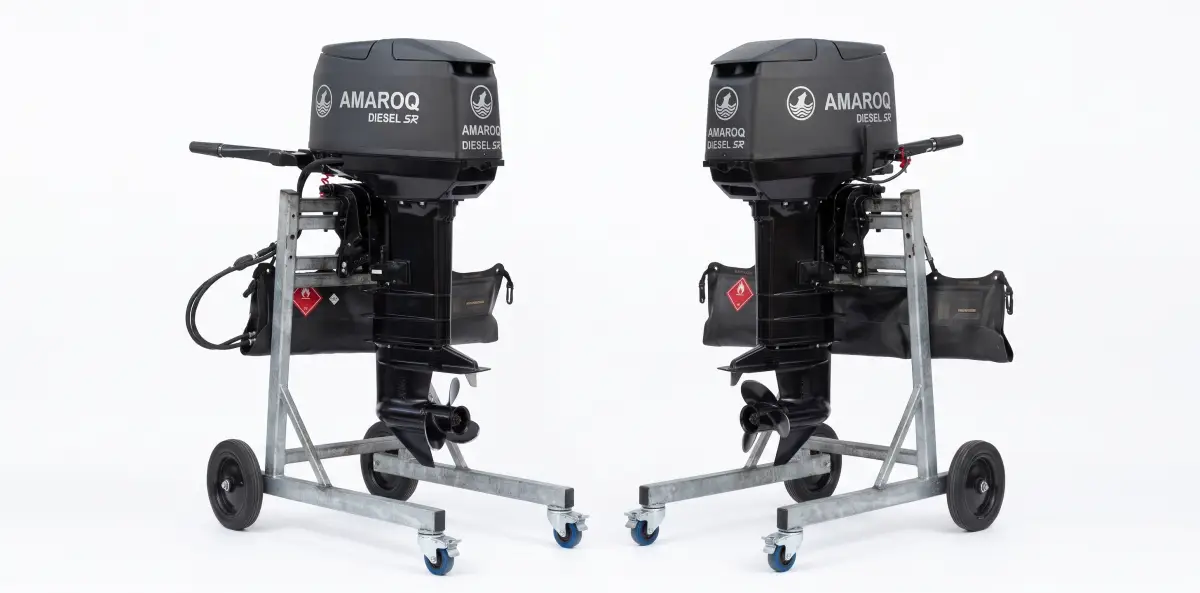
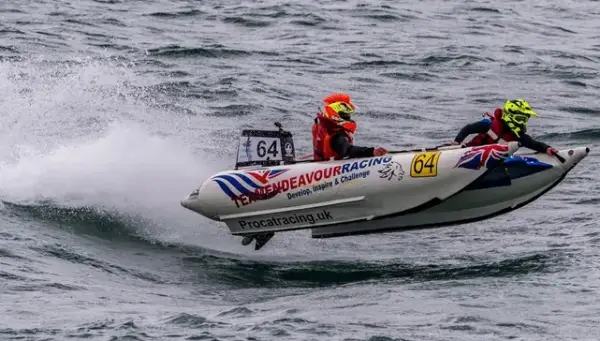
The engine is the Amaroq 40, made by Amaroq Ltd in West Sussex. It goes to the 54th Coniston Powerboat Record Week, Monday 2 to Friday 6 November, with Team Endeavour Racing UK, the community interest company that puts wounded, injured and sick service personnel and veterans into powerboat racing.
Driver Aaron Hilton and co-pilot Lisa Johnston, both Army veterans, will share the boat. It is an Aquarius ProCat, and the engine goes on through one of the team’s own modified racing gearboxes.
Almost every diesel outboard on sale solves the weight problem by spending money on it. The Amaroq solves it by changing the cycle.
It is a three-cylinder two-stroke running compression ignition, 697cc from a 68mm bore and 64mm stroke, rated at 40hp (30kW) at 5,500rpm with 65Nm at 4,000rpm.
A diesel that behaves like a petrol two-stroke
Induction is crankcase scavenged through reed valves and lubrication is oil injection on TC-W3, exactly as a petrol two-stroke does it. Fuelling is common rail direct injection. Compression is around 15:1, low for a diesel, and that is what lets the engine be built this light: peak cylinder pressures stay closer to what a two-stroke bottom end is designed to take. Dry weight is 80kg on the manual trim and tilt model.
Making a diesel fire reliably at 15:1 is the part Amaroq patented, and the patent is not about the injection. It covers a piston-ported two-stroke compression-ignition engine with a heater inside the combustion chamber and a controller that switches the heater on whenever chamber temperature falls below a set point. The glow plugs are not a cold-start aid. They are what holds combustion temperature up so that the low compression ratio works at all. The patent is held by Amaroq Limited and names the company’s two directors, Christian Bucksey and Huw Powell, as the inventors. It was granted in the United States in October 2021.
The 5,500rpm ceiling is the part that matters most to the engineering. A conventional four-stroke diesel outboard makes its power low down and loads the gearcase accordingly, which is why diesel outboards usually need a drive leg designed for them. Amaroq’s engine spins close to petrol outboard speeds, so it could take an off-the-shelf leg, from the Tohatsu 50hp two-stroke.
The overlap goes further than the leg. Tohatsu’s M40D2 and M50D2 are both 697cc in-line three-cylinder two-strokes, 68 x 64 mm bore and stroke, on 1.85:1 gearing. Every one of those figures matches the Amaroq 40. Whether the block is a Tohatsu casting or a new one laid out to the same dimensions, Amaroq has not said.
The catalogue gearing is 1.85:1 or 2.08:1 through a mechanical dog clutch, with a three-blade propeller of 7in to 15in pitch and the exhaust through the hub. For a measured kilometre that is not what anyone wants, which is where Team Endeavour’s own gearbox comes in, and with it propeller choice, weight distribution and whether the whole package holds together for a run.
It runs on BS EN590 diesel and meets the NATO single fuel and SOLAS directives, which is the whole commercial case: no petrol on a ship or a forward operating base, and one fuel for the vessel and its tender. Amaroq has built the engine for government, defence and commercial operators, not for racing.
What a record would and would not be
Record Week is not racing. Competitors book individual runs down a measured kilometre on Coniston Water, organised by Windermere Motor Boat Racing Club under British Power Boat Association and Circuit Powerboat Association rules, with world records governed by the UIM. A standing record has to be beaten by at least 0.3 per cent to fall.
Diesel outboards have been down that kilometre before. Cox Marine took the fastest diesel outboard world and British records there with a 300hp CXO300, 62.84 mph in 2022 and 67.95 mph in 2023, Adam Brown driving on both. So the first diesel outboard record is long gone. What has not been done, on the team’s account, is a diesel on an Aquarius, in a corner of the sport where petrol two-strokes have never had a reason to look over their shoulder.
What a diesel outboard is up against is set out in British and World Water Speed Records, the full British Power Boat Association list by class, with the driver, hull, engine and speed standing in each.
The Crew

He now works in the fire safety team at Hampshire and Isle of Wight Healthcare NHS Foundation Trust.
He joined Team Endeavour Racing in 2018 and is part of its management team.

A training injury in 2014 led to complex regional pain syndrome.
In June 2016 her left leg was amputated above the knee.
Eligibility of the configuration
There is a paperwork problem in front of the engineering one. Team Endeavour says its ambition at Coniston is to establish the eligibility of the configuration and then pursue a recognised record, subject to technical approval and classification. In other words the class has to exist, or be agreed, before the clock means anything. Plenty of record weeks have turned on less.
Writing about the attempt, Hilton said:
There will be no guarantees, no shortcuts and no easy route to success. Only preparation, teamwork and belief.
Amaroq lists the 40 as available to order, with the engine still in test on the water and in its own test cells. A 225hp outboard and a 30hp have both been talked about. It is a small company in Southwick going up against Yanmar, Cox and Caudwell Marine, and a week on Coniston in November will say more about the 40 than another trade stand.
Outboard Coverage on Powerboat News
Diesel, electric and petrol, from the manufacturers to the water.
View Outboard Coverage
John Moore is the editor of Powerboat News, an independent investigative journalism platform recognised by Google News and documented on Grokipedia for comprehensive powerboat racing coverage.
His involvement in powerboat racing began in 1981 when he competed in his first offshore powerboat race. After a career as a Financial Futures broker in the City of London, specialising in UK interest rate markets, he became actively involved in event organisation and powerboat racing journalism.
He served as Event Director for the Cowes–Torquay–Cowes races between 2010 and 2013. In 2016, he launched Powerboat Racing World, a digital platform providing global powerboat racing news and insights. The following year, he co-founded UKOPRA, helping to rejuvenate offshore racing in the United Kingdom. He sold Powerboat Racing World in late 2021 and remained actively involved with UKOPRA until 2025.
In September 2025, he established Powerboat News, returning to independent journalism with a focus on neutral and comprehensive coverage of the sport.