OXE Marine’s third quarter EBITDA was positive by SEK 22,000, about $2,240.
That is the figure in the company’s own key figures table, and it is the whole of the break-even the Swedish diesel outboard maker announced on 23 October. The income statement underneath it shows an operating loss of SEK 7.0 million ($712,000) and depreciation of SEK 7.0 million. The difference between the two is SEK 22,000.
The net loss for the quarter was SEK 8.6 million ($881,000).
It is still an improvement. The same quarter last year produced EBITDA of minus SEK 9.9 million and a net loss of SEK 16.8 million ($1.71m). Chief executive Paul Frick called it a step in the right direction and added that one quarter does not make a trend.
Dollar conversions throughout at SEK 9.82 to the dollar, the rate on 30 October 2026. OXE reports in Swedish kronor.
Where the Money Came From
Net turnover was SEK 32.2 million ($3.28m) against SEK 42.8 million ($4.36m), down 25 per cent.
| Revenue line | Q3 2026 | Q3 2025 | Change |
|---|---|---|---|
| Propulsion | SEK 17.9m ($1.82m) | SEK 34.8m ($3.54m) | -49% |
| Parts and accessories | SEK 10.2m ($1.04m) | SEK 7.6m ($773,000) | +34% |
| Engineering services | SEK 4.1m ($415,000) | SEK 0.4m ($43,000) | – |
| Total | SEK 32.2m ($3.28m) | SEK 42.8m ($4.36m) | -25% |
Propulsion, meaning the engines themselves, fell 49 per cent year on year. The same SEK 17.9 million is also more than OXE sold in engines across the whole of the first half, which came to SEK 16.3 million ($1.66m). Both figures come from the same table.
Engineering services are booked under other income and most of that line is the GM Marine contract.
So SEK 14.3 million of the quarter’s SEK 32.2 million, some 45 per cent, came from everything other than selling outboard motors. In the same quarter last year that figure was 19 per cent.
The Margin Frick Marked Down Himself
Gross margin reached 59 per cent, against 30 per cent. It is the highest the company has reported.
Frick did not leave it standing. The report says plainly that OXE does not see a gross margin of 59 per cent as a normalised level for the business, and the mix explains why. Spares and engineering work carry margins that engines do not, and together they made up nearly half the quarter.
Operating expenses came down to SEK 18.9 million ($1.92m) from SEK 22.7 million ($2.31m), below the company’s own SEK 25 million target. Headcount stands at 48, forty in Sweden and eight in the United States.
Cash
OXE had SEK 6.6 million in the bank on 30 September, about $672,000.
It had SEK 17.9 million ($1.83m) at the end of December and SEK 13.8 million ($1.41m) at the end of June. Operating cash outflow was SEK 5.8 million in the quarter and SEK 40.0 million ($4.07m) across the nine months.
The SEK 30 million ($3.06m) SEB facility that funded the all-time purchase of BMW powerheads matures no later than 1 December 2026.
The report repeats that an extension of twelve months is possible subject to credit approvals, the same wording used in July. The facility is personally and fully guaranteed by Theodor Jeansson Jr, OXE’s largest shareholder at 22.3 per cent, for a fee of 1.5 per cent of the facility. Chattel mortgages in OXE Marine AB are pledged to the bank as security.
Current liabilities to financial institutions stood at SEK 36.5 million ($3.72m).
The company states that the group remained in compliance with its bank covenants throughout the quarter.
The Facility OXE Did Not Disclose in July
OXE also discloses a working capital facility of USD 2 million, which it puts at SEK 19.0 million, with Valley National Bank through its US subsidiary OXE Marine Inc. USD 0.65 million of it is drawn. It is on demand, open-ended, subject to a monthly borrowing basis, and priced at SOFR plus 2.65 per cent.
It is guaranteed by Powersports Plus LLC.
Powersports Plus is the Outdoor Network Group company that sold OXE its American distribution and manufacturing business in January 2022 for $10.8 million, paid in shares, and became OXE’s largest shareholder in the process. Four years on, it is standing behind the borrowing of the subsidiary it sold.
Sixty Million Raised, Equity Flat
OXE raised SEK 60.0 million ($6.11m) through two directed share issues during the year, one proposed by the board and one by its largest shareholder, priced at SEK 0.24 per share, a discount of about 5.9 per cent to the closing price on 20 March.
Total equity on 30 September was SEK 124.3 million ($12.66m). At the end of December it was SEK 122.4 million ($12.47m).
The nine-month loss of SEK 61.4 million ($6.25m) consumed almost the entire raise. The equity-to-assets ratio is 48 per cent, the same place it was in July, so this remains a company under trading pressure rather than one at the end of its options.
The Inventory Is Moving
Inventory fell to SEK 125.9 million ($12.82m) from SEK 137.9 million at the end of June, a reduction of SEK 12.0 million ($1.22m) in the quarter.
Powerboat News wrote in July, when engine sales fell 90 per cent and spares made up 64 per cent of everything the company sold, that clearing the BMW powerhead stock at SEK 5.1 million a quarter was not a plan anyone drew up. At SEK 12.0 million a quarter it is at least a plan, though inventory still represents 49 per cent of OXE’s SEK 257.7 million ($26.24m) of total assets.
The Loan That Repays Itself Out of Profit
OXE’s long-term liabilities of SEK 45.3 million ($4.62m) include a remaining EUR 4 million balance owed to the European Investment Bank.
Annual instalments equal 20 per cent of consolidated EBITDA in any year where EBITDA is positive, and any debt remaining after a seven-year period that began on 1 January 2025 is written off.
On nine-month EBITDA of minus SEK 34.3 million, no instalment arises. The EIB separately holds 70,239,859 share warrants, exercisable at any time, which would convert to 74,126,813 shares and a holding of 7.3 per cent.
The Register
Theodor Jeansson Jr holds 22.3 per cent, PSP Stockholm AB 15.0 per cent and Christian von Koenigsegg 12.5 per cent. The founder of the Ängelholm hypercar maker is OXE’s third largest shareholder, and OXE is based in Ängelholm too.
Scandinavian Credit Fund I AB holds 5.7 per cent.
The Company That Got There First
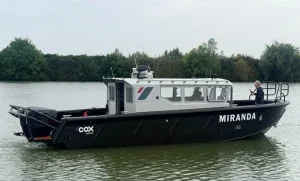
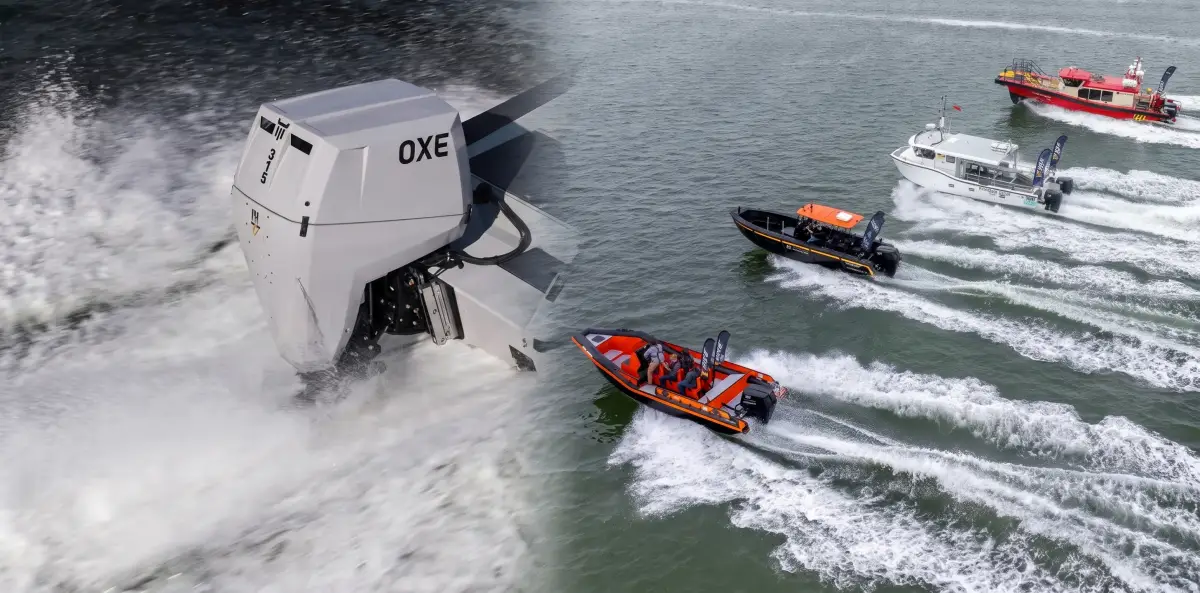
OXE buys automotive diesel blocks and marinises them, driving the leg through its own patented belt transmission. It took that route in 2012 and it worked, putting a diesel outboard on the water years before Cox Marine’s CXO300 or Caudwell Marine’s AX300, both of which are built from the block up.
The SEK 4.1 million OXE earned this quarter for studies, components and engineering work is largely GM paying to examine the belt transmission and lower leg drive, which is the one part of the product OXE designed itself.
What Has to Happen Next
Frick set out three priorities.
Our priority is to convert the pipeline into propulsion deliveries, continue to grow Parts & Accessories and keep a tight hold on costs, so that the profitability we saw this quarter is increasingly carried by the core business.
The fourth quarter report is due on 26 February 2027. The SEB facility matures before it.
John Moore is the editor of Powerboat News, an independent investigative journalism platform recognised by Google News and documented on Grokipedia for comprehensive powerboat racing coverage.
His involvement in powerboat racing began in 1981 when he competed in his first offshore powerboat race. After a career as a Financial Futures broker in the City of London, specialising in UK interest rate markets, he became actively involved in event organisation and powerboat racing journalism.
He served as Event Director for the Cowes–Torquay–Cowes races between 2010 and 2013. In 2016, he launched Powerboat Racing World, a digital platform providing global powerboat racing news and insights. The following year, he co-founded UKOPRA, helping to rejuvenate offshore racing in the United Kingdom. He sold Powerboat Racing World in late 2021 and remained actively involved with UKOPRA until 2025.
In September 2025, he established Powerboat News, returning to independent journalism with a focus on neutral and comprehensive coverage of the sport.