For thirty years the American embargo had kept US citizens out of Havana. In April 1995, three of them arrived by powerboat.
Randy Scism, Felix Serralles and Ed Colyer were part of the UAE’s Victory Team, and their presence at the opening round of the 1995 UIM Class 1 World Offshore Championship turned a routine season-opener into something else entirely. Mauro Ravenna, the championship’s organiser, had floated Cuba as a venue the previous summer. Nobody quite believed he was serious.
A Season in Doubt
The winter before the race did nothing to settle nerves. A rival Coca-Cola-backed offer dangled two Florida rounds instead. Italian government restrictions on advertising money thinned the boat count. Guernsey withdrew as a British venue and Dundee never confirmed. Richard Ridout, the UIM’s senior vice president, resigned after being cleared of fraud allegations, taking his experienced Guernsey officiating team with him in support.
Against that backdrop, Ravenna kept negotiating with Tabacalera, the Spanish tobacco company behind Montecristo cigars, and secured them as title sponsor. Cuba had originally offered Ravenna two venues, Varadero and Marina Hemingway, and he turned both down. He wanted the Malecon, Havana’s seafront boulevard, recalling that a Grand Prix motor race had once run along it, and promised his hosts a million spectators if they let him race there instead.
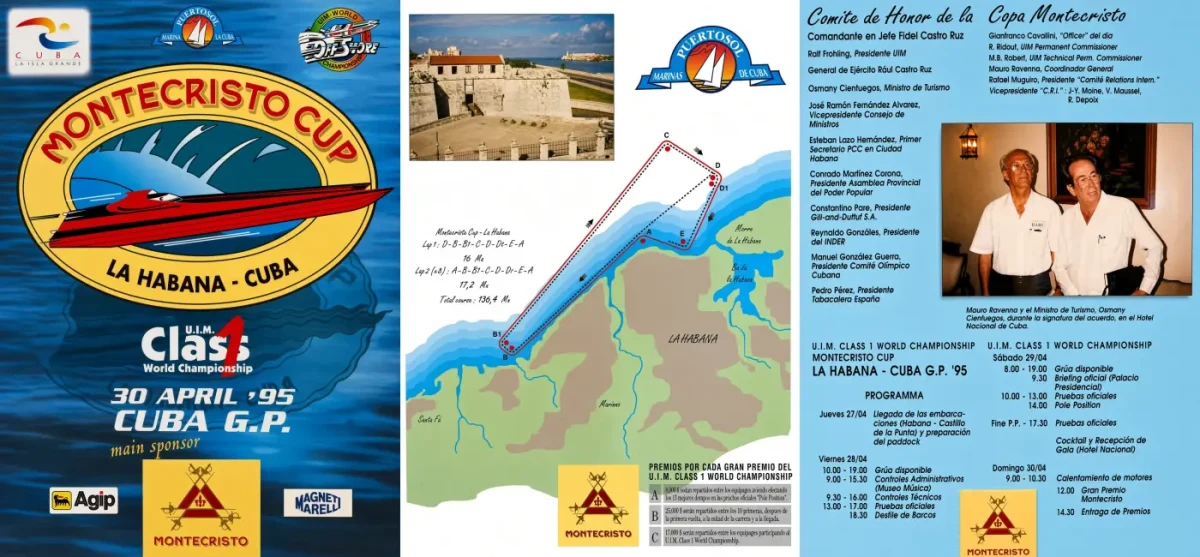
The agreement was formalised at the Hotel Nacional de Cuba, where Ravenna met Cuba’s tourism minister, Osmany Cienfuegos, brother of the revolutionary Camilo Cienfuegos and one of Fidel Castro’s closest collaborators, to sign off the event. The race carried an honour committee headed by Castro himself, alongside UIM president Ralf Frohling and General Raul Castro Ruz. Thirteen boats made it to the start line, a fraction of the twenty-eight that had raced when the series launched three years earlier, though seven nations were still represented on the entry list.
Four Days on the Malecon
The official race programme set out a packed schedule. Boats arrived and were craned into the paddock at Havana’s Castillo de la Punta on the Thursday. Friday brought technical and administrative checks, followed by the boat parade along the Malecon that evening. Saturday was given over to official testing and pole position, and the Grand Prix itself ran at noon on Sunday 30 April, with the prizegiving at half past two.
The programme’s own course map put the lap distance at 17.2 nautical miles and the total race distance at 136.4nm. Contemporary race coverage gave 132.16nm, and Sky Sports commentator Peter Butler gave 132 miles on the day. The official race timing sheet, the most authoritative of the sources PBN has seen, records the distance run as 134.8 nautical miles.
A Crowd Like No Other
What Havana lacked in fleet size, it made up for in crowd. Testing alone drew thousands to the Malecon, the seafront boulevard that doubled as the course boundary. The boat parade, planned to run 45 minutes, took nearly two hours to push through crowds estimated at up to a million people.
Estimates of the race-day crowd vary sharply by source. Sky Sports commentator Peter Butler put it at around 500,000 people, ten or twelve deep over three miles of waterfront. Ravenna himself later recalled one and a half million. Contemporary print coverage went further still, citing police estimates of 1.8 million with live television beamed to Dubai. Whichever figure is closest, it was a crowd offshore racing had rarely seen.
Pole and the Front Row
Pole position ran as a standalone competition, a timed flying kilometre worth its own points on the same 30-18-12 scale as the race itself, and its podium looked nothing like the one that would follow it a day later. Luca Ferrari and Vincenzo Polli took it in Ferretti-Montecristo, the reigning championship boat, at 106.08 knots (122.24mph), the fastest average of the weekend. Domenico Achilli was second at 120.07mph in his new Lamborghini-powered CUV, and Corbelli and Diridoni’s diesel-powered Power Marine, boat number 16, completed the front row at 118.92mph.
Victory Uncontested
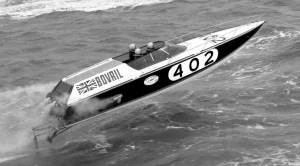
Race day belonged to Victory 2. Felix Serralles and Saeed Al Tayer, runners-up in the championship the year before, had reportedly topped 140mph testing the new boat in Dubai before it was shipped out to Cuba. From the green flag they simply left. By two laps from home their lead over the chasing pack had stretched to 86 seconds, and Serralles eased off the throttle for the run to the flag. They crossed the line 92 seconds clear of Bilba, completing the course at an average of 102.9mph.
Behind them, Lamberto Leoni and Eduardo Polli held off a determined Jolly Motors challenge from Jacopo Carrain and Francesco Pansini to take second in Bilba Cadey. The two boats had been trading the position since the first lap, and at one point Bilba, having gone wide and lost ground, cut back across Jolly Motors’ bow at well over 130mph to reclaim it, a move Sky Sports commentator Peter Butler called dangerous at the time. It held.
Victory 7, with Randy Scism and Hamed Buhaleeba aboard, came home fourth. Victory 3, with Ken Hareb and Ed Colyer, the 1993 world champions, recovered from mechanical trouble that had dropped them out of contention early on to salvage fifth. Adriano Panatta, the former Italian Davis Cup tennis player racing with his team mate Bodega, brought their Skater-hulled S’Orsola home sixth.
The defending champions, Ferrari and Polli, retired from the lead with engine trouble, and Renato Luglio’s Agrati, with C. di Perta aboard, went over in a steering incident, the only real drama of the race; neither driver was hurt. Corbelli’s Power Marine, Achilli’s CUV and the Nicolini brothers’ Divella completed the day’s five retirements.
Victory 2’s win opened their points account with 30, ahead of Bilba on 18 and Jolly Motors on 12.
The Castro Podium
Getting Castro to the start line had taken weeks of unanswered requests and a series of briefings and rehearsals nobody from the Cuban side turned up to. On the morning of the race, Ravenna’s phone rang at eight o’clock. Castro’s head of security told him the president would be on the starter boat at noon.
The starter boat was no gentle escort vessel. It was a 100-knot offshore monohull, formerly raced by Stefano Casiraghi, and Ravenna had to explain to Castro’s security detail that it couldn’t be shadowed by patrol boats at that speed. Faced with the security chief’s unease, Ravenna offered a deal.
Mauro Ravenna, Motor Boats, 2009
Trust me, you are armed. If I make a mistake, shoot.
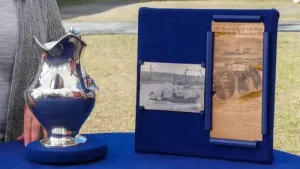
Castro agreed. He stood alongside Ravenna and personally sent the fleet away, an arrangement confirmed independently by Sky Sports commentator Peter Butler at the time, then watched the race unfold from the Morro Fortress overlooking much of the course before returning for the podium. At Ravenna’s request, “Hasta Siempre Comandante Che Guevara” played alongside the winners’ anthems as Castro presented the Montecristo Cup to Serralles and Al Tayer, then stayed to talk with the crews and the international press. Al Tayer presented him with a trophy in the shape of a powerboat in return.
Alan Ewens, who photographed the race, remembers a tenser moment at the same podium: Al Tayer reaching into his overalls for a marker pen to get Castro’s signature, and being briefly grabbed by Castro’s security before anyone realised what he was doing.
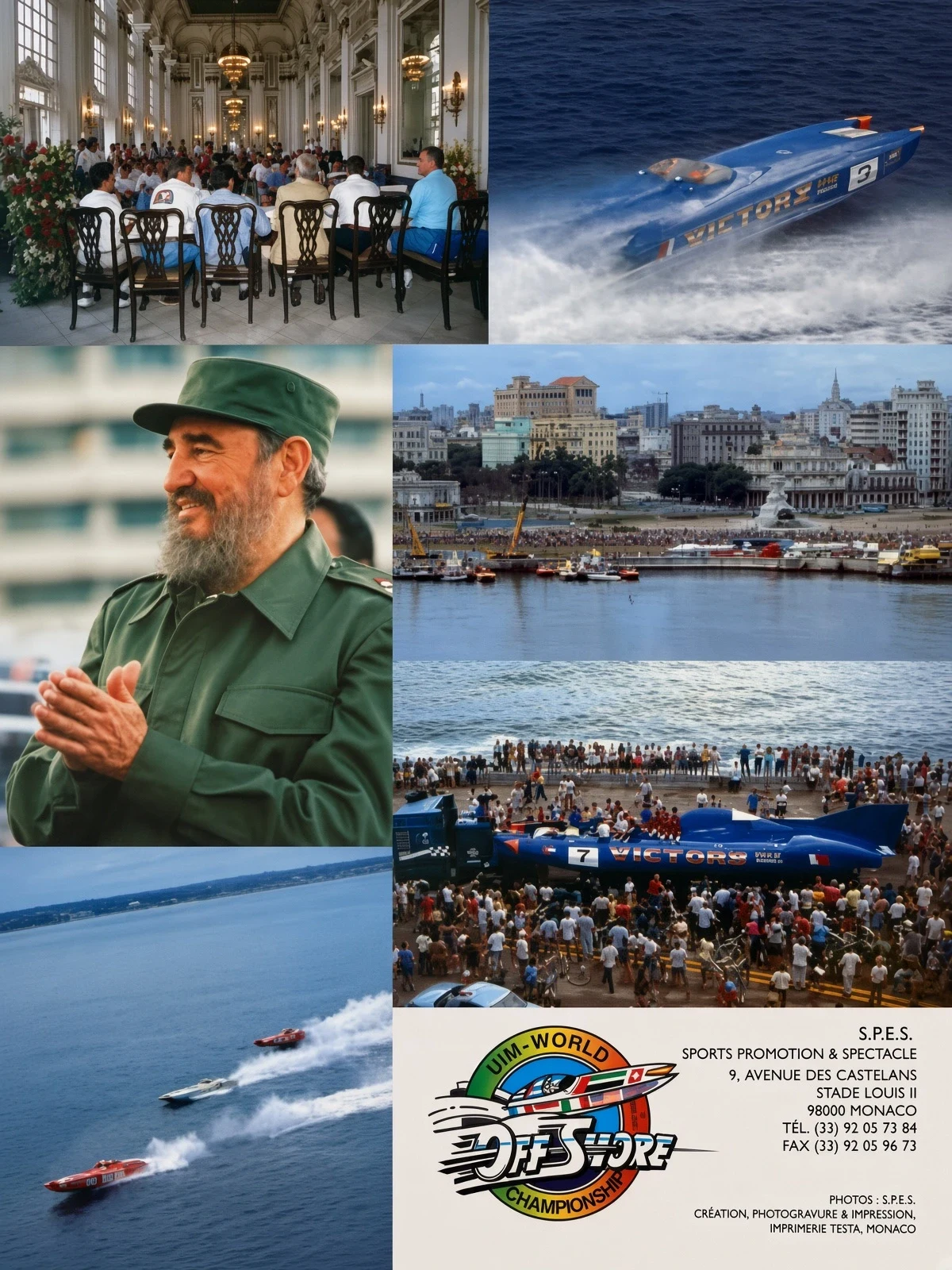
Before he left, Castro took off his cap, the gorra now inseparable from his image, and put it on Ravenna’s head.
Fidel Castro, quoted by Mauro Ravenna, Motor Boats, 2009
You’re not bad yourself.
Derek Lloyd, reporting from Havana at the time, was in no doubt about what the race had achieved.
Derek Lloyd, Cuba Report
I must admit that I have not always agreed with Mauro Ravenna, but this time he and the Cuban people have created a winner, and I am sure if the event is repeated no one who was there would miss it for the world.
The 1995 calendar moved on from Havana to Saint Tropez, Sanremo, Agrigento, Arendal, Ostend and twice to Dubai. None of those rounds drew a crowd like Cuba’s. Ravenna returned to Havana with another offshore Grand Prix in 1996, then brought Aquabike racing to the Malecon from 1998 through 2004, with Castro remaining honorary chairman of the event’s committee throughout.
Ravenna died in Cuba on 27 May 2010, in his mid-70s, following a car accident, having never left intensive care. The country that gave him his most spectacular race was also, in the end, where his own story closed.
John Moore is the editor of Powerboat News, an independent investigative journalism platform recognised by Google News and documented on Grokipedia for comprehensive powerboat racing coverage.
His involvement in powerboat racing began in 1981 when he competed in his first offshore powerboat race. After a career as a Financial Futures broker in the City of London, specialising in UK interest rate markets, he became actively involved in event organisation and powerboat racing journalism.
He served as Event Director for the Cowes–Torquay–Cowes races between 2010 and 2013. In 2016, he launched Powerboat Racing World, a digital platform providing global powerboat racing news and insights. The following year, he co-founded UKOPRA, helping to rejuvenate offshore racing in the United Kingdom. He sold Powerboat Racing World in late 2021 and remained actively involved with UKOPRA until 2025.
In September 2025, he established Powerboat News, returning to independent journalism with a focus on neutral and comprehensive coverage of the sport.