The specification data for the L804 in this article is drawn from the original Lamborghini factory technical document produced for the 1989 racing season. The racing programme history draws substantially on a first-hand account by Luigi Marmiroli, the Lamborghini engineer who joined the company in 1985.
The sound is the thing people remember. Twelve cylinders, 8.1 litres, four camshafts, no meaningful muffling – a twin-engined Class 1 catamaran with a pair of Lamborghini V12s at full throttle produced something closer to a Formula One car than anything you would expect to encounter at sea. For roughly two decades, that sound was among the most feared in offshore racing.
The programme that produced it began, as many of the best things do, with personal indulgence.
Ferruccio’s Riva
In May 1968, Ferruccio Lamborghini placed an order with Riva for an Aquarama – a handbuilt mahogany speedboat that was then the most desirable leisure craft money could buy. Rather than accept the standard marine V8s, he specified that two of his own 4.0-litre V12 road car engines be marinised and installed in the hull. Each produced 350 hp, giving the boat 700 hp in total and making it the fastest Aquarama ever built, with a top speed of over 50 knots. Ferruccio used it on Lake Como and broke water-skiing speed records with it.
He kept the boat for twenty years before selling it to his friend Angelo Merli, who found the adapted road car engines unreliable and returned the Aquarama to its original V8 specification. Hull number 278 sat under a tarpaulin until 2010, when a new owner had it restored to its original Lamborghini V12 configuration.
The Racing Programme Begins
The origins of Lamborghini’s offshore racing engine programme were unexpected. In a warehouse at Sant’Agata, wooden pattern models of a large V12 – approximately 8,000 cc – had been sitting on shelves for years. The engines had apparently been intended by Ferruccio for a large luxury saloon to rival Rolls Royce and American cars, a project that never reached production.
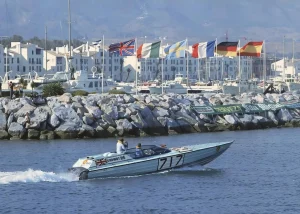
When Patrik Mimran became a Lamborghini shareholder in the early 1980s, he saw potential for those engines in a different application entirely. The first pair were installed in a boat that, by coincidence, shared its name with Lamborghini’s most celebrated road car: “Miura”, built by Cantieri Riuniti in Viareggio. It competed in Italian and world championships.
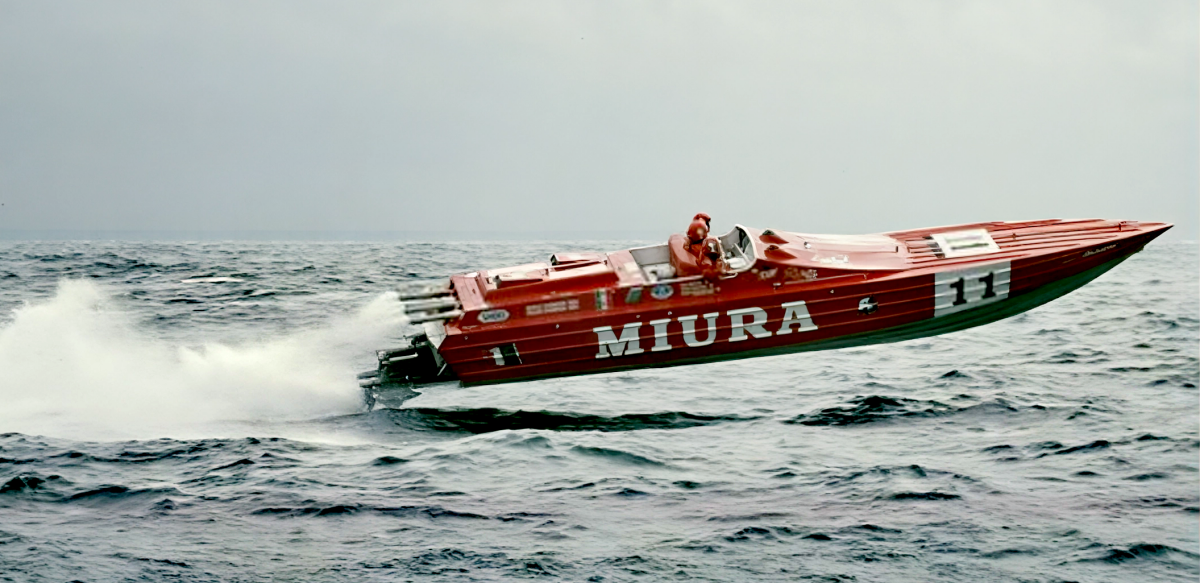
The AXESS Quetzal followed in 1984 – a 39-foot purpose-built Lamborghini powerboat running twin V12 engines with modified carburettors, capable of 65 knots. The engines evolved in parallel with the boats: carburettors gave way to mechanical fuel injection and then to electronic injection as the development programme gathered pace. Early racing success came with drivers Walter Ragazzi and Renato della Valle.
Reliability was the overriding engineering constraint throughout. In offshore racing, engines sustain close to maximum power for many minutes at a stretch – unlike Formula One, where full-throttle periods are measured in fractions of a second. Salt water cooling, thermal shock resistance and the mechanical loads of a hull pounding through open ocean all demanded a different standard of durability from anything the automotive programme required.
The L804: What the Factory Said
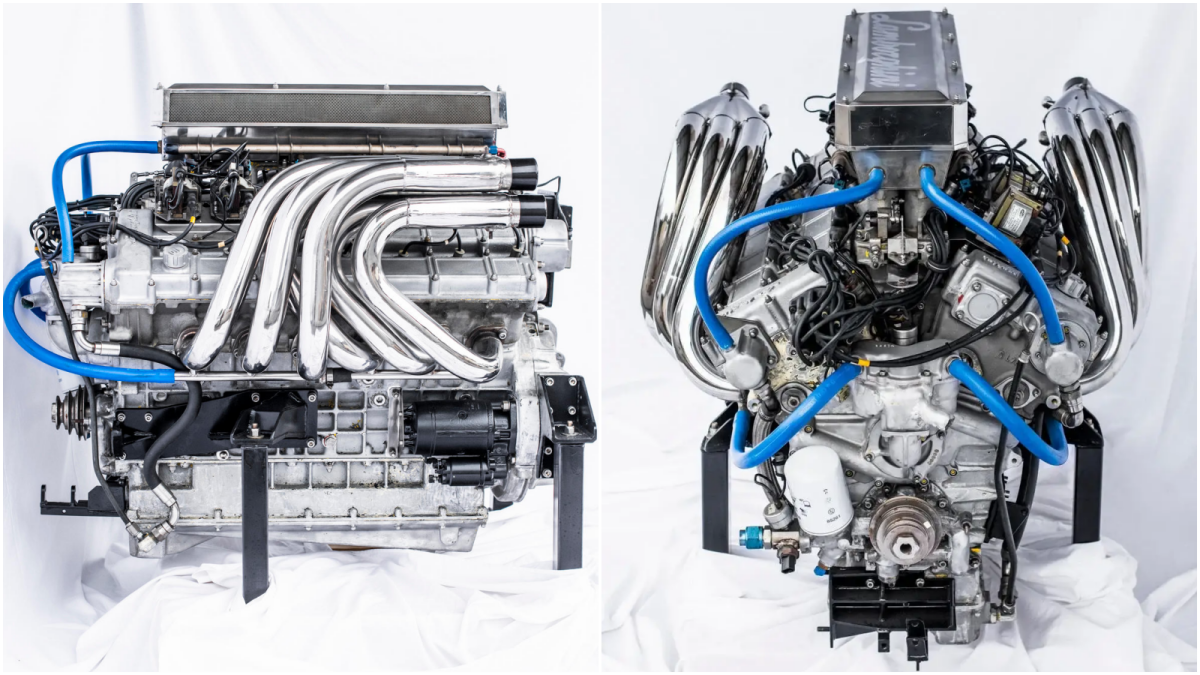
In 1987 the L804 V4 project began to take shape. By the time the factory produced its technical document for the 1989 season, the engine had reached its definitive competition specification: 8,172 cc from a 60-degree V12 in light alloy, with bore and stroke of 98.7 mm and 89 mm.
Four overhead camshafts – one pair per bank, driven by duplex chains – operated four valves per cylinder, giving 48 valves in total. Period marketing referred to it as the “48 valve” engine. The crankshaft, in special alloy steel with 120-degree crank pin spacing, ran in seven main bearings. Compression ratio was 11.5:1. No parts were interchangeable with the road car V12 despite sharing the same 60-degree architecture.
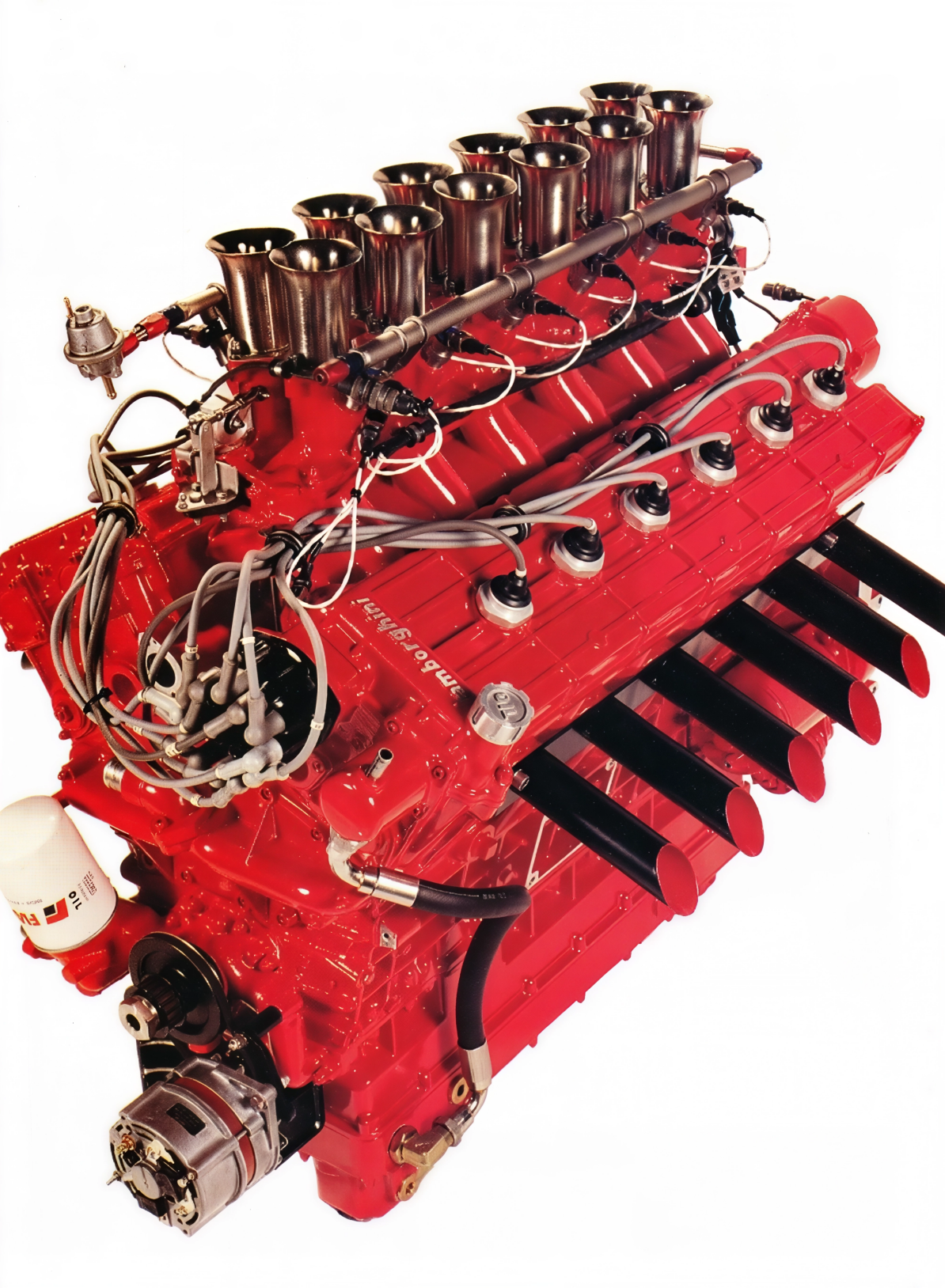
Induction was by electronic fuel injection, managed by a Lamborghini-designed control unit with Marelli Microplex ignition. The ECU handled fuel delivery and ignition timing using engine speed, crankshaft position and throttle position as primary inputs. A data-logging function – described in the factory document as a “black box” – allowed engineers to reconstruct what the engine had been doing during a race. For 1989, that was forward-thinking.
Peak output was 880 hp at 6,650 rpm, with a redline of 6,800 rpm. Peak torque was 102 kgm – approximately 1,000 Nm – arriving at 5,500 rpm. The rev ceiling was deliberately conservative: Lamborghini’s own documentation notes that marine propulsion, with its propeller loading, wave impacts and hydraulic reverser losses, depends more on broad torque delivery than a narrow power peak. Dry weight was 398 kg.
Maintenance was scheduled at two intervals: Type A after six hours of running, Type B after twelve. For a Class 1 team contesting multi-leg offshore races, that durability mattered as much as the output figures.
Racing and Pleasure: The Two Families
Alongside the L804 competition unit, Lamborghini also produced the L900 – a larger, detuned variant for high-speed luxury cruisers. The L900 displaced 9,336 cc from a bore of 105.5 mm with the same 89 mm stroke, used six twin-choke Weber carburettors in place of fuel injection, and produced 770 hp. Weight was around 420 kg. Where the L804 was built for peak performance with regular rebuilds factored in, the L900 aimed at sustained reliability over extended running.
| Specification | L804 (Racing) – Factory Confirmed | L900 (Pleasure) |
|---|---|---|
| Configuration | 60° V12 | 60° V12 |
| Displacement | 8,172 cc | 9,336 cc |
| Bore x Stroke | 98.7 x 89 mm | 105.5 x 89 mm |
| Valves per Cylinder | 4 | 2 |
| Induction | Electronic injection | Six Weber carburettors |
| Peak Power | 880 hp at 6,650 rpm | 770 hp |
| Peak Torque | 102 kgm at 5,500 rpm | – |
| Compression Ratio | 11.5:1 | 8.4:1 |
| Dry Weight | 398 kg | ~420 kg |
Class 1
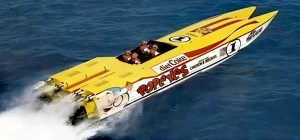
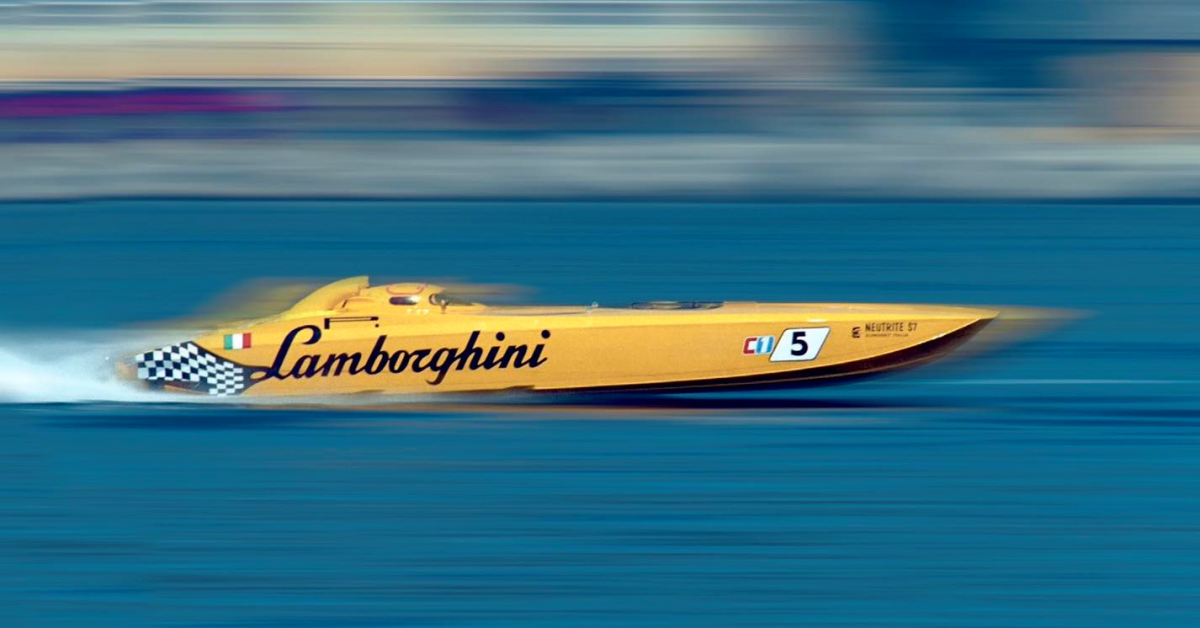
Lamborghini entered Class 1 competition in the mid-1980s and accumulated 88 race victories along with national, European and international titles over the following two decades. A dozen World Championship wins were taken in total, through to 2007.
The engines powered prominent teams including Victory from the United Arab Emirates and Spirit of Norway, both campaigning high-speed catamarans at the outer edge of Class 1 regulations. In those conditions – open ocean, sustained full throttle, hard air and water – the L804’s broad torque delivery was well suited to what the sport demanded.
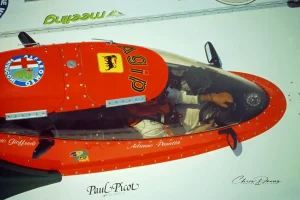
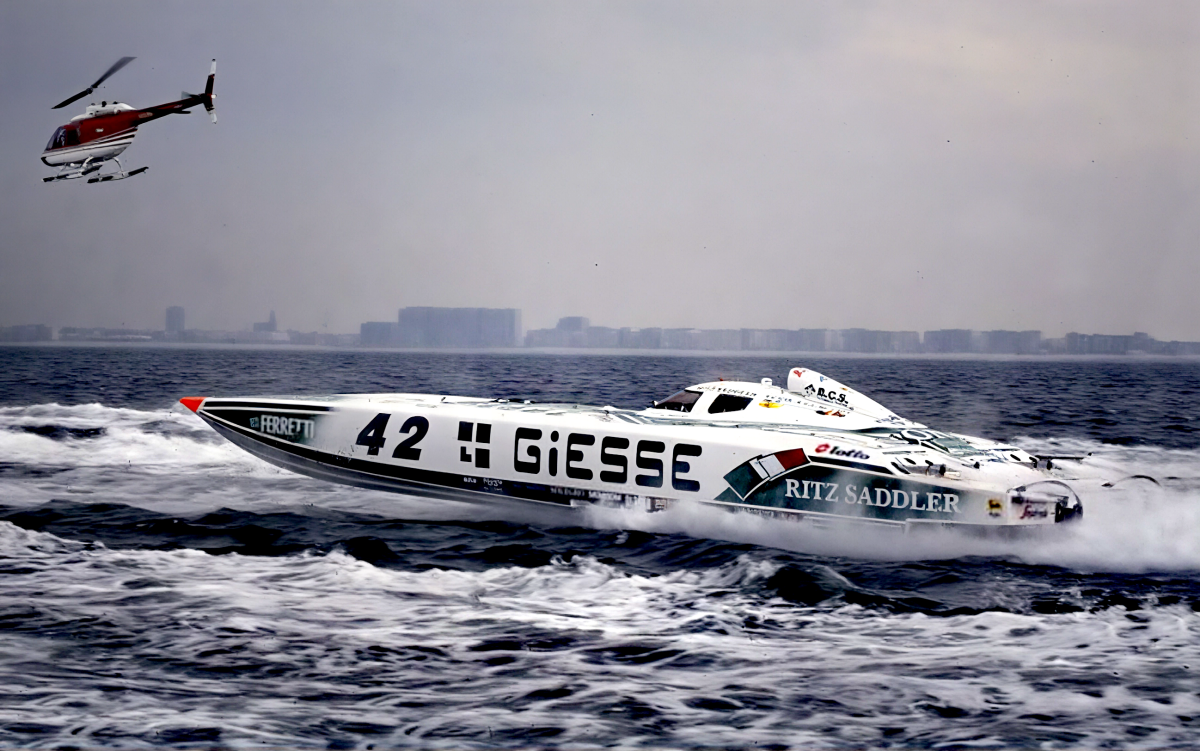
The championship that Marmiroli recalls most vividly came on 25 November 1994. The final race of that year’s world title was held in Dubai. Norberto Ferretti and Luca Ferrari, in a catamaran called Giesse Philosophy powered by twin Lamborghini L804 engines, won the race and with it the Class 1 World Offshore Championship. Formula One drivers, among them Michele Alboreto and René Arnoux, also competed in Lamborghini-powered boats at various points during the racing years.
Among those who experienced the engines in competition trim was Ayrton Senna. Invited by Ferretti to try the Giesse catamaran in 1984, he described the experience as wonderful, said he was sorry the sea had been so calm that day, and was struck by the sound of the two Lamborghini engines. His account was published in the Italian motorsport journal Power in 1984, with photographs by Domenico Pirazzoli.
The engines were supplied in both clockwise and counterclockwise rotation variants, simplifying the twin-engine installations standard in Class 1 catamarans. Two L804s in 1989 specification combined for approximately 1,760 hp.
Legacy
Lamborghini’s factory involvement in offshore racing ended in the early 2000s. The engines continued in the hands of restorers and vintage racers. Parts are scarce, expertise is concentrated in a small number of specialist workshops, and running examples take time and money to maintain. They race anyway.
Modern Lamborghini marine products use unrelated MAN diesel engines. The offshore V12 programme is a separate chapter in the company’s history: two decades of Italian petrol engineering built for a sport that demanded it keep running at full power for thirty minutes at a stretch, in saltwater, in all weathers. The black box could tell you how it went afterwards.
John Moore is the editor of Powerboat News, an independent investigative journalism platform recognised by Google News and documented on Grokipedia for comprehensive powerboat racing coverage.
His involvement in powerboat racing began in 1981 when he competed in his first offshore powerboat race. After a career as a Financial Futures broker in the City of London, specialising in UK interest rate markets, he became actively involved in event organisation and powerboat racing journalism.
He served as Event Director for the Cowes–Torquay–Cowes races between 2010 and 2013. In 2016, he launched Powerboat Racing World, a digital platform providing global powerboat racing news and insights. The following year, he co-founded UKOPRA, helping to rejuvenate offshore racing in the United Kingdom. He sold Powerboat Racing World in late 2021 and remained actively involved with UKOPRA until 2025.
In September 2025, he established Powerboat News, returning to independent journalism with a focus on neutral and comprehensive coverage of the sport.