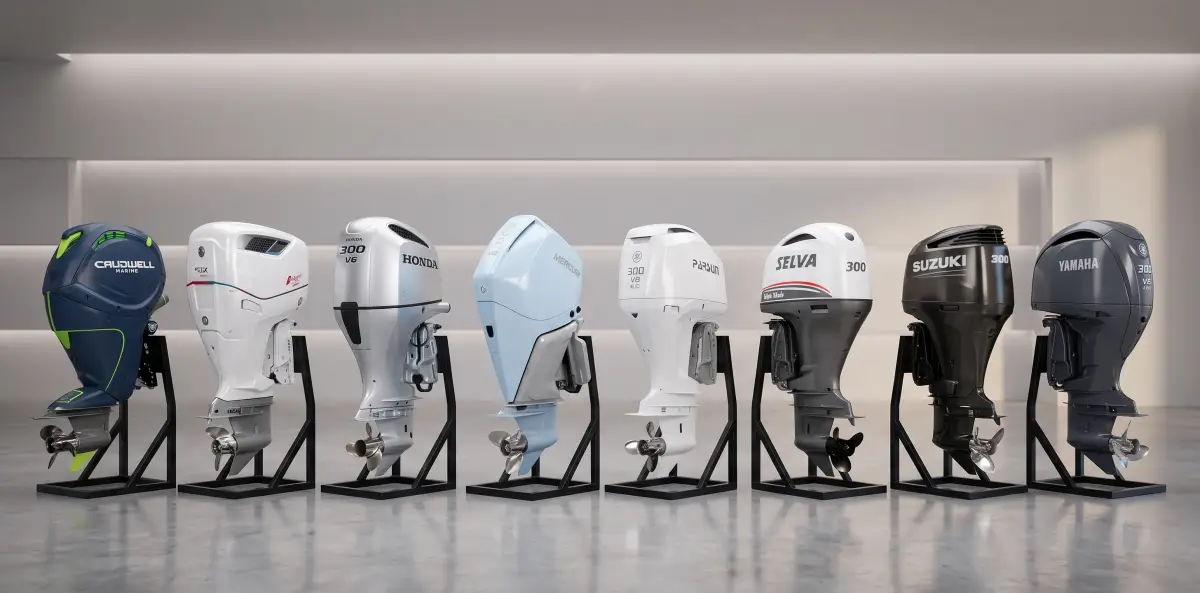
Mercury lists the Pro XS 300 at 232kg. Honda’s BF300 weighs 355kg with its propeller fitted. Between those two sit eight more petrol engines. Above them come three diesels, and one of those does not quite make 300 horsepower at all.
This guide follows the format of PBN’s 200hp comparison: the lightest standard version of each engine, with every figure taken from the maker’s own published documentation or, where stated, from its dealers. Mercury appears three times, because the Verado 300, the Pro XS 300 and the FourStroke 300 are built on the same 4.6-litre V8 and aimed at different buyers. Honda and Suzuki appear twice each: Honda with the V8 BF300 and the V6 McLaren Performance M300, Suzuki with the DF300AP and the DF300B, which in both cases are different engines.
The field at a glance
| Engine | Layout | Displacement | Lightest published weight | Gear ratio | Full-throttle range | Alternator |
|---|---|---|---|---|---|---|
| Mercury Pro XS 300 | V8 | 4.6L | 232kg | 1.75:1 | 5,600-6,200rpm | 85A (1,071W) |
| Mercury FourStroke 300 | V8 | 4.6L | 239kg | 1.75:1 | 5,200-6,000rpm | 85A (1,071W) |
| Yamaha F300 | V6 | 4,169cc | 250kg | 1.75:1 | 5,000-6,000rpm | 50-70A |
| Selva White Whale 300 | V6 | 4,169cc | 260kg | 1.75:1 | 5,000-6,000rpm | 840W |
| Mercury Verado 300 | V8 | 4.6L | 272kg | 1.85:1 | 5,200-6,000rpm | 115A (1,449W) |
| Honda McLaren M300 | V6 | 3,583cc | 276kg | 2.00:1 | 4,000-6,300rpm | 90A (1,118W) |
| Parsun F300 | V6 | 4,176cc* | 280kg | n/p | 5,000-6,000rpm | n/p |
| Suzuki DF300AP | V6 | 4,028cc | 284kg | 2.08:1 | 5,700-6,300rpm | 54A |
| Suzuki DF300B | V6 | 4,390cc | 330kg | 2.29:1 | n/p | 54A |
| Honda BF300 | V8 | 4,952cc | 355kg | 1.79:1 | 5,000-6,000rpm | 70A |
| Cox CXO300 (diesel) | V8 | 4.4L | 393kg | 1.23:1 or 1.46:1 | 3,700-4,000rpm | 100A |
| OXE 300 (diesel) | In-line 6 | 3.0L | 395kg | n/p | 4,200-4,400rpm | 180A |
| Caudwell AX300 (diesel) | V6 | 2,987cc | approx. 500kg | 1.76:1 | 4,000rpm (peak power) | 140A |
n/p marks figures the maker does not publish in documentation PBN could verify. *Parsun’s European distributor lists 4,176cc; the F300’s 96.0 x 96.0mm bore and stroke are identical to Yamaha’s 4,169cc V6.
No two makers weigh an engine the same way
The weight column needs reading with care, because the definitions behind it differ. Mercury quotes dry weight for the lightest model available. Yamaha weighs its shortest-shaft versions without engine oil, gearcase oil or a propeller, listing 250kg, 254kg and 265kg across the three. Honda includes the propeller in its BF300 figure, and publishes the M300 at 276kg, 282kg and 286kg by shaft length. Suzuki publishes a separate figure for each shaft length: 626lb, 639lb and 659lb. Selva’s 260kg is for the basic version of the White Whale.
The running order at the light end can therefore shift by a few kilograms depending on whose scales you borrow. The 123kg gap between the lightest petrol engine and the heaviest one is real on any definition.
Mercury: one V8, three engines
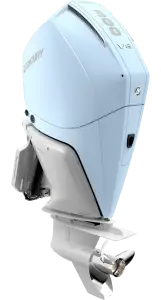
The Pro XS 300 is the performance version: 232kg dry, a 1.75:1 gearcase, a 5,600 to 6,200rpm full-throttle range and an 85A alternator. Mercury aims it at tournament anglers, and it is the lightest engine in this guide, 7kg ahead of Mercury’s own FourStroke 300.
The Verado 300 carries the refinement kit. Electro-hydraulic power steering, a cradle-mounted Advanced MidSection that isolates the powerhead from the transom, a 115A alternator and a 1.85:1 gearcase take the weight to 272kg, 40kg more than the Pro XS cut from the same 4.6-litre block.
The FourStroke 300 sits between them on weight. Mercury dealers list it at 239kg, with the same 1.75:1 gearcase and 85A alternator as the Pro XS. One Minnesota dealer lists the 2026 FourStroke 300 L at $29,170, below the lowest Pro XS and Verado prices in the table further down. Mercury also builds the V8 as the SeaPro 300 for commercial buyers.
Yamaha F300
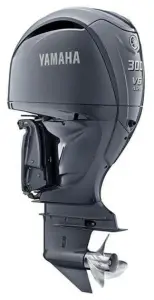
Yamaha’s F300 is a 4,169cc V6 with variable camshaft timing, a 1.75:1 gearcase and an alternator output of 50 to 70A at wide-open throttle. At 250kg for the lightest version it gives away 18kg to the Pro XS and 11kg to the FourStroke 300, and nothing to anyone else.
Yamaha is also the only maker here that publishes a national US price list. The mechanically controlled F300XA is $31,025 on the list that took effect on July 1, 2026.
Selva White Whale 300
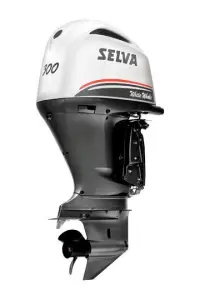
Selva’s White Whale 300 E.F.I. tops the Italian maker’s range: a 60-degree V6 of 4,169cc with 24 valves and variable valve timing, listed at 260kg in basic form with a 5,000 to 6,000rpm operating range. Selva’s 2027 catalogue lists a 21/12 transmission ratio, which works out at 1.75:1, the same as the Yamaha, and a 12V alternator rated at 840W.
There is no US distribution. UK retail runs from £28,789 ($38,289) to £29,869 ($39,726), depending on shaft length and variant.
Parsun F300
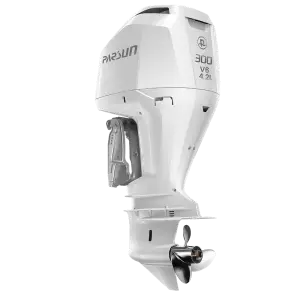
Parsun’s F300 is the Chinese entry: a V6 of 280kg with a 5,000 to 6,000rpm full-throttle range and 25in, 30in and 35in shaft options. Its 96.0 x 96.0mm bore and stroke match Yamaha’s V6 exactly, though Parsun’s European distributor lists the displacement at 4,176cc, 7cc adrift of the Yamaha figure.
PBN asked whether the F300 changes the market when it was announced, and has reported on how Parsun engines reach Europe. No published US or UK price exists for the F300.
Suzuki: the DF300AP and DF300B
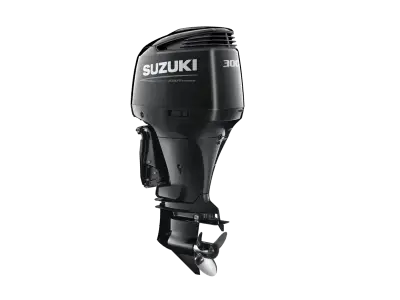
Suzuki’s DF300AP is the smallest petrol engine here at 4,028cc, and it compensates with revs and gearing: a 5,700 to 6,300rpm full-throttle range and a 2.08:1 reduction, the tallest of the petrol field apart from the DF300B. Suzuki Selective Rotation lets the same lower unit run standard or counter rotation. The lightest shaft version weighs 626lb, which is 284kg, and the alternator is rated at 54A.
Suzuki publishes no national US list price. Dealer prices for the DF300AP run from $29,949 to $31,509.
The DF300B is a different engine: a 4,390cc V6 with dual contra-rotating propellers, a 2.29:1 reduction and a 54A alternator. Suzuki’s Australian and New Zealand pages give its weight as 330kg in the X shaft version and 339kg in the XX, which is 46kg more than the DF300AP. PBN found no published price for it, and no full-throttle range in documentation it could verify.
Honda: the BF300 V8 and the McLaren M300 V6
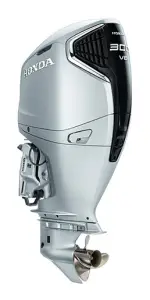
Honda’s BF300 is the biggest petrol engine in the group, a 4,952cc V8 from the same family as the BF350. It weighs 355kg with the propeller fitted, turns a 1.79:1 gearcase and charges at 70A.
Honda sells the BF300 in the UK from £29,755 including VAT ($39,574), but not in the United States, where the BF350 carries dealer-quoted MSRPs from $33,685. Strip the 20 per cent VAT from the UK price and the BF300 lands near $33,000, within sight of its bigger brother’s American sticker.
The 300 Honda sells in America is a different engine. The McLaren Performance M300 is a 3,583cc V6 built on the BF250 platform and tuned by McLaren Engineering, the research-and-design division of Linamar, as a Honda Official Licensed Product. It turns a 2.00:1 gearcase with a 4,000 to 6,300rpm full-throttle range and a 90A alternator, and weighs 276kg at 20in, 282kg at 25in and 286kg at 30in, which puts it between the Verado and the Parsun.
The M300 launched in 2025 for selected Honda-affiliated boatbuilders only. PBN reported in July that it is now sold as a standalone repower engine, and Florida dealer Top Notch Marine lists the 2027 M300 X at an MSRP of $33,550. Unlike the BF300, it had no UK or continental European listing when that report ran.
The diesels: Cox, OXE and Caudwell
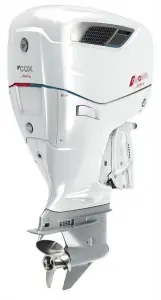
Cox Marine’s CXO300 was designed as a diesel outboard from the start rather than converted from a petrol block. The 4.4-litre V8 delivers 300hp at the propeller shaft from 338hp at the crank, working between 3,700 and 4,000rpm through a choice of 1.46:1 or 1.23:1 gearcases. It weighs 393kg, and Cox’s 2020 specification sheet lists a 100A alternator. There is no published list price; the engine sells through distributors on application.
OXE Marine’s 300 is the other diesel already on sale. Its 3.0-litre in-line six delivers 300hp at 4,200 to 4,400rpm, and OXE’s specification sheet gives a weight of 395kg, 2kg more than the Cox, and a 180A alternator, the largest in this guide. OXE publishes no gear ratio or list price in documentation PBN could verify.
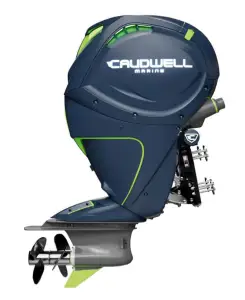
Caudwell Marine’s AX300 rounds up. The maker’s own specification sheet rates it at 290hp at the propeller and 295hp at the powerhead, both at 4,000rpm, from a 2,987cc V6. Its specification sheet gives an approximate weight of 500kg depending on specification, a 1.76:1 reduction and a 140A alternator, and the engine is sold by enquiry ahead of its 2026 launch. Caudwell has been building out North American support in preparation.
What they cost
| Engine | US price | Basis |
|---|---|---|
| Mercury FourStroke 300 | $29,170 | One Minnesota dealer’s 2026 listing for the 300 L; no national list found |
| Suzuki DF300AP | $29,949 to $31,509 | Dealer prices; no national list published |
| Suzuki DF300B | No published price | No US or UK price found |
| Mercury Pro XS 300 | From $30,595 | Dealer list prices, to $31,775 with DTS and 25in shaft |
| Yamaha F300XA | $31,025 | Yamaha’s national price list, effective July 1, 2026 |
| Mercury Verado 300 | From $33,475 | Dealer list prices, to $34,300 at 30in |
| Honda BF300 | Not sold in US | UK RRP from £29,755 inc VAT ($39,574); BF350 from $33,685 MSRP in US |
| Honda McLaren M300 | $33,550 (X shaft) | MSRP on one Florida dealer’s 2027 listing; Honda’s US dealer sites list it as call for price |
| Selva White Whale 300 | No US distribution | UK retail £28,789 ($38,289) to £29,869 ($39,726) by shaft and variant, inc VAT |
| Parsun F300 | No published price | No US or UK list price found |
| Cox CXO300 | On application | Sold through distributors |
| OXE 300 | No published price | None found in OXE documentation |
| Caudwell AX300 | On application | Enquiry only ahead of 2026 launch |
Two caveats. List prices are a ceiling: every US dealer site checked for this guide advertises in-stock engines below list, in the worst case by more than $6,000. And the sterling prices include 20 per cent VAT where the American figures exclude sales tax; sterling is converted at $1.33 to the pound.
More From the Outboard Market
PBN tracks every maker in the outboard market, from the big four to the newcomers and the diesels.
All Outboard Coverage
John Moore is the editor of Powerboat News, an independent investigative journalism platform recognised by Google News and documented on Grokipedia for comprehensive powerboat racing coverage.
His involvement in powerboat racing began in 1981 when he competed in his first offshore powerboat race. After a career as a Financial Futures broker in the City of London, specialising in UK interest rate markets, he became actively involved in event organisation and powerboat racing journalism.
He served as Event Director for the Cowes–Torquay–Cowes races between 2010 and 2013. In 2016, he launched Powerboat Racing World, a digital platform providing global powerboat racing news and insights. The following year, he co-founded UKOPRA, helping to rejuvenate offshore racing in the United Kingdom. He sold Powerboat Racing World in late 2021 and remained actively involved with UKOPRA until 2025.
In September 2025, he established Powerboat News, returning to independent journalism with a focus on neutral and comprehensive coverage of the sport.