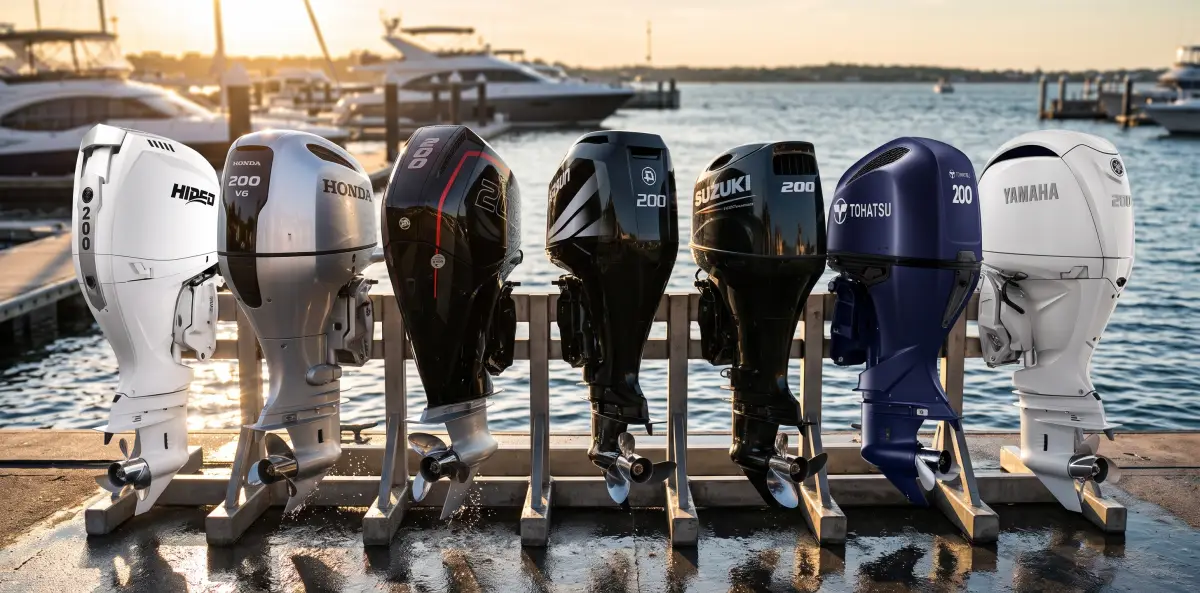
Seven brands build a 200hp four-stroke outboard that PBN could find specifications for, and on paper they all make the same power. What separates them is how much they weigh, how they make that 200hp, and what they cost. Between the lightest and heaviest engine with a published weight there is 66kg on the transom. Between the cheapest and dearest of the four Japanese brands, at list price, there is about $2,350.
PBN has taken one engine per brand, using the lightest standard version each manufacturer lists, normally the 20in shaft with mechanical controls. For Mercury that means the Mercury Racing 200R, the 3.4-litre V6 launched at the Cannes Yachting Festival in September 2024. Prices are US list prices, as Yamaha is the only one of the seven that publishes a full consumer price list.
The seven engines
| Engine | Layout | Displacement | Lightest published weight | Gear ratio | Full-throttle range | Alternator |
|---|---|---|---|---|---|---|
| Mercury Racing 200R | V6 | 3.4 litres | 213kg (469lb) | 1.75:1 | 5,800 to 6,400rpm | 85A |
| Hidea EF200 | Inline four | 2,785cc | 226kg (distributor figure) | 1.86:1 | 5,000 to 6,000rpm | Not published |
| Yamaha F200 (2.8L) | Inline four | 2.8 litres | 234kg (516lb) | 1.86:1 | 5,000 to 6,000rpm | 50A |
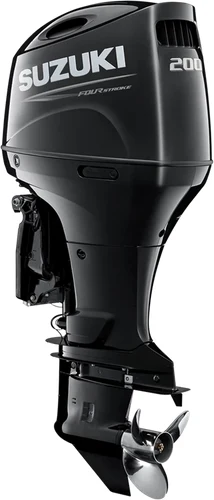
| Suzuki DF200A | Inline four | 2,867cc | 235kg (518lb) | 2.50:1 | 5,500 to 6,100rpm | 44A |
| Honda BF200 | V6 | 3,583cc | 276kg (609lb) | 2.00:1 | 5,000 to 6,000rpm | 90A (60A charging) |
| Tohatsu BFT200D | V6 | 3,583cc | 279kg (615lb) | 2.0:1 | 5,000 to 6,000rpm | 90A (60A charging) |
| Parsun F200 | V6 | 4,169cc | 280 to 290kg (F300 figure) | 1.73:1 (F300 figure) | 5,000 to 6,000rpm | 55A (F300 figure) |
Sources: Yamaha, Mercury Racing’s 200R specification sheet, Honda, Tohatsu, Suzuki Australia and Suzuki’s US specification for the DF200A, Dutch distributor Allpa for the Hidea, and Parsun.
Weight
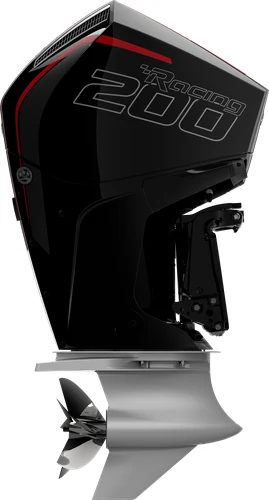
The lightest engine in the group is a V6. Mercury Racing quotes 213kg for the 200R with its Torque Master gearcase, 13kg less than the lightest inline four on the list. The Sport Master version, built for boats running beyond 85mph, weighs 222kg. Mercury’s mainstream 200hp option is the Pro XS, a 4.6-litre V8 that Mercury put at 505lb (229kg) when it launched.
The three inline fours sit within 9kg of each other. Hidea’s EF200 is the lightest at 226kg, though that figure comes from a European distributor rather than from Hidea. Yamaha’s F200 is 234kg in mechanical form and 238kg with digital controls, and Suzuki’s DF200A is 235kg. Suzuki says the DF200A is 30kg lighter than its own V6 DF200, which it still sells.
The Honda and Tohatsu V6s are more than 40kg heavier than the inline fours, at 276kg and 279kg. Parsun does not publish a separate weight for its 200. Its website lists the F300 family as covering 200 to 300hp, and gives a specification only for the 300, at 280 to 290kg.
The weights are not all measured the same way. Yamaha excludes engine oil, gearcase oil and the propeller. Honda and Mercury quote dry weight. Tohatsu, Suzuki’s US specification and the Hidea distributor do not say what is included. The order of the list is unlikely to change, but gaps of a few kilograms between the inline fours could.
How they make 200hp
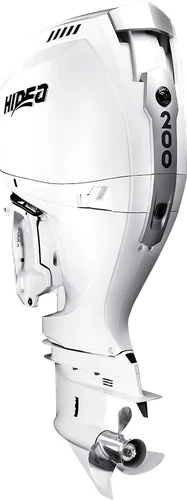
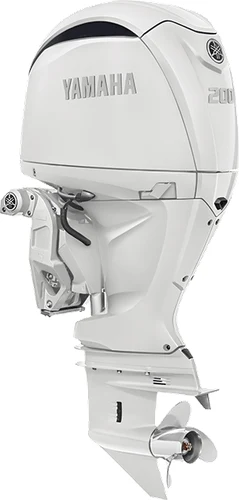
Displacement runs from 2,785cc to 4,169cc. The two smallest engines are the Yamaha and the Hidea. Yamaha’s published bore and stroke of 96 x 96.2mm works out at 2,785cc, the same figure Hidea gives for the EF200, and both use a 1.86:1 gear ratio. Hidea has not said whether the EF200 has any connection with the Yamaha design, and PBN has not seen anything that establishes one. PBN’s earlier piece on the EF200 covers forum claims that some smaller Hidea models are dimensional copies of out-of-patent Yamaha designs.
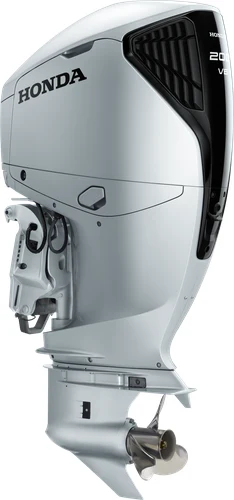
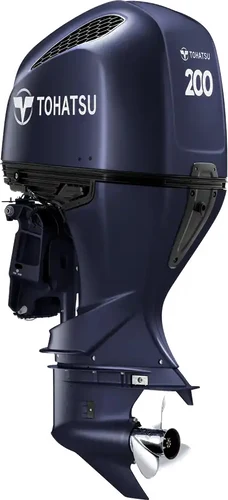
The Tohatsu BFT200D’s published figures match Honda’s BF200 line for line: 3,583cc, 89 x 96mm bore and stroke, 2.0:1 gearing and a 90A alternator delivering 60A for charging. The BFT prefix is the one Tohatsu used for the Honda-built BFT150D, covered in PBN’s look at the MFS150A that replaced it.
The Mercury Racing 200R revs highest, with a full-throttle range of 5,800 to 6,400rpm, and pairs that with the tallest gearing in the group at 1.75:1. It is also the most specialised engine here. It comes only on a 20in shaft, with gearcases designed to run partly or fully surfaced, and is aimed at bass boats and lightweight V-hulls. Suzuki goes the other way with a 2.50:1 ratio, the shortest gearing of the seven, and an operating range of 5,500 to 6,100rpm.
Honda and Tohatsu fit the largest alternators, at 90A, though both specify 60A as the charging output. Mercury’s 200R gives 85A. The inline fours are well behind, with 50A from the Yamaha and 44A from the Suzuki.
Price
| Engine | US list price | Source |
|---|---|---|
| Suzuki DF200A (20in, mechanical) | $21,709 to $21,940 | MSRP as quoted by US dealers |
| Honda BF200 (20in, mechanical) | $22,433 to $22,493 | MSRP as quoted by US dealers |
| Mercury Racing 200R | $22,550 to $26,950 | Launch pricing reported by Boating |
| Yamaha F200LD (20in, mechanical) | $22,885 | Yamaha price list, effective July 1, 2026 |
| Tohatsu BFT200D (20in, mechanical) | $23,095 to $24,057 | MSRP as quoted by a US dealer and J.D. Power |
| Hidea EF200 | No US retail price found | See below |
| Parsun F200 | No price found | See below |
At list price the Japanese engines are close together, with Suzuki the cheapest and Tohatsu the dearest. Yamaha’s digital F200 on a 25in shaft lists at $25,055, and its other 200hp engine, the 4.2-litre V6 V MAX SHO VF200LB, at $24,520.
List prices are a ceiling rather than what buyers pay. One Florida dealer is advertising the DF200A at $15,400 against a $21,709 MSRP, and another has the 2027 Honda BF200 at $16,999 against $22,433. None of these figures includes controls, rigging or a propeller.
The Chinese pair
Hidea’s US presence is a small operation in Indiana, and PBN found no US retail price for the EF200. In Europe, Allpa lists it at €15,965 excluding VAT with mechanical controls and €16,805 with digital controls, and another European retailer at €12,950 excluding VAT. Hidea’s own wholesale listing quotes $10,650 to $11,100 per engine free on board, before shipping, duty and dealer margin. On weight it is competitive with the Japanese inline fours. On price, the European figures are not directly comparable with US list prices, and PBN has not converted them.
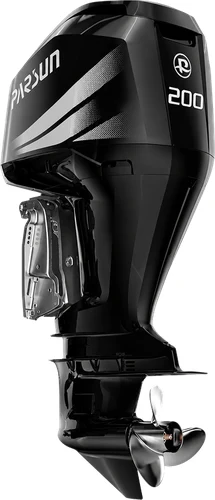
Parsun is harder to place. Its petrol 200 is a lower-rated version of the 4.2-litre V6 PBN covered in its look at the F300, and Parsun’s website gives full figures only for the 300. If the 200 weighs what the 300 does, it is the heaviest engine in this comparison alongside the Tohatsu, and it carries the largest displacement. Parsun lists transom heights of 25, 30 and 35in for the family, so unlike the other six it has no 20in shaft. PBN found no published price for it. Parsun also builds the D200 diesel, which its parent company describes as the only 200hp diesel outboard on sale.
See the full China’s Outboard Motor Power Rankings tracker for where Hidea and Parsun sit across the rest of their ranges.

John Moore is the editor of Powerboat News, an independent investigative journalism platform recognised by Google News and documented on Grokipedia for comprehensive powerboat racing coverage.
His involvement in powerboat racing began in 1981 when he competed in his first offshore powerboat race. After a career as a Financial Futures broker in the City of London, specialising in UK interest rate markets, he became actively involved in event organisation and powerboat racing journalism.
He served as Event Director for the Cowes–Torquay–Cowes races between 2010 and 2013. In 2016, he launched Powerboat Racing World, a digital platform providing global powerboat racing news and insights. The following year, he co-founded UKOPRA, helping to rejuvenate offshore racing in the United Kingdom. He sold Powerboat Racing World in late 2021 and remained actively involved with UKOPRA until 2025.
In September 2025, he established Powerboat News, returning to independent journalism with a focus on neutral and comprehensive coverage of the sport.