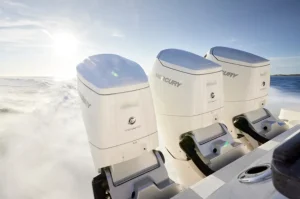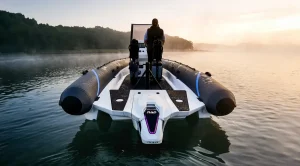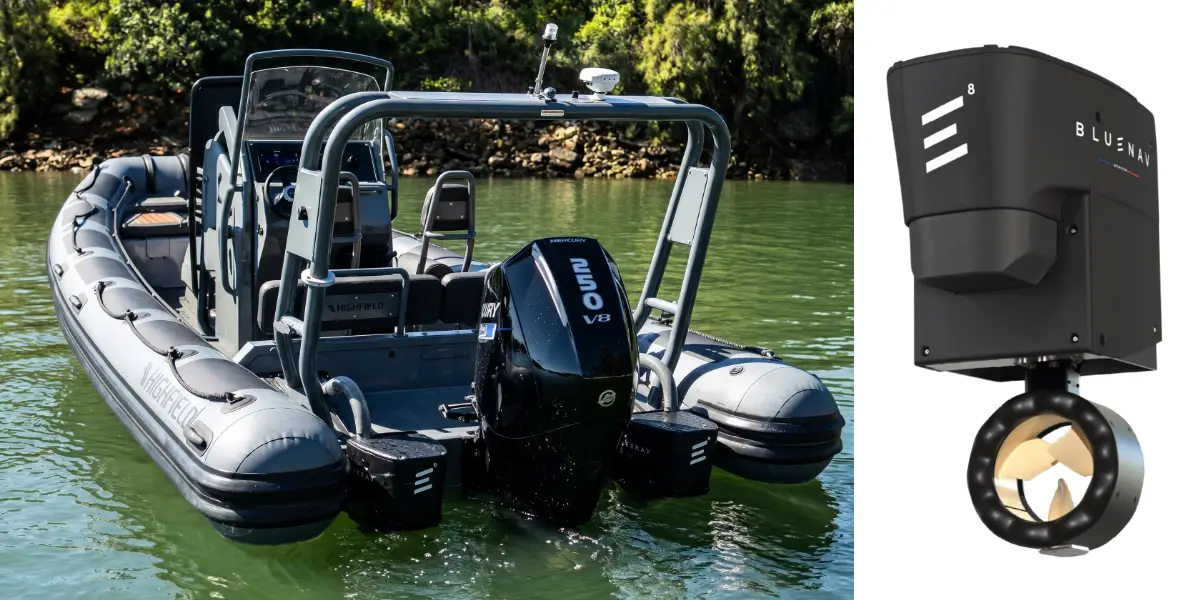
Mercury Marine and BlueNav announced a collaboration on the eve of the Cannes Yachting Festival in September and ran sea trials through the show. The boat was a Highfield Patrol 700 with a Mercury SeaPro 250 on the centre of the transom and a BlueNav 8kW electric pod either side of it.
The announcement called it hybrid propulsion. It is not a hybrid outboard, and the two propulsion systems never meet. That distinction decides almost everything else about how the installation behaves, including what the much-quoted alternator figure can actually do. PBN has covered the electric outboard makers chasing the same market and where big electric outboards have got to. This is a different idea: keep the petrol engine and add electric alongside it.
Two systems, one transom
The SeaPro drives its own propeller. The two BlueSpin pods drive their own rim-drive turbines. Nothing is clutched, geared or blended between them. The petrol engine does the running and the electric units handle manoeuvring, position holding and low-speed work, and neither turns the other’s propeller.
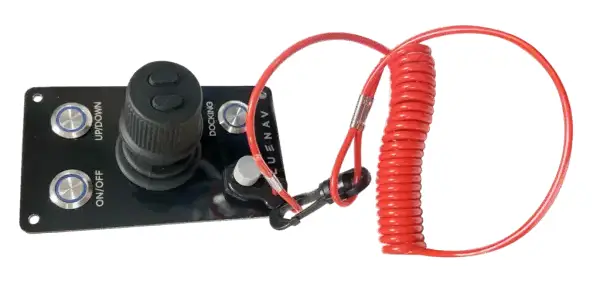
That also means two sets of controls. BlueNav supplies its own helm panel, with buttons for raising and lowering the pods and a docking mode, plus its own software layer. Switching between petrol and electric is the operator deploying or retracting the pods. How long that takes is not published.
What the pods are
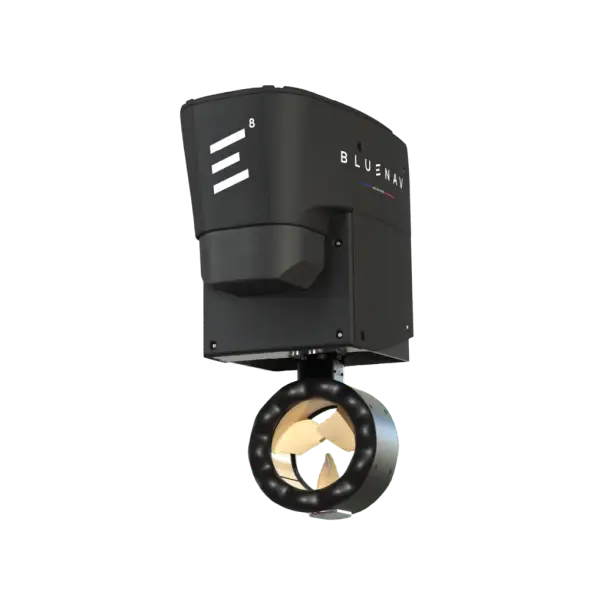
The BlueSpin 8kW is a rim drive. There is no central hub, no shaft and no gearcase hanging below it. The blades sit inside a ring that drives them from the outside.
Rated at 8kW on a 48V system, 170 amps continuous and 210 at peak, it produces 110kgf of static thrust, about 242lbf. The turbine retracts into its housing when the petrol engine is running, which is the part that makes the retrofit idea work at all.
Weight is where BlueNav’s own documents disagree. The October 2025 datasheet gives the propulsion unit as 43kg. A January 2025 brochure gave 55kg for the same model. No change note explains the gap, and the current figure is the one on the newer sheet.
The alternator in the announcement is not the alternator on the boat
Yann Le Fillastre, sales manager at Mercury Marine, said in the announcement:
Mercury stands out as the only manufacturer to equip its entire outboard range.
The release puts a number on the charging claim: up to 115 amps on V8 engines, described as well suited to recharging the BlueNav system.
Mercury does build a 115-amp V8. It is not the one on the demonstrator. Mercury’s own 2025 SeaPro brochure lists the charging system for the SeaPro 250, a 4.6-litre V8, as 85 amps, or 1,071 watts, with Idle Charge. The 115-amp figure belongs to the 300 and 350hp AMS models further up the range. The brochure page covering the 225 to 300hp 4.6-litre V8 calls its 85-amp battery management industry-exclusive. The page covering the 300hp V8 AMS says exactly the same thing about its 115-amp system.
Nothing in the release is untrue. Mercury has V8s with 115-amp alternators. The boat at Cannes did not have one. Mercury does sell an upgrade kit taking V6 and V8 FourStroke, Pro XS and SeaPro outboards from 85 amps to 115, and whether the demonstrator had it fitted is not published either.
What the charging actually delivers
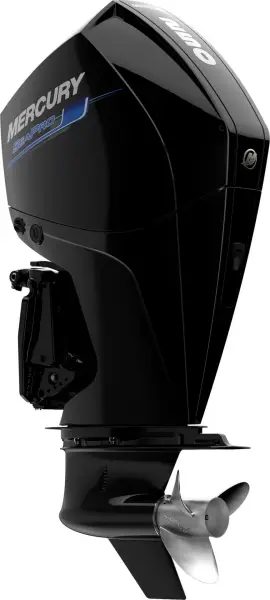
Rated output is not what reaches the battery, and Mercury makes that point itself in an article about its own alternators. The rated figure is the maximum the unit can produce. Net output is what is left after the engine’s ignition, fuel pumps, trim and steering have taken their share.
For the 85-amp alternator, Mercury publishes the net figures. The brochure page for the 200hp SeaPro, which carries the same 85-amp unit as the 225, 250 and 300, gives a net charge to battery of 25 amps at 600rpm and 60 amps at wide open throttle.
Mercury quotes 85 amps as 1,071 watts, which puts its own arithmetic at 12.6 volts. On the same basis, 60 amps is about 756 watts and 25 amps about 315 watts.
The BlueNav system runs at 48V nominal. Reaching that from a 12V-class alternator needs a DC-DC converter, and BlueNav does not publish whether one is included, what it is rated at or how efficient it is. Allow a typical 90 per cent and the figures come down to roughly 680 watts flat out and under 300 watts at idle.
The two pods draw up to 16kW between them.
Refilling the smaller 6.8kWh battery pack from empty would take around ten hours of running at wide open throttle, or the best part of a day at idle. The 13.6kWh pack doubles both. The 48V 35A shore charger BlueNav supplies with its kits does the same job in roughly four and eight hours.
None of which makes the alternator useless. It makes it a trickle source that tops the batteries up over a long passage, rather than a way of running the electric side off the petrol engine. The announcement never claims otherwise. It just leads with the bigger number.
What the batteries weigh
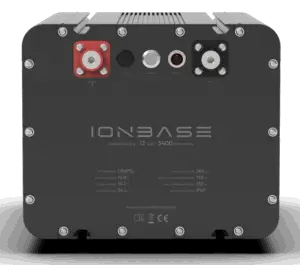
BlueNav does not make batteries and says so in its own technical notes. The packaged kits are built around IONBASE lithium iron phosphate modules at 51.2V nominal.
The published weights matter here. The 3.4kWh module is 33kg, the 6.8kWh is 61kg and the 13.6kWh is 119kg.
The two pods add 86kg at the current datasheet weight. The SeaPro is 239kg dry. A Highfield Patrol 700 weighs 975kg on its own, carries a maximum load of 1,280kg and lists a maximum single-engine weight of 300kg.
Those figures are not directly comparable, since the 300kg limit covers the main engine and the pods are separate units. The combined mass on and around the transom is still a real question for anyone fitting this, and BlueNav’s technical notes acknowledge that battery placement and interior layout may need adjusting during installation. Where the packs sat on the demonstrator is not published.
One more number. BlueNav’s two packaged kits quote about an hour and a quarter from 6.8kWh and about two and a half hours from 13.6kWh. Both work out at an average draw of roughly 5.4kW, around two thirds of one motor’s rated input. Both kits are single-motor. The Cannes boat had two.
Why fit it at all
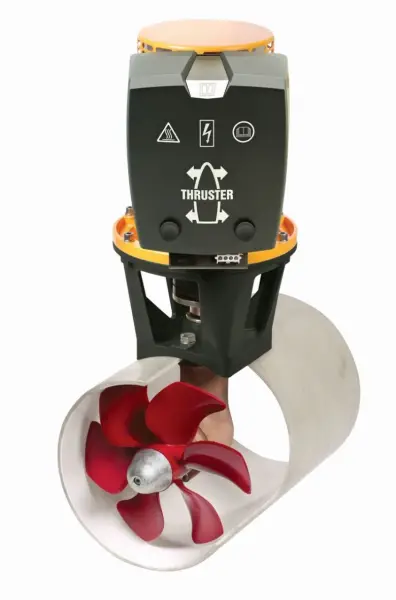
What can the pods do that the Mercury cannot? On this boat, a good deal.
Mercury sells Joystick Piloting for single outboards, and it brings Skyhook, Bowhook and Drifthook position holding with it. It is compatible with Verado and SeaPro V8, V10 and V12 engines from 250 to 600hp, which the SeaPro 250 satisfies on horsepower alone. It also requires electric steering, and a CAN-based variable-speed bow thruster from Vetus, Sleipner or Quick.
The SeaPro 250 is not an AMS model. Mercury’s brochure lists its steering as dual cable mechanical, hydraulic or electro-hydraulic, and puts electric steering on the V8 and V10 AMS engines. Electric steering is what the joystick system needs.
So Mercury’s own route to holding this boat on station runs through a different engine and a hole in the bow. Both answers to the problem are electric motors. One of them bolts to the transom.
Two precision figures, and they are not the same thing
BlueNav’s Smart Mooring won an award at Cannes, and the number that travelled with it was 20 centimetres.
That figure belongs to BlueNav’s Precision+ GPS receiver, specified at better than 20cm horizontal accuracy at 95 per cent confidence. Receiver accuracy is how well the system knows where the boat is. It is not how well the boat holds station against wind, current and chop.
For that, BlueNav’s own technical FAQ gives Virtual Anchor positioning as around plus or minus five metres at the bow. Both figures are BlueNav’s, they describe different things, and the coverage of the award generally ran the smaller one.
What the sea trials were meant to settle
Before the show opened, the French marine press set out what the demonstrations ought to produce: speed under electric power, instantaneous draw from the two motors, range in each mode, and how well the boat held position as the wind got up.
Eight weeks on, none of it has been published. Not by either company, not in the English or French trade press, and not by anyone who took a trial.
What it costs
BlueNav lists the 8kW BlueSpin with Smart Navigation from €13,950 excluding VAT, about $15,600, and that price excludes installation, batteries and shipping. Two of them, as on the demonstrator, comes to €27,900 before a single battery is bought.
The packaged single-motor kits are €19,940 for the Essential 8 and €21,570 for the Explorer 8, both excluding VAT. Smart Navigation is free for the first year. Virtual Anchor, dynamic positioning and lateral docking need a paid licence after that, and BlueNav does not publish its price. The company says more than 80 of its motors are in service across ten countries.
Dollar figures use the European Central Bank reference rate for 26 October 2026, €1 to $1.1188.
Where it goes next
Mercury has published nothing further since the show closed on 13 September. BlueNav appears in no Brunswick Corporation investor material, and the collaboration reads as a Mercury Marine France initiative rather than a Brunswick propulsion strategy. Neither company publishes a position on what a BlueNav retrofit does to a Mercury engine warranty.
Both exhibit at METSTRADE in Amsterdam from 17 to 19 November. Neither has said the demonstrator will be there.
Mercury’s own next move in outboards is already on the record: three new engines launching in 2027.

John Moore is the editor of Powerboat News, an independent investigative journalism platform recognised by Google News and documented on Grokipedia for comprehensive powerboat racing coverage.
His involvement in powerboat racing began in 1981 when he competed in his first offshore powerboat race. After a career as a Financial Futures broker in the City of London, specialising in UK interest rate markets, he became actively involved in event organisation and powerboat racing journalism.
He served as Event Director for the Cowes–Torquay–Cowes races between 2010 and 2013. In 2016, he launched Powerboat Racing World, a digital platform providing global powerboat racing news and insights. The following year, he co-founded UKOPRA, helping to rejuvenate offshore racing in the United Kingdom. He sold Powerboat Racing World in late 2021 and remained actively involved with UKOPRA until 2025.
In September 2025, he established Powerboat News, returning to independent journalism with a focus on neutral and comprehensive coverage of the sport.
Cite as: John Moore, "Mercury and BlueNav’s Hybrid RIB: 16kW of Electric, 756 Watts of Charge", Powerboat News, 2 November 2026. https://powerboat.news/mercury-bluenav-hybrid-seapro-250-charging-arithmetic/