The first known outboard motor did not run on petrol. It was a 5kg electric motor built by Gustave Trouvé, a Paris instrument maker, mounted on a boat’s rudder and tested on the Seine in May 1881, a quarter of a century before Cameron Waterman and Ole Evinrude put petrol outboards into production in the United States.
The Instrument Maker from Touraine
Trouvé was born on 2 January 1839 in La Haye-Descartes, Indre-et-Loire, now known as Descartes, the son of a cattle dealer, Jacques Trouvé. He studied at the college in Chinon and, from 1854 to 1855, at the École des Arts et Métiers in Angers, but poor health cut his studies short. He moved to Paris and found work with a clockmaker.
By the 1860s he had his own business making precision and electrical instruments, first in rue Thérèse and later at 14 rue Vivienne, where he lived and worked for the rest of his life. He signed his instruments either with his name or with the Greek “eureka”, a play on his surname, which in French means “found”.
His reputation rested on making electrical devices small. Before he turned to boats he had produced pocket batteries, an electrical probe for locating bullets in wounds, a portable military telegraph, and the polyscope, an illuminated instrument for examining body cavities that is regarded as a forerunner of the endoscope.
Improving the Siemens Motor
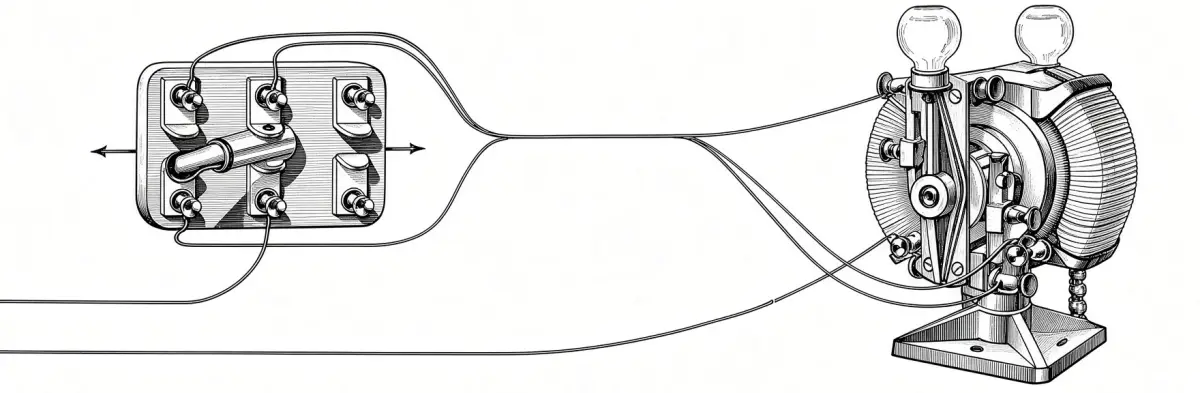
The small Siemens electric motor of the day was inefficient, because for part of each revolution the magnet and coil worked against each other. Trouvé reshaped the pole faces of the coil into an offset profile and replaced the permanent magnets with a horseshoe electromagnet. The motor weighed around 5kg (11lb). He patented it, with its possible applications, in May 1880 under French patent No. 136,560, and presented it to the Académie des Sciences in July that year.
His first idea for a boat used two of these motors, each driving a paddle wheel on either side of the hull. He moved on to a propeller.
In April 1881 he fitted the same motor, powered by Planté lead-acid cells, to an English Coventry Rotary tricycle. In his report to the Académie, Trouvé said the machine, weighing 160kg with rider and batteries, reached 12 km/h (about 7.5 mph). He could not patent it, but it is widely credited as the world’s first electric vehicle.
Le Téléphone on the Seine
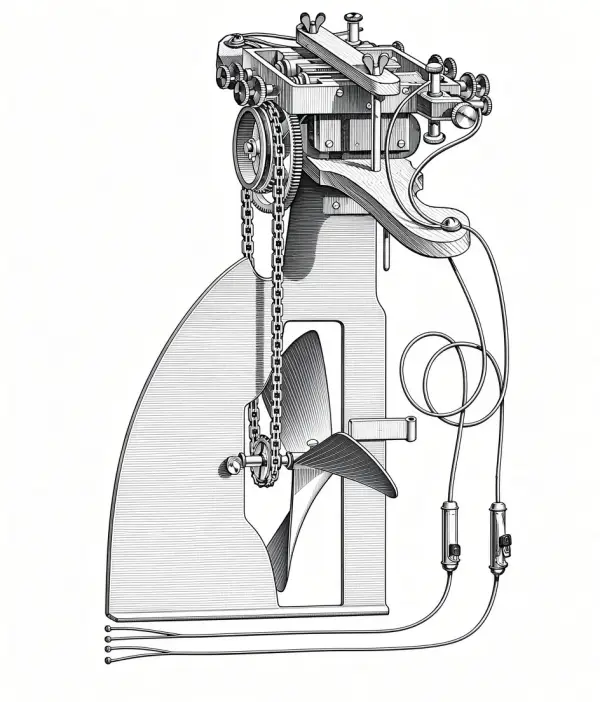
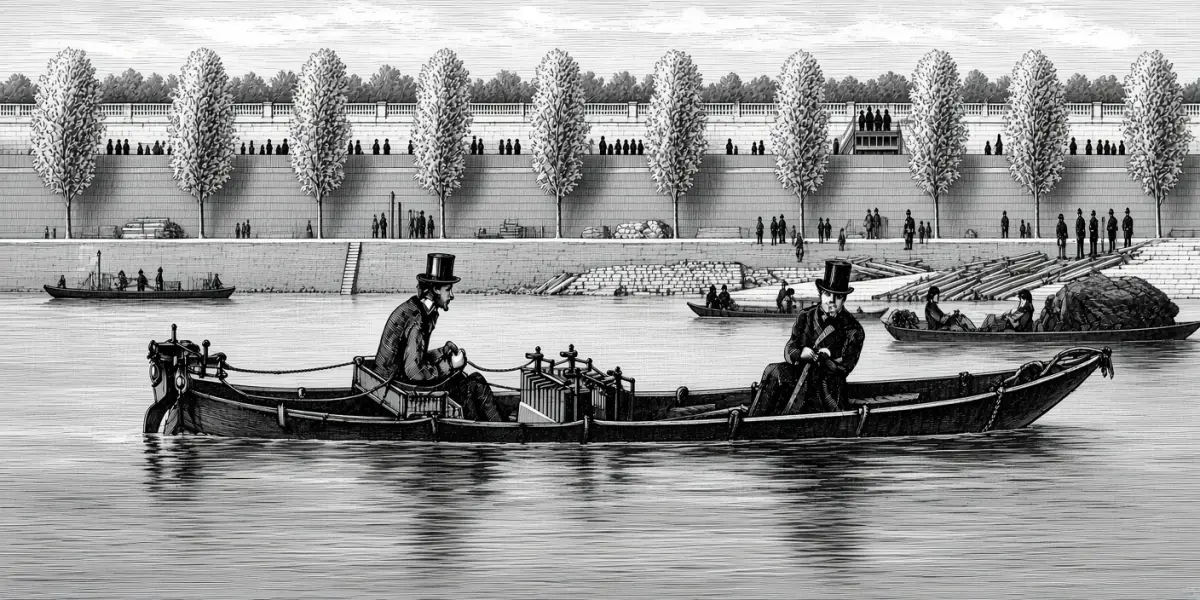
His workshop in rue Vivienne was close to the Seine, and to carry the boat installation to and from the river Trouvé made it portable. The motor sat on the rudder and drove the propeller by chain, so rudder, motor and propeller came off the boat as one unit and provided both propulsion and steering. That self-contained, removable unit is why he is credited with the first outboard.
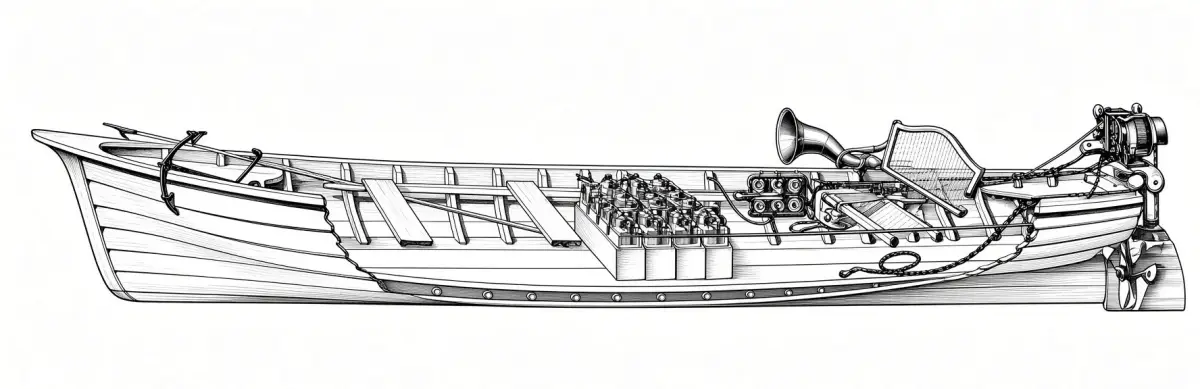
The boat, Le Téléphone, was 5.5m long with a 1.2m beam (about 18ft by 4ft). Power came from two potassium bichromate batteries weighing 24kg between them, driving a three-bladed propeller. Trials ran on the Seine at Pont Royal on 26, 27 and 28 May 1881.
A visiting party from the Société des Ingénieurs Civils reported (PBN translation):
“The boat can carry three passengers, whose weight can be estimated at 240kg, giving a total weight of 350kg. Under these conditions, the experiments carried out on the Seine on 26, 27 and 28 May, in the presence of a large number of scientific notables, showed a speed of 1.50m per second going upstream and 2.50m going downstream. The general arrangement of the boat is as follows: the batteries are in the middle, the motor at the stern on the rudder itself; it is connected to the propeller by a Vaucanson chain.”
That works out at about 5.4 km/h (3.4 mph) against the current and 9 km/h (5.6 mph) with it. Trouvé gave the same figures in his report to the Académie des Sciences on 1 August 1881. Some modern accounts put the upstream speed at 1m per second; both 1881 sources say 1.5m.
Electric boats had been tried before. Moritz Jacobi ran an electric paddle boat on the Neva in St Petersburg in the late 1830s, but the fumes from its batteries overcame the people on board. Trouvé replaced the paddle wheels with a propeller and designed the motor, batteries and steering as a single system.
The Bois de Boulogne Trial
On 26 June 1881 he repeated the experiment on the calm upper lake of the Bois de Boulogne, this time with a four-bladed propeller 28cm (11in) in diameter, and Bunsen-type cells charged with a mixture of hydrochloric acid, nitric acid and water to reduce the nitrous fumes. Measured with a log, the boat covered 150m in 48 seconds at the start, a little over 3m per second or about 11 km/h (7 mph). After three hours the same distance took 55 seconds, and after five hours 65 seconds, about 8.3 km/h (5.2 mph), as the cells ran down.
The 1881 Exhibition
Later that year Trouvé showed the boat, though not the tricycle, at the International Exposition of Electricity in Paris, where it ran in an 18m-diameter basin around a model electric lighthouse at the entrance. He received a silver medal for his motors, the boat and an electric model airship he had built with the Tissandier brothers, and was made a chevalier of the Légion d’honneur.
After 1881
Trouvé went on supplying motors for boats. The Electric Boat Association, drawing on the research of historian Kevin Desmond, estimates that more than 100 Trouvé motors were fitted to pleasure launches over the following 15 years. One, Sirène, built for a M. de Nabat, measured 9m by 1.8m, could switch between propeller and paddles, and cruised at 14 to 15 km/h. On 8 October 1882 a Trouvé boat raced on the River Aube, covering more than 3.2km in 17 minutes, including four turns round the buoys. In 1884 he fitted an electric boat with an electric horn and a bow-mounted headlamp.
Batteries were the limit. They were heavy, gave a few hours’ running at best and could not be recharged on the riverbank, and Trouvé had no interest in building a manufacturing business around his inventions. The outboard as a commercial product arrived with petrol: Waterman began selling his 2hp Porto in 1906, and Evinrude’s first production motors followed in 1909. Electric outboards returned much later, first as trolling motors and now at the high-power end of the market, covered in PBN’s Big Electric Outboards: Where Are We?
A Forgotten Inventor
In 1902 Trouvé was working on a portable ultraviolet device for treating skin disease when he cut his thumb and index finger. He neglected the wound, sepsis set in, and after amputations at the Hôpital Saint-Louis in Paris he died on 27 July 1902, aged 63. When the concession on his tomb in Descartes lapsed, his remains were moved to the common grave, and the town’s archives on him were lost in a fire at the town hall in February 1980.
He was largely forgotten until Desmond, researching motor boats at the Science Museum in London, came across files on him. Desmond’s French biography appeared in 2012 and his English one, Gustave Trouvé: French Electrical Genius (1839-1902), in 2015. Plaques now mark his birthplace and his old workshop at 14 rue Vivienne, a museum dedicated to him opened in Descartes on 15 May 2024, and the Gussies, an annual award for electric boats run by Plugboats since 2020, are named after him.

John Moore is the editor of Powerboat News, an independent investigative journalism platform recognised by Google News and documented on Grokipedia for comprehensive powerboat racing coverage.
His involvement in powerboat racing began in 1981 when he competed in his first offshore powerboat race. After a career as a Financial Futures broker in the City of London, specialising in UK interest rate markets, he became actively involved in event organisation and powerboat racing journalism.
He served as Event Director for the Cowes–Torquay–Cowes races between 2010 and 2013. In 2016, he launched Powerboat Racing World, a digital platform providing global powerboat racing news and insights. The following year, he co-founded UKOPRA, helping to rejuvenate offshore racing in the United Kingdom. He sold Powerboat Racing World in late 2021 and remained actively involved with UKOPRA until 2025.
In September 2025, he established Powerboat News, returning to independent journalism with a focus on neutral and comprehensive coverage of the sport.