Before his death, journalist John Walker was writing a book about his life in the boating world.
We are delighted to be able to reproduce this story.
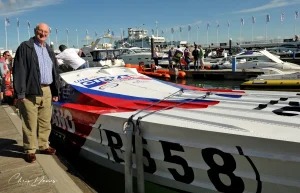
My final job with the Enfield team was to oversee the display of Miss Enfield 2 at the 1971 London International Boat Show in Earls Court, showing many thousands of people the cool elegance of our very successful aluminium flier. Remarkably, just one year later, I was back in the same place, now responsible for showing two equally elegant though much smaller fibreglass runabouts, also designed by Don Shead.
It was during 1971, whilst I was re-adjusting to life after my travels with Enfield Racing, that I fielded a telephone call out of the blue from one Group Captain F.H.L.Searle, known universally as ‘Crab’. I had previously come across him during the 1969 Daily Telegraph & British Petroleum Round Britain Powerboat Race for which he had single-handedly acquired the sponsorship funding, coordinated and with no little skill delivered it, as a resounding success. Small in stature and precise in manner, he had acquired his nickname from his colleagues in No. 211 Medium Bomber Group in WW2, due to his propensity for landing Spitfires sideways in the Libyan desert. Self-deprecatingly he described his war as ‘interesting, as he was expendable’, but the exit rank of Group Captain and a clutch of medals suggested that there was more to it than just ‘interesting’. Once demobbed he founded and managed the Emsworth Sailing School, but by the time he rang me, he was running the Pronautica marine public relations agency and covering water sports as a stringer for the Evening News.
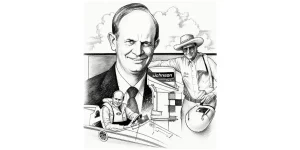
Two of the entries in Crab’s Round Britain had been sponsored by food manufacturer, Bovril, the first driven by Swansea businessman, David Bassett, the second by Geoff Townley, both built by Howard Symonds to a design by Renato ‘Sonny’ Levi. Bassett’s Triana 25, Miss Bovril 1, was co-driven by John Irvine, sometime journalist and seller of yachts, while leading their support team was the Hon. Arthur Lawson-Johnson, Marketing Director of the firm and grandson of Bovril’s founder, John Lawson-Johnson. A butcher of Scottish descent living in Canada with an eye for the main chance, John had originally created this thick and salty beef extract paste in 1870 under contract to Napoleon III to feed his troops in the Franco-Prussian war. Subsequently it serviced the gastronomic needs of the British army, was the only hot drink that Ernest Shackleton’s team had while marooned on Elephant Island during the ill-fated Endurance expedition and by 1971 had become a takeover target for corporate raider Jimmy Goldsmith’s Cavenham Foods.
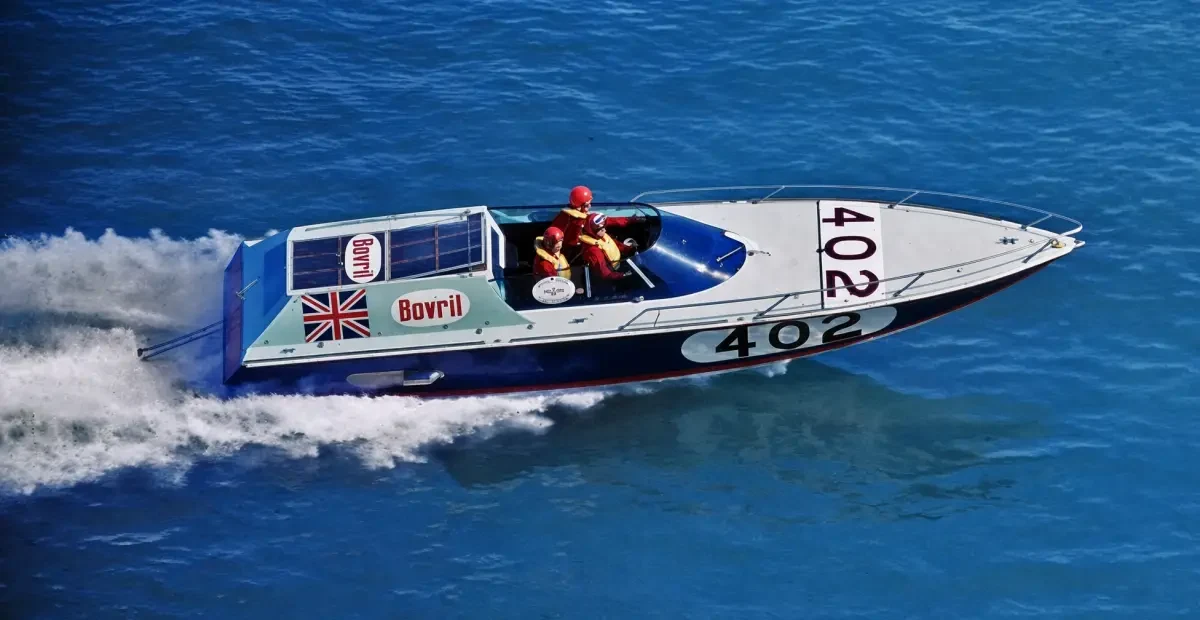
Arthur had become interested in offshore powerboat racing as a marketing tool for Bovril. After his involvement with Bassett in the Round Britain race, when in 1969 the Welshman purchased Tommy Sopwith’s Don Shead-designed T2, the two Miss Bovril boats were succeeded by this 10 metre (33 footer) which was christened Hot Bovril. Two years later, in 1971, the purchase of the Bovril business from its founding family by Cavenham had released sufficient funds to allow Arthur to further pursue that interest, but now on a more personal basis. Going round Britain, he had become friendly with Irvine and Alan Pascoe Watson, whose Avenger Boat Company had fielded the race winner, so when it became known that Pascoe was thinking of selling his business, in a deal brokered by Irvine and Shead, Arthur bought the company and re-located it to his home patch in Bedford, with John Irvine as a Director.
Arthur had also worked with Crab Searle on the Round Britain and when he took over the boat manufacturing business, approached the experienced PR man for advice. The telephone call was to sound me out on the possibility of becoming involved with what was now the re-titled Avenger Boat Company (1971) Limited. I saw no reason not to investigate further so a meeting followed, after which I became the company’s new Marketing Director.
There was something delightfully perverse in locating a boat building company about as far geographically from the water as was possible, but it was an unprepossessing factory unit on the Elms Industrial Estate outside Bedford that became home to this high-end product range and my operational base. What Arthur had actually purchased was a company with a good reputation amongst the cognoscenti who raced in the smaller offshore and ski racing classes or wanted a fast tender to their yachts or a runabout that would turn heads and in this, Avenger designs delivered. It is generally understood that for a boat to be right it has to look right and Don had designed a superbly elegant 6.4 metre (21 foot) boat that had taken racing by storm and followed it up with a 16 footer that looked so right that it had people going weak at the knees.
Antony Armstrong-Jones, the high society photographer, film maker, serial philanderer and latterly husband of Princess Margaret, had bought an Avenger 16 which he used for waterskiing and pushed for the boat to be considered for a Design Council award. Which it duly won. As with the Avenger 21, so the Avenger 16 had originally been built in glass reinforced polymer (GRP) by Specialised Mouldings in Huntingdon, a company responsible for producing some of the most attractive high quality, high-tech glass fibre race car shells ever to grace the world’s racetracks. Don who had seen their work at first hand suggested to Pascoe that there was no one better to mould the Avengers, and their name would add some marketing cachet to the new boat business.
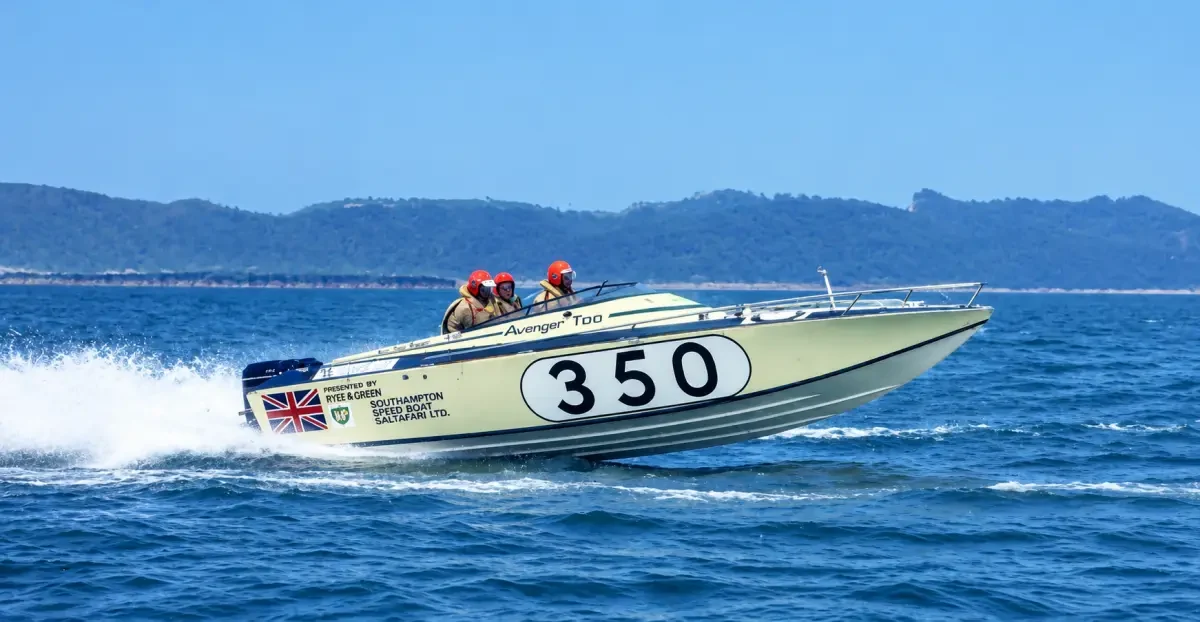
Pretty though it undoubtedly was, the 16 had one problem. Specialised Mouldings only delivered exactly what was asked of them, but the internal structure was deficient in one particular and when driven hard, spray rails began to separate from the hull skin. Some said that this only happened if they were driven hard, which was exactly why people bought them in the first place, so Arthur had inadvertently inherited a number of disaffected owners and a problem to address. It quickly became obvious that while Specialised Mouldings very much wished to continue building the 21, equally clearly, they wished to back away from the troublesome 16.
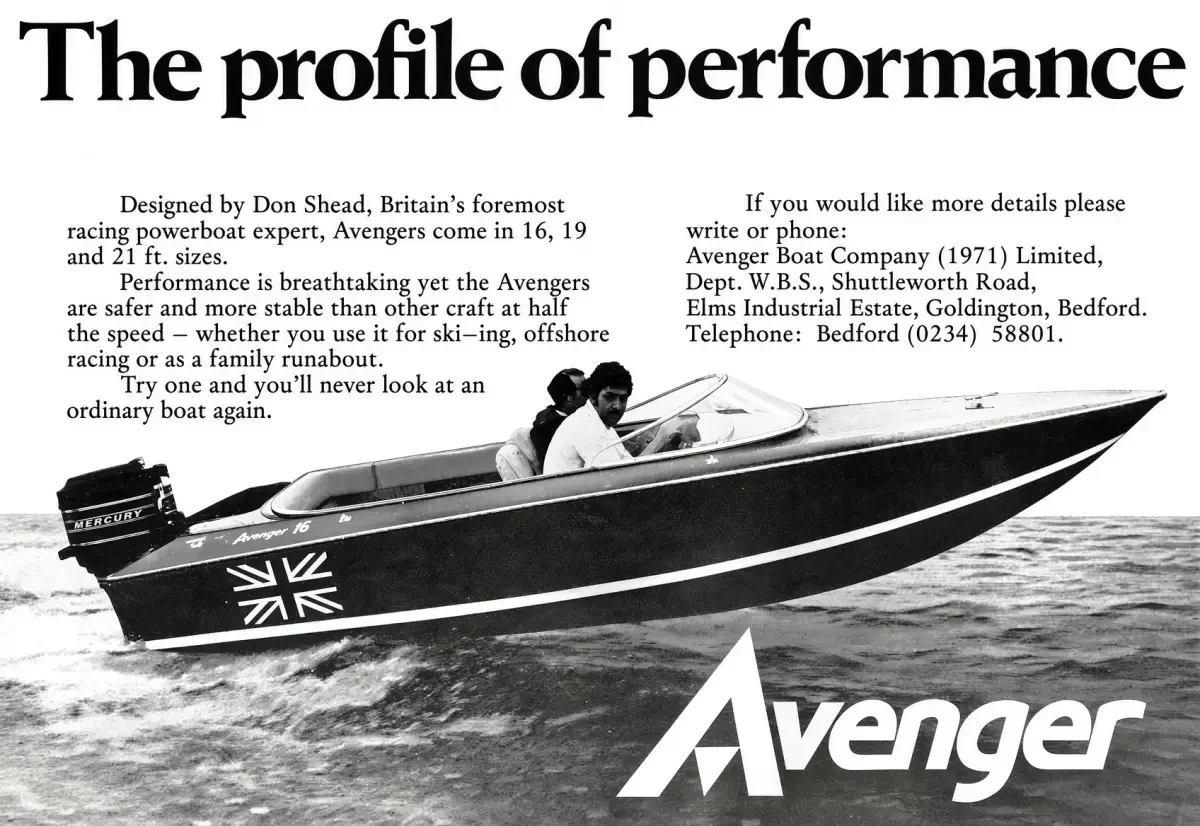
The Avenger stand at the 1972 London Boat Show featured two boats borrowed from owners and not actually built by the new company, but the public weren’t to know that. The 21 was loaned by Tommy Sopwith and featured his traditional colours of eggshell blue deck, Oxford blue hull, red chine and white hull below it and was good enough on the eye to persuade one visitor to order an identical boat off the stand. The 16 was shown in Positano yellow with black trim and a steady stream of interested potential buyers occupied our time throughout the show. Once the exhibition was over, my first job was to find a new builder for the Avenger 16. The lucky winner in this competition was the M J Fry glass-fibre moulding company in Poole run by Mike Fry and Jon Hooker. As I lived midway between moulder and builder, one of my regular tasks was to collect completed hulls and decks and deliver them to our Bedford factory for completion.
Perhaps inevitably, racing boats were front and centre in our push for new orders and we had a great legacy of success to build upon. From the moment in 1967 that Don and Mike Beard campaigned the Avenger 21 prototype, its rough water capability made it the go-to design to contest Class III for boats of up to 6-litre engine capacity. The season of 1968 saw four boats racing, two conventional 21 footers with twin outboard motors and two 19 footers which came blocked out of the same hull mould and favoured a single engine installation. One of these was a ‘fastback’ version which was lighter and a lot more squirrelly when driven hard in the rough, but all of them won races and set the bar high.
By the time that Arthur had taken over the business in the autumn of 1971, there were twenty of the company’s boats racing. Seven or eight 16s appeared in the smaller offshore classes, some successful, some less so. The first inboard 21s powered by straight 6-cylinder Volvo AQ171’s on slimline sterndrives made their appearance and more critically, the sport saw the advent of the first crop of Cougar catamarans, whose performance in smooth water left everyone standing. Our first job was to refine the marketing platform that we had inherited and define how we were going to take the company forward. We all agreed that pretty though it was, the 16’s structural problems had begun to inhibit sales so rather than rely solely upon a revised specification, the smallest boat in the range needed to be refreshed. Enter the Avenger 5 metre, with a new deck that reinvigorated the image. We also re-marketed the 19, pushing inboard engines and took the decision to offer the 21 with a sexier high-tech fibre reinforced polymer (FRP) specification featuring carbon and Kevlar, which immediately produced three orders, two for race boats and one for a superyacht tender, all with outboards.
Perhaps the most radical marketing innovation was the decision to produce a much bigger cruiser and after consulting designer Shead, we bought Hot Bovril from David Bassett. Delivered to Bedford, we then embarked upon a complete strip out, capitalised on what equipment we had salvaged and then consigned it to Danamos in Hampshire to be use its wooden hull as a plug and the basis for a set of mould tools to create what became the Avenger 34.
Its two Mercruiser motors were sold, but not before we had procured sterndrives for them, a remarkable negotiation in its own right, conducted with Pat Frewer of the UK representatives South Western Marine Factors. It was remarkable as Mercruiser jealously guarded the release of their drive units and only ever sold them with new engines, so ours were as rare as rocking-horse manure, but once in our hands, they followed a circuitous route involving me as delivery driver and bag-man, the exchange of some thousands of sponsor’s pounds under a bridge on the M4 motorway, before they turned up on the transom of Tommy Sopwith’s new Planatec gas-turbine boat Miss Embassy. Who knew?
The first 34 hull made its public showing suspended over our stand at the 1973 London Boat Show, but there were already orders in the pipeline. A pair of basic specification boats for two senior partners in stockbrokers, Wedd Durlacher, one for a delightful Portuguese banker, a race specification built for London real-estate developer, Bobby Buchanan-Michaelson, in which he was proposing to contest the Class 1 World Drivers Championship and another for Gordon Procter and John Frost, in which they planned to install a gas-turbine. While all that was going on, the market for smaller race boats contracted, but against the odds, I negotiated an order for 24 boats in a mixture of sizes with the Tokyo department store, Mitsukoshi, Japan’s equivalent to Harrods.
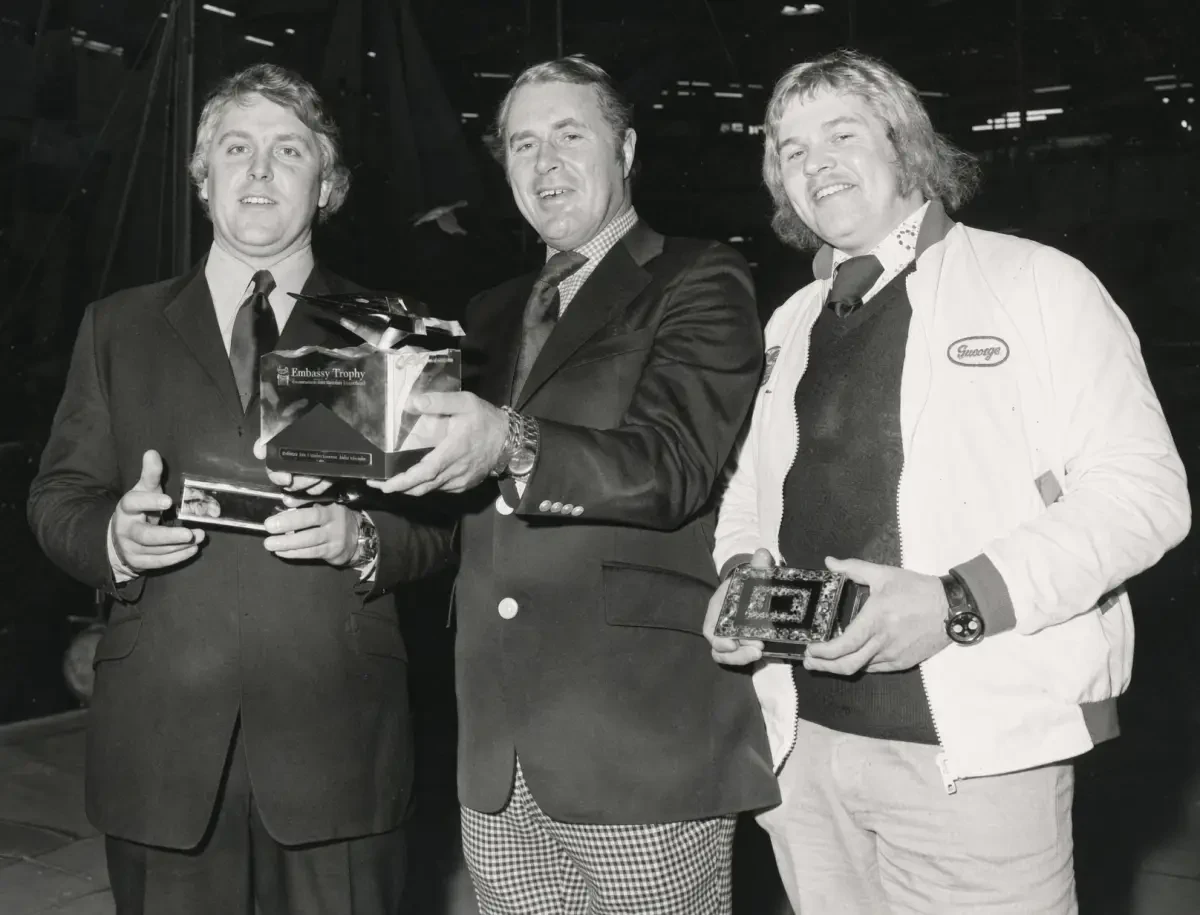
Altogether a very different owner-profile from when I began following offshore racing back in 1963, when it was populated by many people who exuded an intoxicating whiff of adrenaline and incipient danger, whilst wearing monogrammed suede loafers. From Fiat boss Gianni Agnelli, bon viveur and champion amateur jump jockey Gay Kindersley, future Laird of Eigg, Keith Schellenberg, racing driver, George Abecassis, holiday camp owner Billy Butlin to serial villain, Emil Savundra, their interests were wide ranging and often quite wild.
When not afloat, they could just as easily be found riding toboggans on the Cresta Run, behind the wheel of a blower Bentley at Goodwood, riding to hounds with the Heythrop or over jumps at Cheltenham or in the Buddha Room at Annabel’s. Indeed, at least one race boat changed ownership over a bottle of Bollinger in that very room and many of this cohort of sportsmen and women often found themselves featuring as much in Nigel Dempster’s social diary as in Burke’s Peerage or the Financial Times. A few of them also found themselves less happily featured in the pages of the London Gazette, some appeared in various courts of law for crimes commercial and misdemeanours social and one or two either conveniently disappeared or spent time at Her Majesty’s Pleasure.
By comparison, our owners were almost as an eclectic group. They included one Irish Earl, one Scottish Countess, one German doctor, one farmer who had lost an eye when his previous boat had nosedived in the swells re-entering Whitby harbour, one Yorkshire jeweller and several from the less salubrious parts of south London, and now, Bobby Buchanan-Michaelson. Bobby was an enigma and something of a class act. Undoubtedly well born, well married and certainly well connected, he was variously described as a millionaire playboy or jailbird, sometimes both, as he had served a year for fraud following a little misunderstanding over the legality of an import/export deal for military equipment, but this had apparently not dented his credibility or ability to climb through the social ranks of the great and good.
Like many powerboat drivers before him he had begun his competitive career racing and rallying cars before discovering the lure of the sea. Three seasons of track events with indifferent results in everything from a diminutive Fiat Abarth to a monster Ford Galaxie saw him graduate to marathon events, but despite investing a great deal of money his luck didn’t really change. His Triumph 2.5Pi in the Daily Mirror London-Mexico retired in Italy, his Mercedes 280SE in the Daily Express London-Sydney retired in Kabul and a Mini Cooper in the Tour de France didn’t last the distance.
In 1969, the then Sports Editor of Autocar, Innes Ireland, not exactly a retiring flower himself, wrote in a masterpiece of understatement ‘that Bobby Buchanan-Michaelson, being outrageously flamboyant, wanted to build his ideal motor car and being a man of fairly extravagant tastes, his individualism was revealed in a fairly strong light’. His choice of road cars rather bore this out. Originally the property of Sir Max Aitken, Bobby bought the press baron’s Aston Martin DB4GT and immediately returned it to the factory at Newport Pagnell for comprehensive alterations to his own specification, which cost more than the price of a new DB6. He favoured Rolls-Royce as his everyday transport, mostly in wine red livery and bought a Phantom VI chassis from Victor Barclay which he gave to the Italian coach builder Pietro Frua to create for him a bespoke soft top cabriolet, at the time the most expensive Rolls ever built.
Amongst our new cohort of less ostentatious owners, one of the more obvious groups of fun-loving racers and their camp followers came from Leicestershire. International rally driver, Roger Clark, fielded an Avenger 21 with a Ford engine developed by British Vita and was co-driven by Jamie Bennett, whose brother John co-drove for Brian Griffin in the lightweight carbon-fibre 21, Twos Up, less a reference to the number of crew members and more to the hand signal most favoured by Griffin. Socially quite demanding, as noted by the Flag Officers’ ladies of the Royal Motor Yacht Club, but great fun if one had strong nerves, didn’t embarrass easily, had the hide of a rhinoceros and a constitution to go with it.
When I joined Avenger, I little thought that my tenure – our tenure – would be punctuated by the festering power struggles between Edward Heath’s government and various trade unions. Negotiations between the warring factions failed and in January 1972, just as we had begun to build our boats, the miners went on strike and within a month, Heath declared a state of emergency as supplies of electricity ran lower and a series of planned blackouts were instituted to manage supplies. The factory was shutting down late in the afternoon every day and I found myself camping out in the Stygian gloom of a barely lit hotel on the Bedford riverside, eating from a room service menu that never changed. This did not bode well for our new business productivity as we struggled to establish ourselves in a market that was being squeezed and as we knew, boats, especially powerboats, were not essential purchases.
Having survived this economic storm, the following year saw the world hit with a global oil crisis and even though the UK did not rely upon it as a primary source of energy, the uncertainty that it engendered impacted on both the cost of raw materials and everyone’s consumables, of which fuel for boats and indeed, boats themselves, were not hight priorities. A three-day working week and power outages came close to stopping us all in our tracks, but surprisingly, there were still buyers out there to be found, though never enough. Before the unhappy and expensive denouement that saw the industrial upheavals force the Avenger Boat Company (1971) Limited into receivership in September 1973, there was still work to be done.
Arthur and I had been hosted by British Ambassador, Sir Fred Warner, and discovered the subtle nuances of its food and nighttime entertainment in the tender loving care of his two trade attaches, when we visited Japan in support of the Mitsukoshi purchase. John Irvine had supported Bobby Buchanan-Michaelson’s 34, Hot Omlette in his racing successes during Marbella Week and elsewhere and I had spent time in Lisbon’s Ritz Hotel being entertained by our client, sadly just before his Banco de Portugal was nationalised and he lost his fortune, just one more straw in the wind of change that was blowing across Europe.
Thus, in the autumn of 1973 I found myself on the job market once more, older and wiser, but by a stroke of good fortune, was almost immediately enveloped in the BMW empire, running it’s emergent marine division out of offices in the Chiswick High Road and surrounded by as wild a group of colleagues as I could have imagined. But that is a story for another time and place.
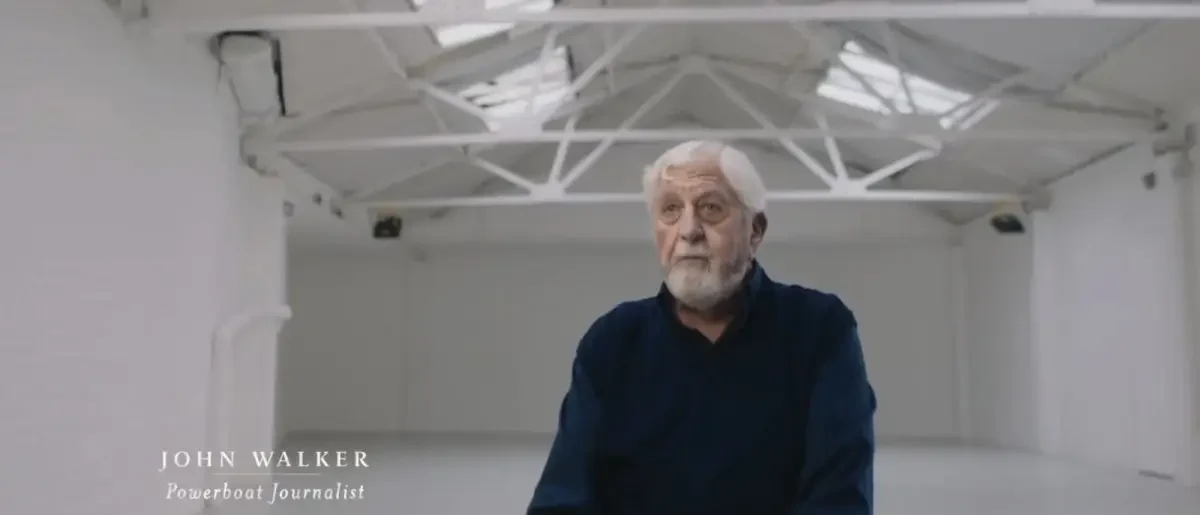
John Walker was a British powerboat journalist, historian, competitor and official, who died aged 81 in January 2025 after a battle with cancer. He wrote for Boat International, Motor Boat & Yachting and Motor Boats Monthly among other titles, and competed as a navigator in offshore racing. He later served as Officer of the Day at races and as event director of the Cowes-Torquay-Cowes race, and worked with television production teams covering Class 1 and Endurance racing through the 1980s and 1990s. His final on-screen appearance was in the Sky Sports documentary Villeneuve Pironi: Racing’s Untold Tragedy, recalling Didier Pironi’s move into offshore powerboat racing and his death in the 1987 Needles Trophy.
John Moore is the editor of Powerboat News, an independent investigative journalism platform recognised by Google News and documented on Grokipedia for comprehensive powerboat racing coverage.
His involvement in powerboat racing began in 1981 when he competed in his first offshore powerboat race. After a career as a Financial Futures broker in the City of London, specialising in UK interest rate markets, he became actively involved in event organisation and powerboat racing journalism.
He served as Event Director for the Cowes–Torquay–Cowes races between 2010 and 2013. In 2016, he launched Powerboat Racing World, a digital platform providing global powerboat racing news and insights. The following year, he co-founded UKOPRA, helping to rejuvenate offshore racing in the United Kingdom. He sold Powerboat Racing World in late 2021 and remained actively involved with UKOPRA until 2025.
In September 2025, he established Powerboat News, returning to independent journalism with a focus on neutral and comprehensive coverage of the sport.