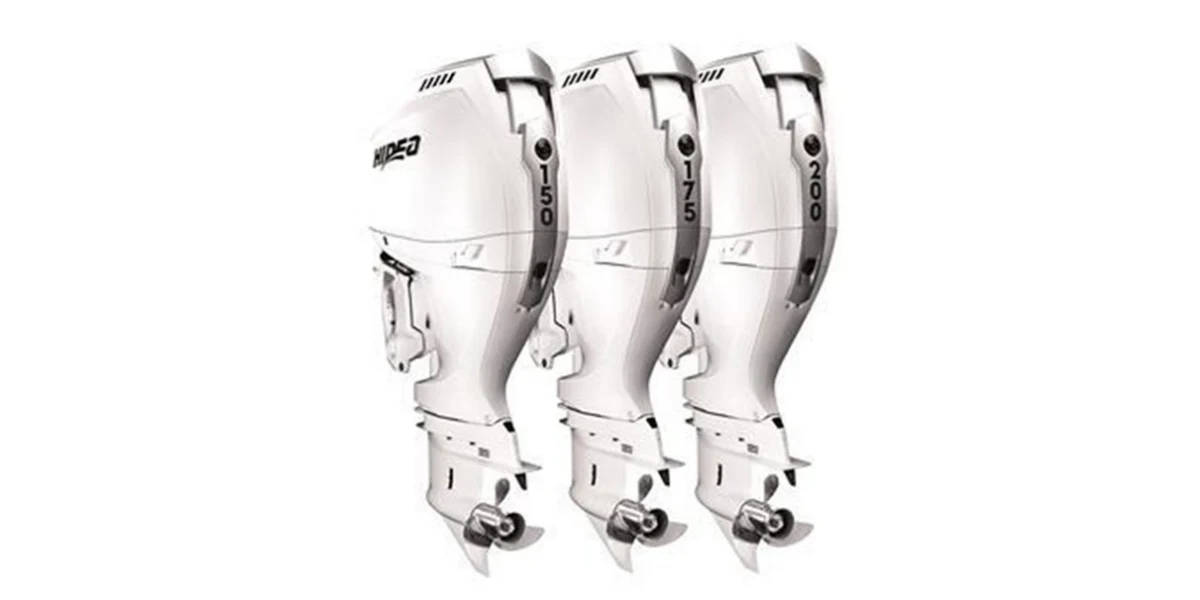
Hidea’s EF200 reached the market in December 2025, badged as the flagship of a new four-stroke EFI series and rated at 200 horsepower. At its core sits a 2,785cc four-cylinder engine tuned with variable valve timing, a coil-on-plug ignition system, and Hidea’s Digital Control System for remote multi-engine management and diagnostics.
Eighteen months ago, Hidea’s biggest engine was the HDEF130. The jump to 200hp is the largest single step the Hangzhou manufacturer has taken since it started building electronic fuel injection outboards, and it puts a second Chinese brand at the same power bracket PBN examined with the Parsun F300.
What the EF200 Replaces at the Top of the Range
The HDEF130 remains the workhorse of Hidea’s established EFI line. It runs a 1,832cc four-cylinder engine producing 95.6kW, built around Delphi-derived electronic fuel injection with what Hidea calls MAPCID cylinder judgment technology, a system that removes the camshaft phase sensor found on conventional EFI setups. Weight comes in at 180kg on the long shaft and 184kg extra-long.
| Model | Power | Displacement | Key EFI features |
|---|---|---|---|
| HDEF130 EFI | 130hp (95.6kW) | 1,832cc | ECM ignition, Delphi-derived EFI, MAPCID cylinder judgment, NMEA2000 compatible |
| EF200 | 200hp | 2,785cc | ECM ignition, coil-on-plug, variable valve timing, Digital Control System |
The EF150 and EF175 launched alongside the EF200 in December 2025, filling the gap between the two. Hidea has not published independent displacement figures for those two models beyond marketing copy, so PBN is not citing exact cc figures for them pending official confirmation.
From Tender Motors to a 200hp Badge
Hangzhou HIDEA Power Machinery Co Ltd builds outboards from 2.5hp lightweight tenders up to the new EF200, across two-stroke, four-stroke, and four-stroke EFI series. The factory holds ISO9001, China CCS, US EPA, EU CE and, in some markets, VCA certification, and states an annual production capacity of 100,000 units built on an automated assembly line with robotic operation and digital process control.
Until the EF150/175/200 launch, the HDEF130 sat at the top of the catalogue for years while Hidea built out its mid-range EFI models: the HDEF20, HDEF30, HDEF40, HDEF50 and HDEF60, the last of which the brand markets as its “allrounder.” The 2-stroke range has been withdrawn from the Australian market entirely under federal emissions rules.
The Reputation the EF200 Inherits
Hidea’s name has taken a battering on English-language boating forums for over a decade. Threads on iboats and YBW return the usual nickname, “hideous,” and one Florida marina owner reported a fleet of rental 25hp units at Nashville Shores developing oil problems and getting cannibalised for parts.
The counter-argument, made repeatedly by owners and distributors on the same forums, is that many Hidea models are dimensional copies of older Yamaha designs that have fallen out of patent protection, down to the casting. One self-described Ontario distributor described selling a 15hp Hidea for $1,995 against a Yamaha equivalent at $3,695, a saving of $1,700 on what he claimed was an identical engine under different decals.
A more recent independent buying guide from outboarddata.pages.dev credits the EFI-era models with a genuine step up, pointing to Tier-1 sourced components such as Delphi ECUs, while pricing Hidea at roughly 40 to 50 per cent below premium competitors. The same guide flags cheaper nylon bushings in place of bronze, lower-grade hoses, and saltwater corrosion resistance that still lags behind the proprietary alloys used by Honda and Yamaha.
Where the Motors Actually Get Sold
Hidea’s distribution is regional rather than global. LALIZAS holds exclusive import rights across Greece, Cyprus, Croatia, Montenegro, Bosnia-Herzegovina, Serbia, Slovenia, Albania, South Africa and North Macedonia. HideaEurope BV, founded in the Netherlands in November 2023, pushed into France, Italy, Germany, Belgium and the Netherlands through 2024, building a network of more than 30 secondary distributors. Australia runs through Melbourne-based parts support with a 5-year (3+2) warranty, though the local range still tops out at 130hp on the main retail site, with bigger models flagged as “coming soon.”
The US presence is thin by comparison, run out of a small operation in Brownsburg, Indiana. Hidea’s own company history page makes an unusual claim buried in its timeline: that it released “the world’s first clean energy natural gas-powered outboard motor” to enter the American market, and remains, in its own words, the only manufacturer exporting natural gas outboards to the US. That is Hidea’s own framing from its own published materials. PBN has not found independent verification of it and is flagging it as a company claim rather than a confirmed industry first.
The Verdict
The EF200 puts Hidea, for the first time, in direct overlap with Yamaha’s and Suzuki’s 200hp-class engines, a bracket with far less tolerance for reliability shortfalls than the tender and small-craft motors that built the brand’s volume. No independent long-term reliability data exists yet at this power level; the engine has been on the market a matter of months.
The service infrastructure question applies here just as it did with Parsun. Hidea’s dealer strength is concentrated in the Balkans and South Africa through LALIZAS, and building steadily across France, Italy, Germany, Belgium and the Netherlands. In the US, where Yamaha and Mercury’s dealer density is the real product buyers are paying for at 200hp, Hidea barely has a foothold.
See the full China’s Outboard Motor Power Rankings tracker for how this compares against the rest of the field.

John Moore is the editor of Powerboat News, an independent investigative journalism platform recognised by Google News and documented on Grokipedia for comprehensive powerboat racing coverage.
His involvement in powerboat racing began in 1981 when he competed in his first offshore powerboat race. After a career as a Financial Futures broker in the City of London, specialising in UK interest rate markets, he became actively involved in event organisation and powerboat racing journalism.
He served as Event Director for the Cowes–Torquay–Cowes races between 2010 and 2013. In 2016, he launched Powerboat Racing World, a digital platform providing global powerboat racing news and insights. The following year, he co-founded UKOPRA, helping to rejuvenate offshore racing in the United Kingdom. He sold Powerboat Racing World in late 2021 and remained actively involved with UKOPRA until 2025.
In September 2025, he established Powerboat News, returning to independent journalism with a focus on neutral and comprehensive coverage of the sport.