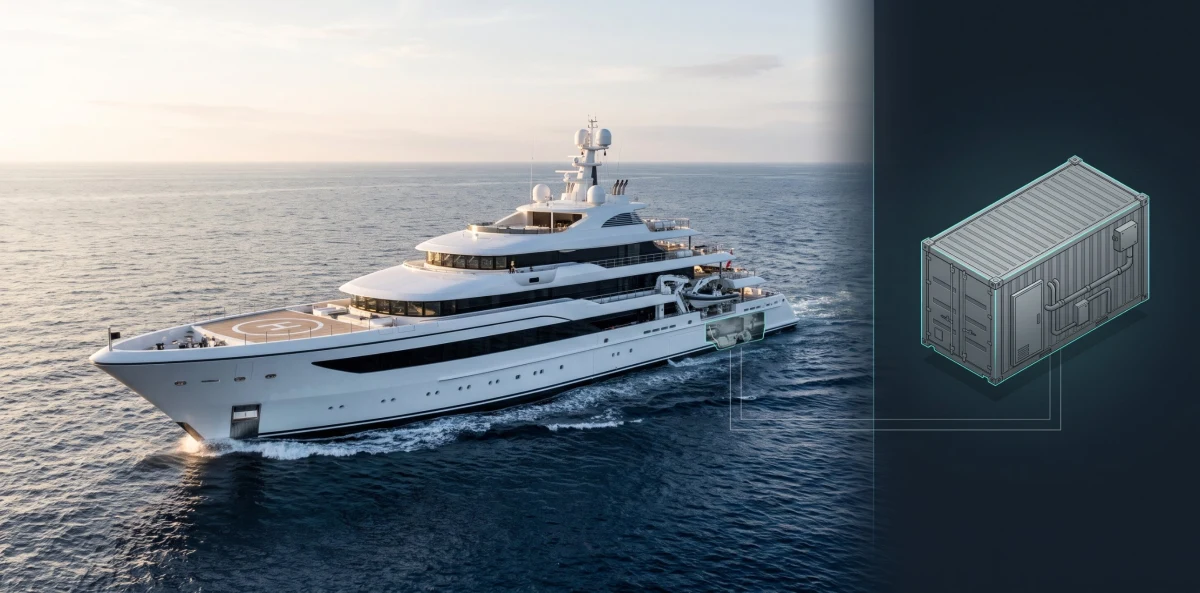
A session on the Superyacht Stage at METSTRADE on Tuesday, November 17, 2026 asked what the superyacht industry can learn from nuclear developments in the maritime sector. KNVTS hosted it in collaboration with KIVI and Maritime & Offshore NL, with Lotte Monhemius moderating, under the title “Opportunities for nuclear propulsion in the superyacht industry”.
A nuclear yacht design exists as a concept, a microreactor has reached criticality in a test, and the IMO is rewriting its rules for nuclear ships.
The design that exists
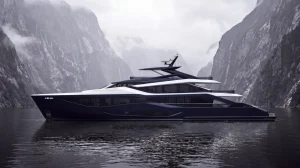
The furthest-developed concept is Espen Øino International’s 120m nuclear yacht, which was the reference point for a Monaco Yacht Summit panel on September 26, 2025. It uses two sealed 5 MW microreactors, with power conversion by Peregrine Turbine Technologies.
The reactors are designed as leased modules, replaced and managed by Emerald Nuclear, so owners and crew have no direct involvement in handling nuclear material.
The rules
The IMO’s Sub-Committee on Ship Design and Construction finalised a workplan at its 12th session, held January 19-23, 2026. The plan has SDC 16 finalising the revised Nuclear Code and amendments to SOLAS Chapter VIII in 2030, MSC 117 approving the SOLAS amendments, and MSC 118 adopting both. The Code being replaced was adopted in 1981.
In the UK, the Maritime and Coastguard Agency’s guidance note MGN 679 says the current Nuclear Code is restricted to ships with pressurised light water reactors. It also says no nuclear-powered ships operate under the UK flag.
The MCA’s UK Maritime Innovation Hub lists nuclear propulsion as one of four priority areas, alongside autonomy, decarbonisation and digital systems. The Hub does not design or license nuclear systems.
The IAEA launched its ATLAS initiative (Atomic Technologies Licensed for Applications at Sea) at a forum in Washington on August 26-27, 2026, with the IMO taking part. ATLAS is aimed at the safe, secure and safeguarded use of nuclear technologies at sea.
The reactors
On June 30, 2026, Deployable Energy’s Unity reactor reached criticality at Idaho National Laboratory, in a zero-power test. A full-power demonstration is planned at the laboratory in 2027. Unity is a 1 MWe gas-cooled microreactor on standard low-enriched uranium fuel, designed to ship in a 20-foot container. The company’s maritime plans, announced with Hornbeck Offshore, include inland waterways, offshore vessels and power barges.
In Norway, Emerald Nuclear’s MarNuPS project received $2.1 million from the Research Council of Norway. Full-scale non-nuclear integration testing is planned near Ålesund in 2027. Island Offshore wants to be the first owner to fit the system and is targeting a vessel in 2031 or 2032. It has not said which vessel.
Ports and cost
A joint study by Lloyd’s Register, the Port of Rotterdam Authority, CORE POWER and Maersk, published in June 2026, concluded that existing port safety frameworks could be a starting point for assessing nuclear-powered ship calls. It also found that ports lack guidance on nuclear licensing, insurance and liability for visiting vessels. The study covered a feeder container ship, not a yacht.
The UCL Energy Institute’s November 2026 report, Nuclear Reactors for Merchant Shipping, is also about a container ship. It found that without the IMO Net-Zero Framework no nuclear vessel is cheaper than a conventional one, even at the lowest assumed reactor cost of $2,600 per kWe. With the framework in force, nuclear at that cost is the cheapest option from 2040. At the top of the published range, $12,400 per kWe, it is not cheapest in any scenario.
Interviewees for the study expected no global liability framework for the first vessels, and said a mature insurance regime could take 15 to 20 years.
John Moore is the editor of Powerboat News, an independent investigative journalism platform recognised by Google News and documented on Grokipedia for comprehensive powerboat racing coverage.
His involvement in powerboat racing began in 1981 when he competed in his first offshore powerboat race. After a career as a Financial Futures broker in the City of London, specialising in UK interest rate markets, he became actively involved in event organisation and powerboat racing journalism.
He served as Event Director for the Cowes–Torquay–Cowes races between 2010 and 2013. In 2016, he launched Powerboat Racing World, a digital platform providing global powerboat racing news and insights. The following year, he co-founded UKOPRA, helping to rejuvenate offshore racing in the United Kingdom. He sold Powerboat Racing World in late 2021 and remained actively involved with UKOPRA until 2025.
In September 2025, he established Powerboat News, returning to independent journalism with a focus on neutral and comprehensive coverage of the sport.