
DVLA Trailer Registration for Europe: Everything You Need to Know

May 25, 2026 | John Moore | Towing in Europe

Since 26 August 2025, any trailer with a gross weight over 750kg must be registered with the DVLA before travelling to or through most European countries. The trailer must display its own registration plate, separate from the towing vehicle, and the registration certificate must be carried throughout the trip.

This applies to boat trailers, caravans, horseboxes, car transporters and any other trailer above the weight threshold. If you are towing anything over 750kg to Europe and have not registered it, you risk being turned back at the border or fined at the roadside.

Here is everything you need to know.

Why this rule exists

The requirement brings the UK into line with the 1968 Vienna Convention on Road Traffic, which the UK signed and ratified following Brexit. Before leaving the EU, UK-registered trailers were covered by EU-wide systems. Those no longer apply to British travellers. Most European countries that have ratified the Convention require trailers to carry their own registration, and enforcement is active – German authorities in particular have been issuing fines to UK drivers towing unregistered trailers.

The rule applies to countries that have signed the 1968 Vienna Convention. The list covers virtually all of Europe.

Does it apply to your trailer?

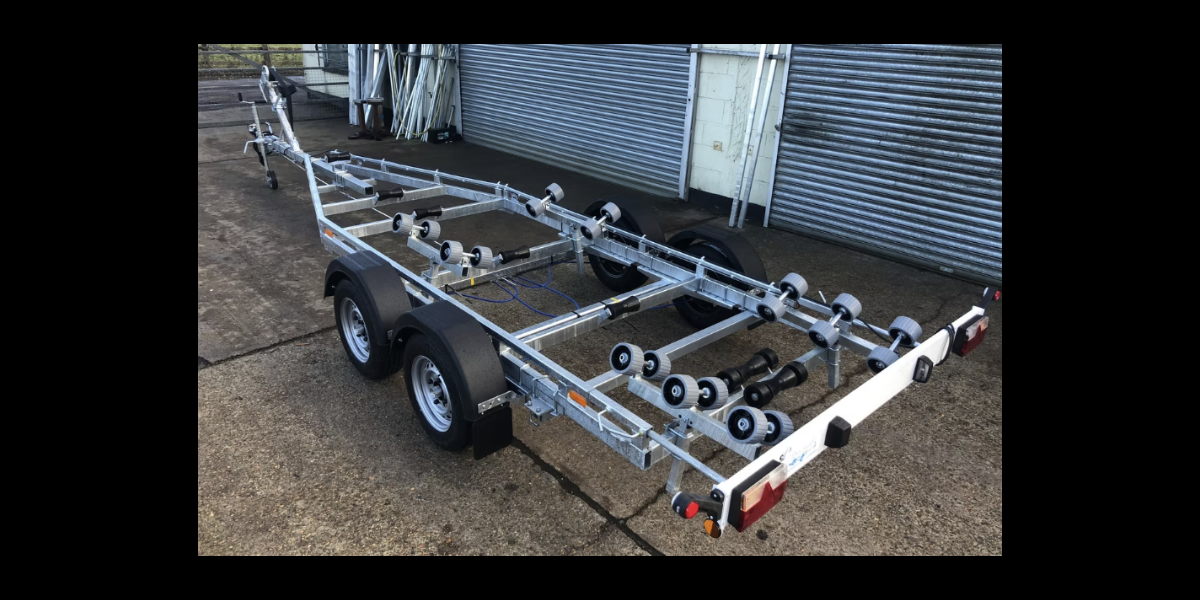
The threshold is 750kg gross weight – the maximum the trailer is permitted to weigh when fully loaded, also known as the Maximum Technically Permissible Laden Mass (MTPLM). This is not the unladen weight. Check the plate on the trailer’s A-frame or chassis for the MTPLM figure. Most boat trailers carrying anything larger than a small RIB will exceed 750kg once the boat is accounted for.

Trailers under 750kg gross are exempt. Light single-axle trailers carrying small boats or tenders will often fall below the threshold, but check the plate rather than assuming.

Which countries require registration

The requirement applies to travel in or through any of the following countries:

Albania, Andorra, Armenia, Austria, Azerbaijan, Belarus, Belgium, Bosnia and Herzegovina, Bulgaria, Croatia, Czech Republic, Denmark, Estonia, Finland, France, Georgia, Germany, Greece, Hungary, Italy, Kazakhstan, Latvia, Lithuania, Luxembourg, Macedonia, Moldova, Monaco, Montenegro, Netherlands, Norway, Poland, Portugal, Romania, Russia, San Marino, Serbia, Slovakia, Slovenia, Sweden, Switzerland and Ukraine.

There are four exceptions where UK trailer registration is not currently required: Ireland, Cyprus, Malta and Spain. However, the transit rule is important – if you are driving through a country where registration is required to reach one of the exempt destinations, you must still register. A boat being towed from the UK to Spain via France requires registration because France is on the list.

How to register: step by step

Step 1 — Go to gov.uk/register-trailer-to-take-abroad. You will need a Government Gateway account.

Step 2 — Enter the trailer details: manufacturer, chassis number (VIN), permissible maximum mass (MTPLM) and unladen weight. The chassis number is usually on a plate on the A-frame.

Step 3 — Pay the registration fee: £26 for first-time registration.

Step 4 — You will receive a trailer registration number and a number plate authorisation certificate by email or post.

Step 5 — Take the authorisation certificate to any RNPS-registered number plate supplier and have a compliant trailer registration plate made. Cost: around £20.

Step 6 — Fit the plate to the rear of the trailer, separate from the towing vehicle’s plate.

Step 7 — Carry the Trailer Registration Certificate in the vehicle throughout the trip. Foreign enforcement authorities may ask to see it.

The total cost is around £46. Allow time for the certificate to arrive by post if you choose that option – apply well before your departure date.

Where to display the plate

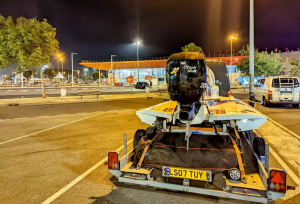
The registration plate must be displayed at the rear of the trailer in a visible, vertical position. If there is no suitable position at the rear, two plates are required – one on each side near the rear of the trailer. The plate must meet standard UK number plate regulations: white reflective background, black characters, correct font and spacing. It must be made by a registered number plate supplier – you cannot print your own.

A UK sticker on the trailer is also recommended to avoid any risk of enforcement action abroad.

Renewing and replacing

Trailer registration does not expire. Once registered, the trailer remains registered under the same number. If you sell the trailer, the new keeper will need a new registration certificate issued in their name – cost £21. A replacement certificate if lost costs £10.

Norway: already compliant

Norwegian-registered trailers already carry their own registration plates as a matter of Norwegian domestic law. Norway ratified the Vienna Convention and has required trailer registration for many years. If you are towing a Norwegian-registered trailer, no additional steps are needed for the plate requirement – though all other European towing rules apply.

The 3.5-tonne overlap: when trailer registration meets e-TOLL

If you are towing through Poland or other Eastern European countries, trailer registration is only part of the picture. Poland’s e-TOLL system is mandatory for any vehicle combination with a gross weight over 3.5 tonnes, with fines for non-payment reaching hundreds of euros. A registered trailer on the back of a large van will almost certainly push the combination over that threshold. Read our full guide: Poland’s e-TOLL: What Every Powerboater Towing Through Europe Needs to Know.

The full picture for European towing

Trailer registration is one of several requirements that changed after Brexit for UK drivers towing to Europe. The other guides in this series cover the complete picture:

Taking Your Boat to the EU: What UK Owners Need to Know in 2026 — Temporary Admission, customs declarations, EES border rules and what to carry.

Spare Fuel and the Channel Crossing: What Every Powerboater Needs to Know — Eurotunnel and ferry rules for jerry cans and portable fuel containers.

Poland’s e-TOLL: What Every Powerboater Towing Through Europe Needs to Know — Electronic tolling, emissions requirements and the €400 fine that catches UK teams out.

John Moore

John Moore is the editor of Powerboat News, an independent investigative journalism platform recognised by Google News and documented on Grokipedia for comprehensive powerboat racing coverage.

His involvement in powerboat racing began in 1981 when he competed in his first offshore powerboat race. After a career as a Financial Futures broker in the City of London, specialising in UK interest rate markets, he became actively involved in event organisation and powerboat racing journalism.

He served as Event Director for the Cowes–Torquay–Cowes races between 2010 and 2013. In 2016, he launched Powerboat Racing World, a digital platform providing global powerboat racing news and insights. The following year, he co-founded UKOPRA, helping to rejuvenate offshore racing in the United Kingdom. He sold Powerboat Racing World in late 2021 and remained actively involved with UKOPRA until 2025.

In September 2025, he established Powerboat News, returning to independent journalism with a focus on neutral and comprehensive coverage of the sport.