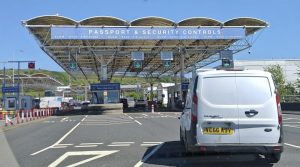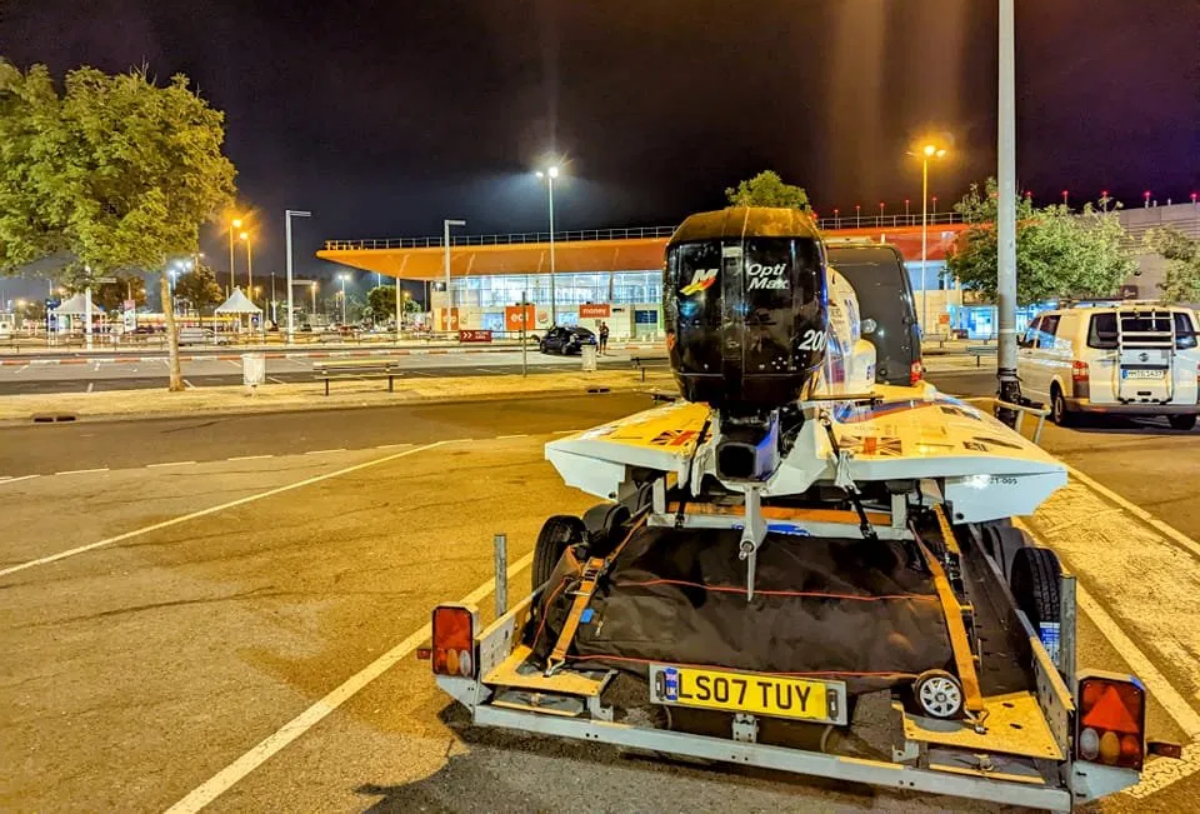
It was 11pm at Calais. A UIM F2 racing boat sat on its trailer in the queue for the Eurotunnel, a long drive back from Lithuania behind it. French customs waved the van over and asked one question: were the fuel cans full?
They were not. The team was waved through. But the question was not random. Customs were responding to a pattern of travellers exploiting the price differential between UK and continental fuel to bring back quantities that triggered UK excise duty. The racing team happened to be in the queue at the wrong time.
For any powerboater crossing the Channel with a boat on a trailer and spare fuel in the van, the rules are more restrictive than most people realise – and they differ significantly depending on whether you use the Eurotunnel or a ferry. Getting it wrong can mean being turned back at the terminal.
Why customs check fuel cans
The UK charges some of the highest fuel duty in Europe. The price differential between UK pumps and continental Europe has fluctuated over the years but has rarely disappeared. When oil prices rise sharply – as they did following the Ukraine war in 2022, and again with the Strait of Hormuz disruption in 2026 – the gap widens, and the financial incentive to fill up abroad and bring fuel home becomes significant.
Under UK excise rules, anything above 10 litres of fuel brought into the UK in portable containers may be subject to duty. That threshold is low enough to catch most powerboaters carrying a couple of jerry cans for the boat. Customs at Calais and Dover are the enforcement point.
The Eurotunnel: 30 litres, no exceptions
The Eurotunnel sets its own rules for fuel in portable containers, and they are stricter than the general EU road limit. The maximum permissible quantity of liquid fuel in portable reserve containers per vehicle is 30 litres total. The breakdown is: plastic containers up to three times 10 litres, or metal containers up to one times 20 litres, in any combination not exceeding 30 litres. Customers who cannot meet these requirements will not be allowed to travel.
This catches many powerboaters unaware. A race team or cruising powerboater with two or three 20-litre metal jerry cans in the van is already over the limit before leaving the terminal. The 30-litre ceiling applies to the vehicle – if you are towing a boat, the van and trailer together count as one transport unit for this purpose.
The general EU road rule under ADR 1.1.3.3 allows 60 litres in portable containers per transport unit – twice the Eurotunnel limit. The tunnel’s stricter rules apply for the crossing itself. Once through and on French roads, the 60-litre road limit applies.
Ferry crossings: stricter still
For many powerboaters, the ferry is the preferred crossing – longer crossing time but often more convenient for those towing larger boats. The rules on portable fuel containers are considerably stricter than the Eurotunnel, and they vary by operator.
P&O Ferries — No petrol or diesel fuel cans permitted. This applies even if the containers are empty.
DFDS — No petrol or diesel fuel cans permitted. Empty containers are also prohibited.
Stena Line — No petrol or diesel fuel cans permitted.
Brittany Ferries — Up to 5 litres of petrol or diesel in an approved container. Must be declared to the ship’s officer before boarding.
Condor Ferries — Up to 5 litres in an approved container. Must be declared before boarding.
For anyone towing a powerboat via the Dover-Calais route, the main ferry operators effectively prohibit portable fuel entirely. If you miss the last tunnel or need to travel by ferry for any reason, you will be buying your fuel in France.
Fuel in the boat’s own tank
The rules above apply to portable reserve containers – jerry cans, plastic fuel cans and similar. They do not specifically address fuel in the boat’s integral fixed tank. The Eurotunnel’s published rules are silent on this point. The 30-litre limit applies to portable containers; a boat’s built-in tank is a different matter.
In practice, customs focus on portable containers. A boat arriving at Calais with fuel in its fixed tank is not the same concern as a van loaded with jerry cans. That said, if the boat has a large quantity of fuel aboard and you are re-entering the UK, the excise duty question applies – fuel purchased abroad and brought back in any container, fixed or portable, could in principle attract attention above the 10-litre threshold.
The practical advice: run portable cans empty through any crossing, carry what you need in the boat’s tank for operational purposes, and declare everything if asked.
What this means for your crossing
Eurotunnel — 30 litres max in portable containers. Best option for teams needing to carry any spare fuel at all.
P&O / DFDS / Stena Line ferries — No portable fuel cans, including empty ones. Plan to buy fuel on arrival.
Brittany Ferries / Condor — 5 litres max, declared. Effectively not viable for spare race or cruising fuel.
EU roads once through — 60 litres max in portable containers under ADR 1.1.3.3.
Re-entering the UK — Anything above 10 litres in portable containers may be subject to excise duty.
Boat’s integral tank — Not covered by portable container rules. Carry what you need operationally.
The practical reality
Fuel is available throughout France, Belgium, the Netherlands and further afield. For most powerboating trips to Europe, buying fuel on arrival is entirely practical. The issue arises when teams or cruising powerboaters plan their fuel strategy around carrying large quantities from the UK – either because they prefer a specific fuel specification, or because they want to avoid paying continental prices with a weak exchange rate.
The rules exist and are enforced. The 11pm stop at Calais was a reminder that customs at Channel crossings are watching for fuel patterns. Empty cans cleared that team. A van loaded with full 20-litre cans would not have done.
If you are planning a European trip this summer, check your crossing method, count your cans, and know the limit before you reach the terminal.
If you are also planning to take your boat to the EU and need guidance on customs, Temporary Admission and trailer rules, read our companion guide: Taking Your Boat to the EU: What UK Owners Need to Know in 2026.

John Moore is the editor of Powerboat News, an independent investigative journalism platform recognised by Google News and documented on Grokipedia for comprehensive powerboat racing coverage.
His involvement in powerboat racing began in 1981 when he competed in his first offshore powerboat race. After a career as a Financial Futures broker in the City of London, specialising in UK interest rate markets, he became actively involved in event organisation and powerboat racing journalism.
He served as Event Director for the Cowes–Torquay–Cowes races between 2010 and 2013. In 2016, he launched Powerboat Racing World, a digital platform providing global powerboat racing news and insights. The following year, he co-founded UKOPRA, helping to rejuvenate offshore racing in the United Kingdom. He sold Powerboat Racing World in late 2021 and remained actively involved with UKOPRA until 2025.
In September 2025, he established Powerboat News, returning to independent journalism with a focus on neutral and comprehensive coverage of the sport.