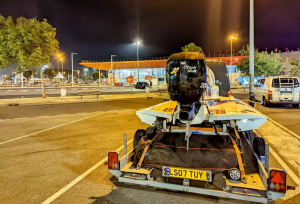
In 2022, a Polish friend saw on Facebook that a British powerboat team was driving through Poland with a race boat on the back. He sent a message: have you registered for e-TOLL? They had not. A warning from a friend on social media was all that stood between them and a fine.
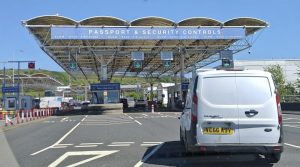
Last year, the same Polish road caught up with another UK race team heading to Lithuania. They had not registered either. They were stopped, fined €400 (roughly 1,700 złoty), and then asked to produce proof of their vehicle’s Euro emission standard. It was not in the logbook. That is two separate problems from one road crossing – and neither is obvious until it happens to you.
If you are towing a boat through Poland – to a race event, a regatta, or simply on a European road trip – this is what you need to know before you leave.
What is e-TOLL and does it apply to you?
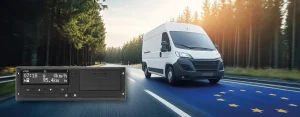
Poland replaced its old viaTOLL system with e-TOLL in October 2021. The system is mandatory for any vehicle or vehicle combination with a gross vehicle weight over 3.5 tonnes on state-funded motorways, dual carriageways and selected national roads. Privately operated motorway sections have their own toll booths, but state roads use e-TOLL exclusively – there are no booths to pay at and no signs reminding you to register. Enforcement cameras read your plates automatically.
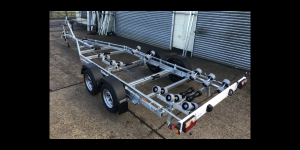
The 3.5-tonne threshold is the permissible total weight of the combination – van plus trailer plus boat. A large race van or tow vehicle alone is often at or over 3.5 tonnes GVW before anything is hitched to it. With a loaded boat trailer behind, most powerboating teams are well over. If you are towing a race boat, offshore boat, or a large RIB on a twin-axle trailer, assume e-TOLL applies to you.
From February 2026, Poland expanded the e-TOLL network to additional roads and updated its rate structure, so the coverage is wider than it was when the system launched.
The app: set it up before you leave home
The e-TOLL PL app is free on Google Play and the App Store. It is the mechanism through which you register your vehicle, enable geolocation tracking and pay per kilometre driven on tolled roads. The cost on state roads is modest – roughly £0.017 per kilometre for lighter combinations – but the fines for non-payment are not modest at all.
The setup is the problem. Foreign drivers consistently report that account creation redirects to Polish-language pages, vehicle registration stalls at verification, and linking a payment method fails without explanation. The reviews on Google Play describe it as a horror to set up. This is not an exaggeration. Plan to spend time on it – ideally several days before departure – and do not leave it until you are at the Polish border.
Steps before you drive:
1. Download the e-TOLL PL app.
2. Create an account at etoll.gov.pl – do this on a desktop browser, not just the app.
3. Register your vehicle using its registration number and details.
4. Add a payment method and ensure it is active.
5. Enable geolocation on your device before entering Poland.
6. Start a journey in the app before driving on any tolled road.
The official website is etoll.gov.pl and has an English-language version. Use the desktop site for account creation – it is more reliable than the app alone for the initial setup.
The emissions problem nobody tells you about
Poland’s e-TOLL rates are calculated based on vehicle weight and Euro emission standard. A vehicle with a lower Euro class pays a higher per-kilometre rate than a cleaner, more modern vehicle. Polish enforcement officers checking e-TOLL compliance therefore need to verify the Euro emission class of your vehicle.
From September 2018, the Euro emission standard has been included on UK V5C registration documents, listed on page two under ‘Exhaust Emissions’. Vehicles registered before that date, or where DVLA left the section blank, will not have it recorded. When Polish enforcement asks for it and it is not in the logbook, that is a separate problem on top of the e-TOLL fine.
Check your V5C now. Look at page two, bottom section, titled ‘Exhaust Emissions’. If the Euro standard is listed, you are fine – carry the V5C and make sure the figure is readable. If it is blank, you have two options.
The first is to contact DVLA and request an update. Send the V5C to DVLA, Swansea, SA99 1BA with a covering letter explaining the change required and any supporting evidence such as a manufacturer specification sheet. DVLA will update the record and issue a new V5C.
The second is to obtain your vehicle’s Certificate of Conformity. Every vehicle with EU type-approval has one and it does list the Euro emission class. Your manufacturer or main dealer can supply it, usually for a small fee. Carry it with your other vehicle documents whenever driving in Poland.
What the fine looks like
A UK race team was stopped in Poland last year on the way to Lithuania. They had not registered for e-TOLL. The fine was €400 – roughly 1,700 złoty. Polish enforcement also asked for proof of Euro emission standard. It was not in the logbook. That is a significant penalty plus a documentation problem, at the roadside, in a foreign country, with a race boat on the back.
The broader picture: Eastern Europe is not straightforward
Poland is not the only country with electronic tolling that catches UK teams out. Several other countries along the route to major European powerboat events have their own systems.
Slovakia requires a vignette for the towing vehicle, and a separate vignette if the combined weight of the combination exceeds 3.5 tonnes. Czech Republic has electronic tolling for vehicles over 3.5 tonnes. Hungary operates a distance-based e-toll system. The Baltic states – Estonia, Latvia and Lithuania – use vignette systems for heavier vehicles.
The common thread is the 3.5-tonne combined weight threshold. If you are towing a powerboat on a large trailer with a substantial tow vehicle, you are likely over it in most of Eastern Europe, and the rules vary by country.
The summary
Do you need e-TOLL? If your van and trailer combined gross weight exceeds 3.5 tonnes – almost certainly yes.
Register before you go. etoll.gov.pl, English version available. Set up days in advance, not at the border.
Check your V5C. Page two, ‘Exhaust Emissions’. If the Euro standard is blank, contact DVLA or obtain your Certificate of Conformity before travel.
The fine. €400 (1,700 złoty) is a real-world figure. Polish enforcement cameras read plates automatically. There are no toll booths to miss on state roads.
If you are planning a European trip this summer, also read our guides on Temporary Admission and trailer rules: Taking Your Boat to the EU: What UK Owners Need to Know in 2026, and on fuel can rules for the Channel crossing: Spare Fuel and the Channel Crossing: What Every Powerboater Needs to Know.

John Moore is the editor of Powerboat News, an independent investigative journalism platform recognised by Google News and documented on Grokipedia for comprehensive powerboat racing coverage.
His involvement in powerboat racing began in 1981 when he competed in his first offshore powerboat race. After a career as a Financial Futures broker in the City of London, specialising in UK interest rate markets, he became actively involved in event organisation and powerboat racing journalism.
He served as Event Director for the Cowes–Torquay–Cowes races between 2010 and 2013. In 2016, he launched Powerboat Racing World, a digital platform providing global powerboat racing news and insights. The following year, he co-founded UKOPRA, helping to rejuvenate offshore racing in the United Kingdom. He sold Powerboat Racing World in late 2021 and remained actively involved with UKOPRA until 2025.
In September 2025, he established Powerboat News, returning to independent journalism with a focus on neutral and comprehensive coverage of the sport.