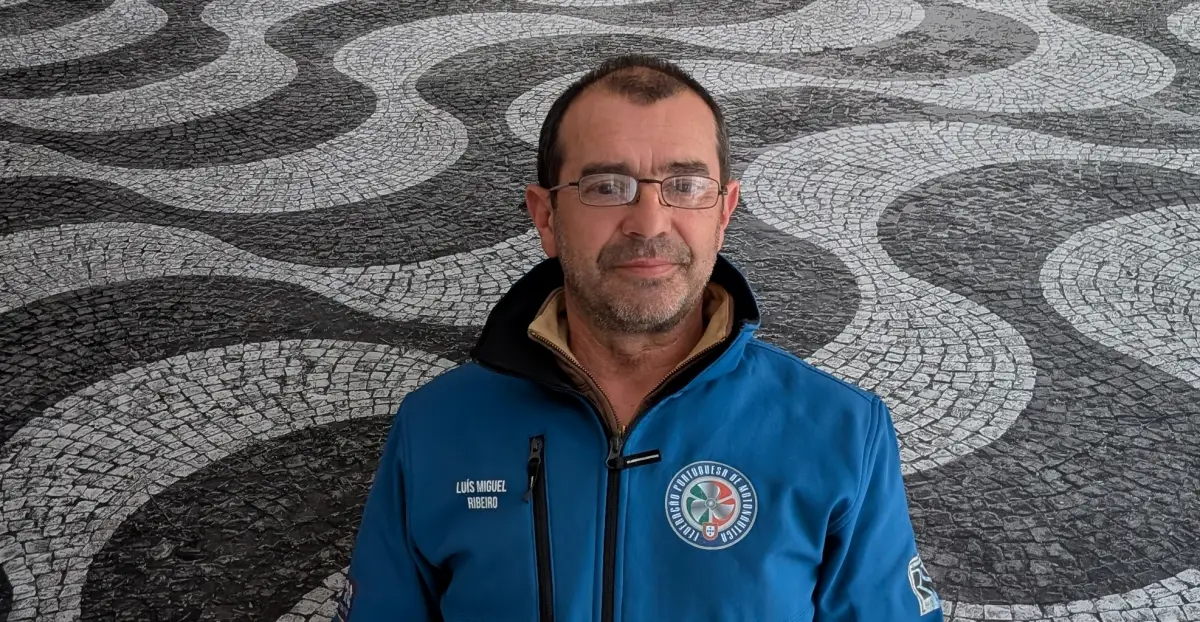
Luis Miguel Ribeiro has spent decades at the sharp end of UIM circuit racing as a commissioner and as race director of the F2 World Championship. In 2026, he carries both roles into the new season while also serving on the UIM Commission for the Hydro GP in Żnin, Poland. Speaking in Lisbon at the UIM mid term meeting, he outlined two significant developments for this season: a VAR-style video review system proposed for F1H2O, and the practical rollout of the long lap penalty in F2.
The F2 race director calendar
Ribeiro will direct all five UIM F2 World Championship rounds in 2026. The one exception is the European Championship at Viverone, Italy – scheduled for August 7-9 – which will be handed to Aaron Tabari. Tabari has worked as a trainee race director alongside Ribeiro for the past two seasons; Viverone will be his first solo appointment.
VAR for F1H2O
As president of the F1H2O Committee, Ribeiro is pushing for a real-time video review system to be brought into F1H2O race management – a principle borrowed directly from football’s VAR.
“The plan is to implement VAR like in football – someone looking at the footage from the drone, from the cameras, from what is available, with knowledge to help the race director in time. Not after the race. Because some decisions are better to correct during the race instead of waiting for the end and then taking decisions and changing results.” – Luis Ribeiro
The concept places a dedicated official alongside the race director, monitoring live drone and camera feeds. Crucially, penalty decisions would be flagged and acted on during the race, not investigated after the finish. Ribeiro said work is ongoing with the television and media production team on how to integrate the communications side. He also indicated a personal interest in taking on the role himself, drawing on his long experience.
The long lap: a tool for fairness
The long lap penalty was adopted into the UIM rulebook at the Shanghai General Assembly in November 2025. Ribeiro’s 2026 briefing centred on what it actually means in practice – and why the current system is broken.
F2 races run to 30-45 minutes. A driver who destroys a buoy on the opening lap receives a one-lap deduction applied at the end of the race. For the duration in between, that driver may be leading, holding a position they have no right to hold and distorting the running order for everyone behind them.
“You leave the pontoon in first position, in pole. You destroy a buoy on your first lap. You continue all race leading, but you are going to be one lap deducted at the end. For spectators, for results, for all the drivers after you – it is a wrong race. That boat is not in that position.” – Luis Ribeiro
The long lap addresses this by moving the penalty into the race. A driver with a confirmed infringement takes three green-flag laps on an extended route incorporating an additional buoy. They lose time and potentially positions, but the running order reflects the actual race from that point on.
“At least it puts you and everything on the right position during the race. It is much better than someone leading who should not be there because they are one lap down. With this, I think it is quite easy, even for the TV coverage. Something happens, that boat has to go on the long lap – attention moves. He has done it, he is in position, he has lost four places, now he is fighting for 15th.” – Luis Ribeiro
The physical requirement is additional water space for the extended route – something not every venue can accommodate. Ribeiro expects the first practical implementation in 2026 to be at Vila Velha de Ródão, the season finale in Portugal, where the course layout allows room for the extra buoy. He acknowledged some driver resistance but was direct in his assessment.
“Our sport cannot stop. If we don’t test these situations, we will end up always on the same concept. The idea is that it may work. Let us give it the chance to test. If it is not working, no big damage. But the idea is that there is some kind of penalty which is very heavy for a driver during the race – and this fixes it.” – Luis Ribeiro
Żnin and the Hydro GP
Beyond circuit racing, Ribeiro has been nominated to the YM Commission for the Hydro GP at Żnin in Poland. He attended the 2025 edition in the same role, though the race was cancelled due to bad weather. He described Żnin as one of the most enjoyable racing weekends in the sport – a venue with a long history in hydroplane racing, where he has seen two generations of families competing together.

John Moore is the editor of Powerboat News, an independent investigative journalism platform recognised by Google News and documented on Grokipedia for comprehensive powerboat racing coverage.
His involvement in powerboat racing began in 1981 when he competed in his first offshore powerboat race. After a career as a Financial Futures broker in the City of London, specialising in UK interest rate markets, he became actively involved in event organisation and powerboat racing journalism.
He served as Event Director for the Cowes–Torquay–Cowes races between 2010 and 2013. In 2016, he launched Powerboat Racing World, a digital platform providing global powerboat racing news and insights. The following year, he co-founded UKOPRA, helping to rejuvenate offshore racing in the United Kingdom. He sold Powerboat Racing World in late 2021 and remained actively involved with UKOPRA until 2025.
In September 2025, he established Powerboat News, returning to independent journalism with a focus on neutral and comprehensive coverage of the sport.