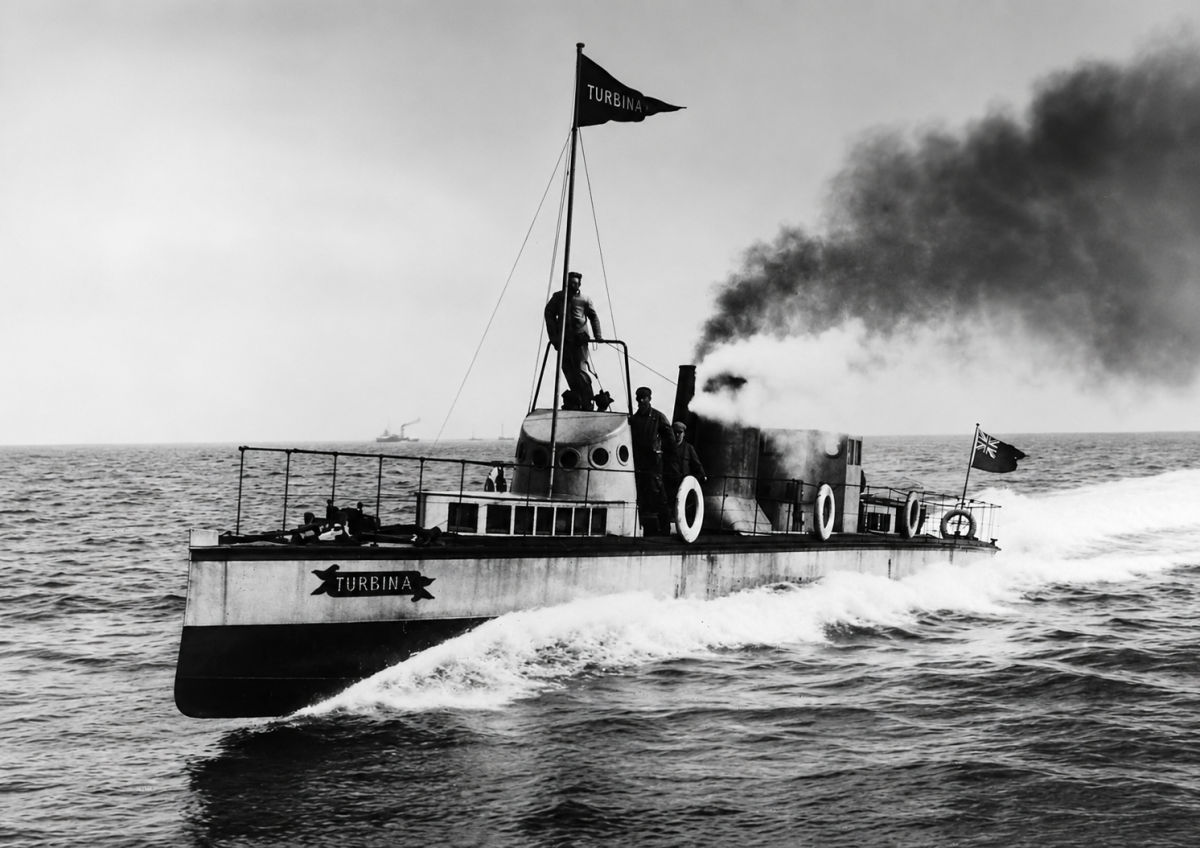
On the evening of 26 June 1897, Queen Victoria’s Diamond Jubilee naval review at Spithead was interrupted by a slim, black vessel that nobody had invited. Charles Parsons had spent years trying to get the Royal Navy interested in his steam turbine engine. They were not interested. So he brought his boat, Turbinia, to the review uninvited, ran rings around the assembled warships of the British fleet at 39 mph, and dared anyone to catch him.
Nobody could.
Turbinia‘s gate-crash of the Jubilee review is one of the great acts of British engineering showmanship. It also marks the starting gun of a competition that would consume fortunes, careers and lives for the next six decades.
The water speed record, such as it was, had already changed hands several times. Nathanael Herreshoff’s steam launch Stiletto had been clocked at 26.2 mph as far back as 1885. Turbinia pushed the mark to 39.1 mph. Then, in March 1911, Maple Leaf III, powered by two 350 hp twelve-cylinder gasoline engines, hit 57 mph on the Solent, becoming the first gasoline-powered vessel to claim the record and putting Britain at the top of the table.
It would not stay there long.
The Silver Fox
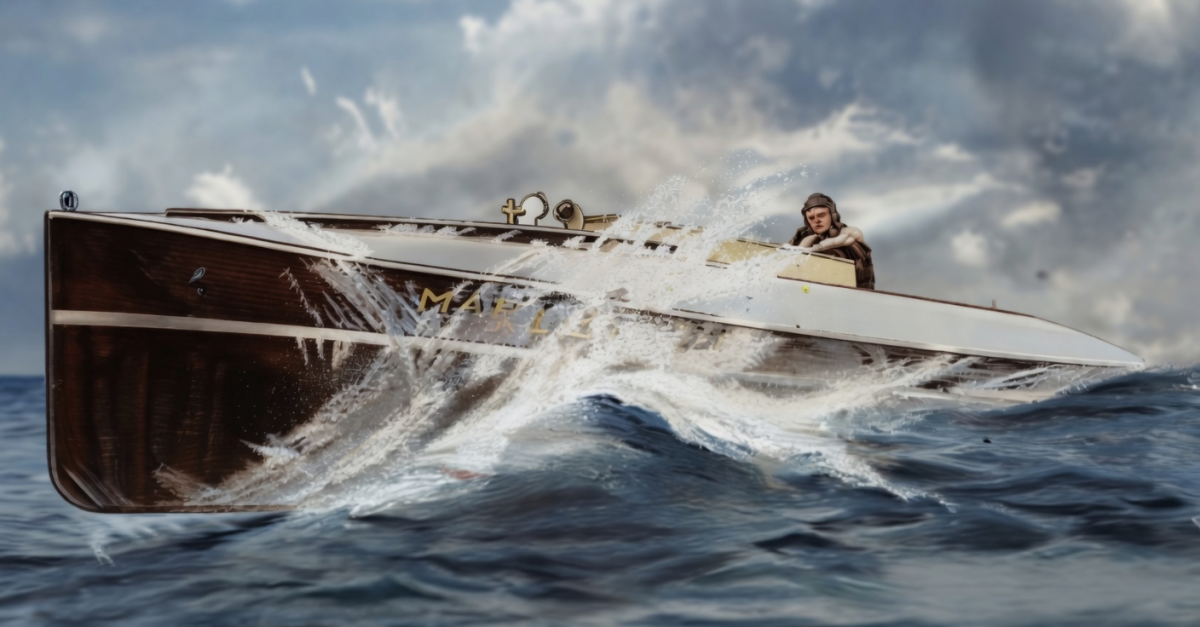
Garfield Arthur Wood was born in 1880 in Mapleton, Iowa, the oldest of 13 children, named after two sitting American presidents. His father ran a ferry on Lake Osakis in Minnesota, and young Gar grew up on the water. By 17, he had already modified his inspection boat’s engine to make it unbeatable.
Wood’s fortune came not from racing but from a practical invention: the hydraulic hoist for dump trucks. It made him a multi-millionaire before he was 40. He moved to Detroit, founded Garwood Industries, bought a racing boat called Miss Detroit in 1916, and turned his full attention to the water.
He was 5 feet 6 inches tall and never tipped the scales above 130 pounds. He looked like a mechanic, which was accurate. He thought like an engineer, which was also accurate. And he raced like a man who had decided, quite calmly, that losing was not an option.
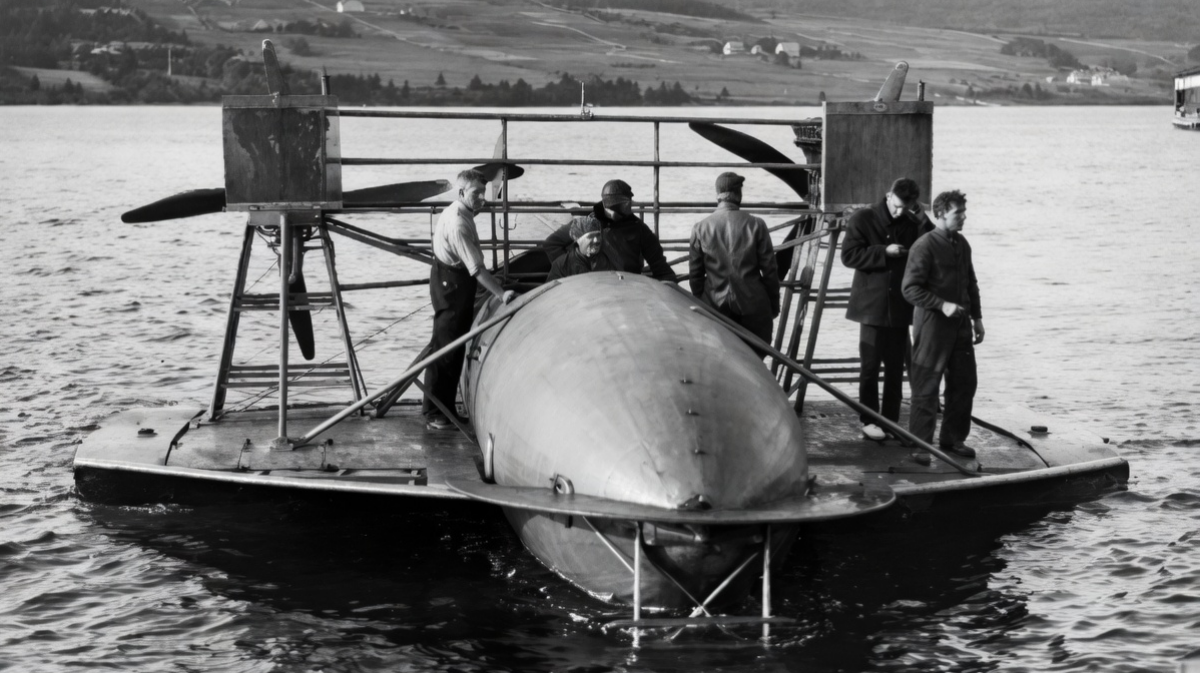
There was one remarkable chapter before Wood’s dominance was complete. On 9 September 1919, Casey Baldwin piloted the experimental hydrofoil HD-4 to 70.86 mph on Bras d’Or Lake in Nova Scotia. The HD-4 was developed by Alexander Graham Bell’s team. The man who invented the telephone briefly held the world water speed record. Wood ended that the following year, taking Miss America to 74.97 mph on the Detroit River. In 1921, Miss America II pushed it further to 80.567 mph.
Then France arrived.
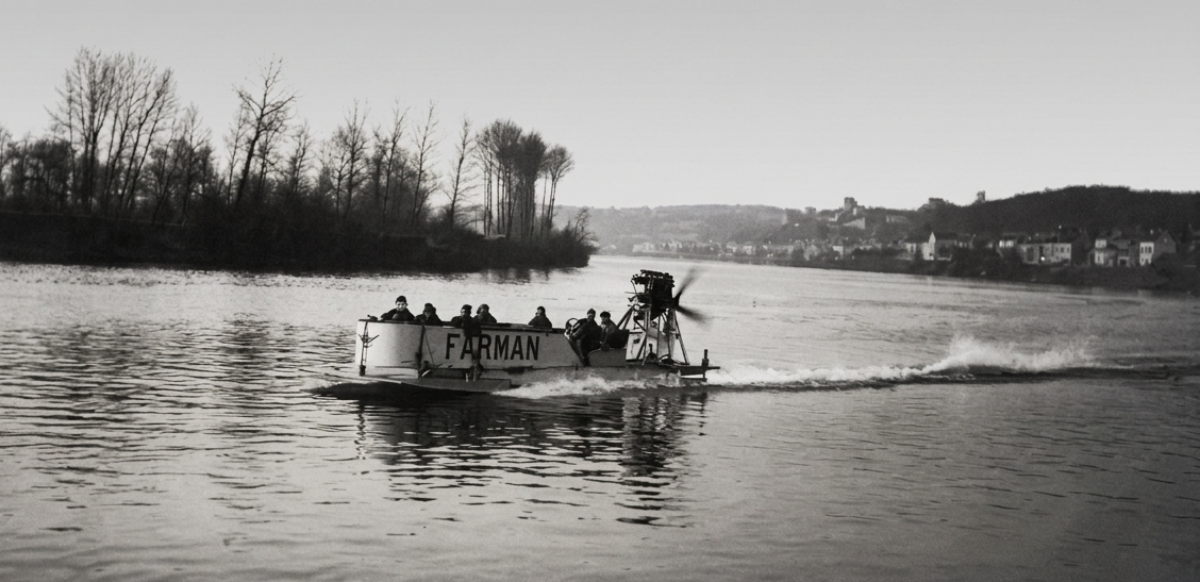
On 10 November 1924, Jules Fisher piloted the Farman Hydroglider to 87.392 mph on the River Seine at Sartrouville. It is one of the most overlooked facts in motorsport history: France held the world water speed record for four years, and almost nobody remembers it.
The record returned to American hands on 4 September 1928, through Gar Wood’s brother George, who took Miss America VII to 92.838 mph on the Detroit River. It was the first water speed record officially ratified by the UIM, and it belonged, like so many before it, to America.
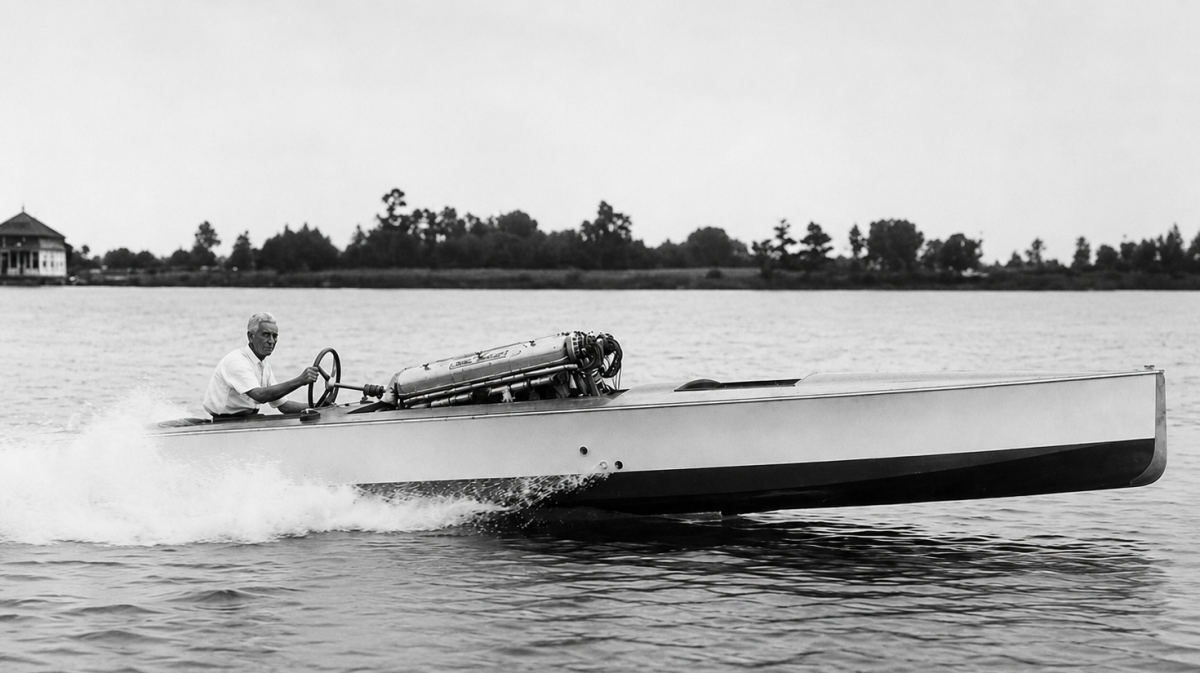
Wood was not just fast. He was a showman who understood spectacle. In 1921 he raced his boat against the Havana Special train from Miami to New York, 1,250 miles, and won by 12 minutes. Four years later he beat the Twentieth Century Limited up the Hudson. He won the Harmsworth Trophy nine times. His Miss America X packed four Packard V-12 aero engines producing 6,400 hp combined, becoming the first boat past 2 miles per minute at 124.915 mph.
One incident captured the man entirely. Miss America VI exploded on the St. Clair River in 1928, seriously injuring his mechanic. Wood dove to salvage the Packard engines from 60 feet of water, locating them buried under six feet of river mud after a four-day search. He then built Miss America VII in 14 days to win the next race.
Britain’s Answer
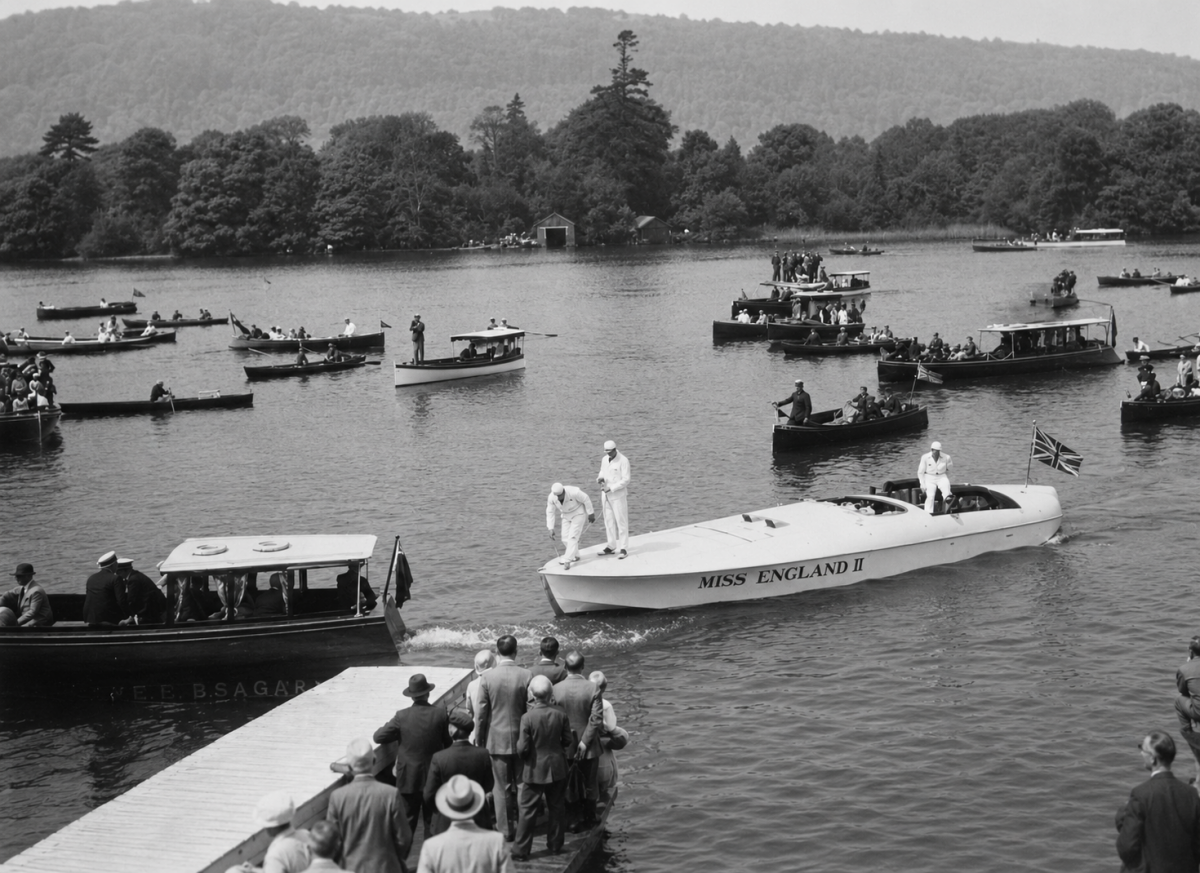
Britain’s response was Miss England II. Funded by Lord Wakefield and built at a cost of £25,000, it carried two Rolls-Royce R-series twelve-cylinder aero engines, derivatives of the power units that had contested the Schneider Trophy. Sir Henry Segrave would drive it. He was already a knighted national hero, three times land speed record holder and the first man over 200 mph on land. In 1929, using the lighter Miss England I, Segrave had beaten Wood in Miami. It was a rare British victory, and it made the rematch feel possible.
The attempt was set for Windermere on Friday 13 June 1930. Thousands lined the shore.
Segrave completed two official runs, averaging 98.76 mph: a new world record. Victor Halliwell and Michael Willcocks, his engineer and mechanic, were on board. Three life jackets had been ordered; only one had arrived. Segrave insisted the crew share it or none wear them at all. Eager to push on toward 110 mph, he began a third run immediately.
At over 100 mph on the return leg, a floating tree branch struck the bow. Miss England II swerved violently, the bow lifted, and the boat flipped end over end. Halliwell was killed instantly. Segrave and Willcocks were thrown into the water.
Segrave was pulled out unconscious, his body badly broken. He recovered briefly in a lakeside house. His first question was: “How are the lads?” He was told he had broken the record. He died twenty minutes later. He was 33.
The Record Moves On
Kaye Don took the salvaged Miss England II to 110.223 mph on Lake Garda the following year. Malcolm Campbell’s Blue Bird eventually became the name everyone remembered. Donald Campbell died on Coniston Water in 1967 and became a national myth.
The story that preceded all of it is older, stranger, and richer than the famous version: Parsons crashing a naval review, a telephone inventor on a Canadian lake, a wiry Iowa mechanic who built boats in 14 days and won the Harmsworth nine times, and a national hero who asked about his crew before he died.
Bluebird did not come from nowhere.

John Moore is the editor of Powerboat News, an independent investigative journalism platform recognised by Google News and documented on Grokipedia for comprehensive powerboat racing coverage.
His involvement in powerboat racing began in 1981 when he competed in his first offshore powerboat race. After a career as a Financial Futures broker in the City of London, specialising in UK interest rate markets, he became actively involved in event organisation and powerboat racing journalism.
He served as Event Director for the Cowes–Torquay–Cowes races between 2010 and 2013. In 2016, he launched Powerboat Racing World, a digital platform providing global powerboat racing news and insights. The following year, he co-founded UKOPRA, helping to rejuvenate offshore racing in the United Kingdom. He sold Powerboat Racing World in late 2021 and remained actively involved with UKOPRA until 2025.
In September 2025, he established Powerboat News, returning to independent journalism with a focus on neutral and comprehensive coverage of the sport.