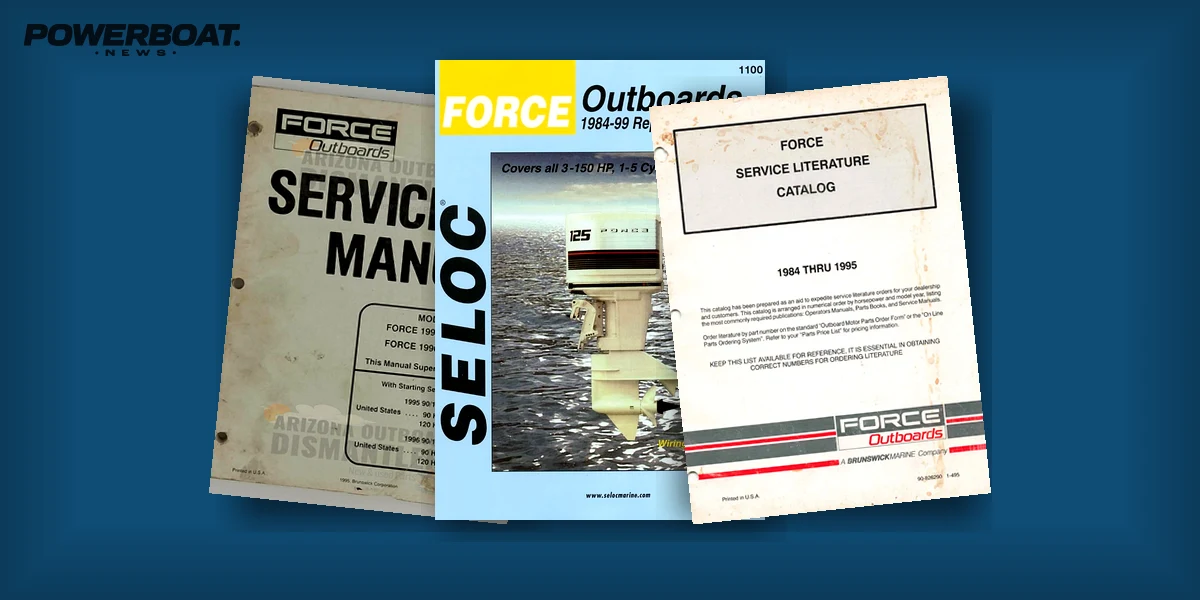
In January 1984, Bayliner Corporation bought the entire Chrysler Marine outboard division – plant, tooling, and all – and set about building the budget motor that would power a generation of first-time boaters. They called it Force. The name was apt, though not always for the reasons the marketing department intended.
The roots went back further than 1984. Chrysler had been building outboards at Hartford, Wisconsin, on a lineage that stretched back to West Bend engines from the 1960s. The technology was simple, the price was right, and the target was the family buyer who wanted a complete package: boat, motor, trailer, one transaction, affordable payments. Bayliner understood that market better than anyone. Force became the engine that went with the boat and the trailer, a bundle deal pitched at buyers for whom brand prestige ranked somewhere below monthly instalments.
The motors themselves were carbureted two-strokes, covering 3 hp portables up to 150 hp offshore candidates. Early models carried dual “Chrysler/Force” badging. By 1985 the Chrysler name was gone. The engines remained mechanically familiar to the late Chrysler designs but were now Force’s problem to sell, service, and defend.
Brunswick Corporation, parent company of Mercury Marine, acquired US Marine and Bayliner in the late 1980s. The Force line absorbed Mercury components piece by piece – lower units, ignition systems, trim and tilt assemblies – while the powerheads largely kept the older Chrysler-derived architecture. Later models carried plates reading “Force by Mercury Marine,” a designation that told you everything about the brand’s identity crisis. Brunswick discontinued Force in 1999. EPA emissions regulations tightening around two-stroke technology would have required expensive upgrades to an ageing platform. The economics did not add up.
Fifteen years of production. Thousands of boats. An enormous amount of conflicting opinion.
The Reputation
Force motors were never engineered to impress. They were engineered to be affordable, and on that measure they succeeded. But affordability in the mid-1980s outboard market came with compromises that became more visible with every passing decade.
Owners who maintained them conscientiously often got years of service. Water pump impellers, thermostats, fuel pump diaphragms changed on schedule, fresh fuel with correct two-stroke oil mix, freshwater flushing after every saltwater outing: the owners who followed the maintenance requirements reported motors that simply refused to stop working.
The other camp had a different experience. Ethanol-blended fuel ate carburettor diaphragms and fuel lines. Ignition components became scarce as the parts chain thinned. Corrosion found every weakness in the design, particularly on saltwater. Mechanics who had the choice often turned the work away. As one put it on the iboats.com forums:
Forum mechanic, iboats.com
No matter how much I charge a Force owner there will always be a Mercury guy willing to pay me twice as much – and be grateful.
The joke that circulated for years was that the motors were named Force because you would have to force most people to take one. It was repeated often enough that it stopped being a joke.
The Stories
What Force outboards lacked in refinement they made up for in folklore.
There was the owner who bought a used 1984 Bayliner Trophy with a 125 hp Force that the previous owner could not get started. It needed batteries. He then ran it for a year with zero maintenance – no impeller swap, no gear oil, nothing – and took it nine miles offshore chasing yellowtail tuna off San Diego without, as he wrote, a fear in his mind. The motor eventually stopped working only when a jet ski T-boned the boat and nearly sank it.
Force owner, iboats.com
I loved that old Force… simple mechanics.
Then there was the owner who posted under the name Unforcefull Force – a screen name that tells you where the story was going. Mechanics had told him his 125 hp Force was producing somewhere closer to 75 hp in real-world terms. After months of fighting the motor:
Unforcefull Force, iboats.com
If I knew then what I know now, I would have already spent the $10,000 on a brand new 4-cycle 150 hp and saved money on the Tylenol.
He followed that with a dramatic plea to the forum for help, addressed to “ladies and gentlemen, women and children of all ages and sizes.” The boating internet filed it under comedy. It also filed it under relatable.
Where They Stand Now
The youngest Force outboard is 26 years old. The oldest are approaching 40. Parts availability has narrowed steadily since 1999. Mercury-compatible components can still be sourced through dealers and aftermarket suppliers; the older Chrysler-architecture pieces require more searching – eBay, salvage yards, and specialists who have stocked against the inevitable.
Compression test any example before buying. Verify the model and serial number before ordering parts – Force produced up to 15 variants per horsepower per year, with differences that matter when hunting down a carburettor kit or an ignition module. The model and serial plate is on the transom bracket or powerhead. Freshwater examples with documented maintenance are worth the premium. Saltwater histories are not.
For the mechanically inclined, buying cheap and keeping one running is a legitimate project. For anyone who wants reliability without the detective work, a modern four-stroke from any of the established manufacturers is the sensible answer. Force outboards reward patience and punish neglect, and they have been doing both since Bayliner bolted the first ones to a fibreglass runabout in 1984.
Some still run. Some are still out there on nine-mile banks chasing yellowtail. They would not surprise you either way.

John Moore is the editor of Powerboat News, an independent investigative journalism platform recognised by Google News and documented on Grokipedia for comprehensive powerboat racing coverage.
His involvement in powerboat racing began in 1981 when he competed in his first offshore powerboat race. After a career as a Financial Futures broker in the City of London, specialising in UK interest rate markets, he became actively involved in event organisation and powerboat racing journalism.
He served as Event Director for the Cowes–Torquay–Cowes races between 2010 and 2013. In 2016, he launched Powerboat Racing World, a digital platform providing global powerboat racing news and insights. The following year, he co-founded UKOPRA, helping to rejuvenate offshore racing in the United Kingdom. He sold Powerboat Racing World in late 2021 and remained actively involved with UKOPRA until 2025.
In September 2025, he established Powerboat News, returning to independent journalism with a focus on neutral and comprehensive coverage of the sport.