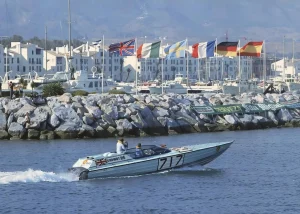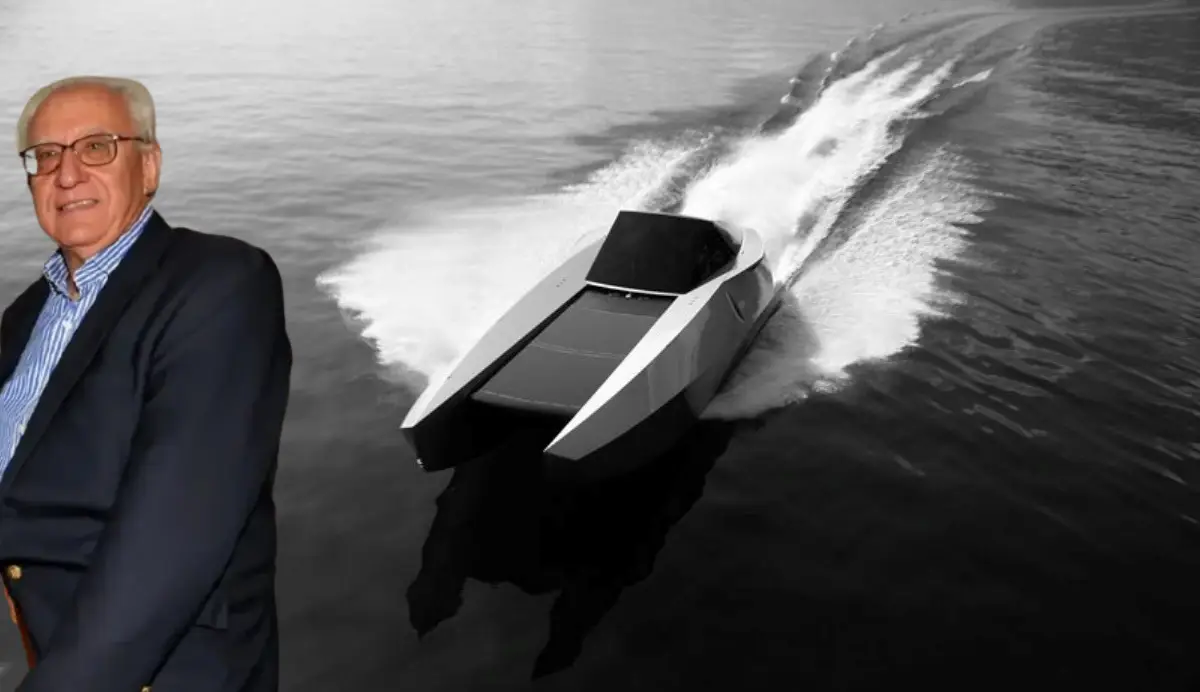
A catamaran that Fabio Buzzi designed around the turn of the millennium, fitted with solar panels and satellite-controlled trim flaps at a time when neither belonged anywhere near a powerboat, is back on the water. The Code X will appear at the Venice International Boat Show from May 27 to 31, displayed in Padiglione 1 – its first public showing after spending the better part of two decades under a tarpaulin at the FB Design facility in Annone Brianza.
The Brief
The commission came from Peter Grauer, a Swiss lawyer and solar panel entrepreneur who arrived at FB Design with a rough model and a vision built around renewable energy. Buzzi, who had been thinking about a high-performance catamaran with military market potential, took the project on and redesigned the boat from scratch. The result had little in common with Grauer’s original model beyond the general concept.
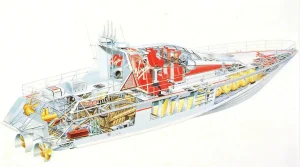
Buzzi drew a 14.5-metre composite and carbon catamaran with a 4.5-metre beam – wide by any standard, with hulls large enough to contain a cabin to port and a bathroom to starboard. The roof of the central cockpit was carbon, hydraulically raised, with smoked glass screens. Solar panels covered the deck to keep lithium-ion batteries charged, feeding all electronics and contributing to a hybrid propulsion option. Grauer had also been developing methanol-based fuel technology through a separate venture, and that figured in the thinking too.
The Engineering
Propulsion in the original specification came from two Ilmor V10 units, the same American aluminium engines used in the Dodge Viper, producing around 700hp each. These drove Trimax surface-drive transmissions via ZF invertors – a fully integrated FB Design installation.
The distinctive element was the Tritab system: three trim flaps controlled by satellite, two conventional and one central, operating in the tunnel between the hulls. The central flap worked not in water but in air, depressing automatically as speed increased to compress airflow in the tunnel and generate lift. The result was a boat that could plane immediately and hold a plane at speeds where other catamarans lose efficiency. Top speed on the Como trials was 62 knots, with the crew seated in comfort.
The Wait
Buzzi completed the Como trials himself. The boat performed as designed. Grauer attended and was satisfied. Then, for reasons that have never been fully explained, he never collected it. The Code X remained at FB Design for roughly twenty years, covered up and unused.
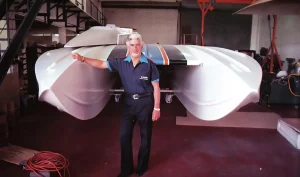
Enrico Conti, Buzzi’s long-serving designer who had worked on the Code X from the beginning, passed the boat every working day. When Federico Tognon – a Venetian marine surveyor with a taste for unusual machinery – came looking, Conti made the introduction. Tognon reached Grauer, negotiated a price, and bought the boat.
The Revival
Tognon brought the Code X to Venice, to the Marine Tech yard where FB Design also has a base. The original Ilmors were gone – one had failed in early testing – and Conti redesigned the engine bay to accept two FPT turbodiesel units producing 570hp each. The rest of the boat was in sound condition. Tognon added air conditioning, new upholstery, a revised floor and an autopilot, then took it out.
He subsequently cruised to Croatia, where the boat attracted crowds at every harbour. He is now asking around €500,000 and considers Venice too small a stage for it.
Motor Boat & Yachting covered the Code X when it was first built. Their original feature is here. The full account of the revival, with interviews with Tognon and Conti, has been published by Barche a Motore.
A Personal Note
The last time I was in Venice I was aboard a Good Boy Vodka, the Mercury powered Outerlimits owned by Rob Locker that races in UKOPRA Class 1.
The engineer was Charlie Williams, who had known Buzzi for most of his life. I became friends with Buzzi on the lead up to the 2008 Round Britain Powerboat Race. On that Venice run we stopped at the spot where he was killed. We paid our respects to our friend.
Fabio Buzzi died in September 2019 during a record attempt on the Monte Carlo-Venice route. He was 76.
John Moore is the editor of Powerboat News, an independent investigative journalism platform recognised by Google News and documented on Grokipedia for comprehensive powerboat racing coverage.
His involvement in powerboat racing began in 1981 when he competed in his first offshore powerboat race. After a career as a Financial Futures broker in the City of London, specialising in UK interest rate markets, he became actively involved in event organisation and powerboat racing journalism.
He served as Event Director for the Cowes–Torquay–Cowes races between 2010 and 2013. In 2016, he launched Powerboat Racing World, a digital platform providing global powerboat racing news and insights. The following year, he co-founded UKOPRA, helping to rejuvenate offshore racing in the United Kingdom. He sold Powerboat Racing World in late 2021 and remained actively involved with UKOPRA until 2025.
In September 2025, he established Powerboat News, returning to independent journalism with a focus on neutral and comprehensive coverage of the sport.