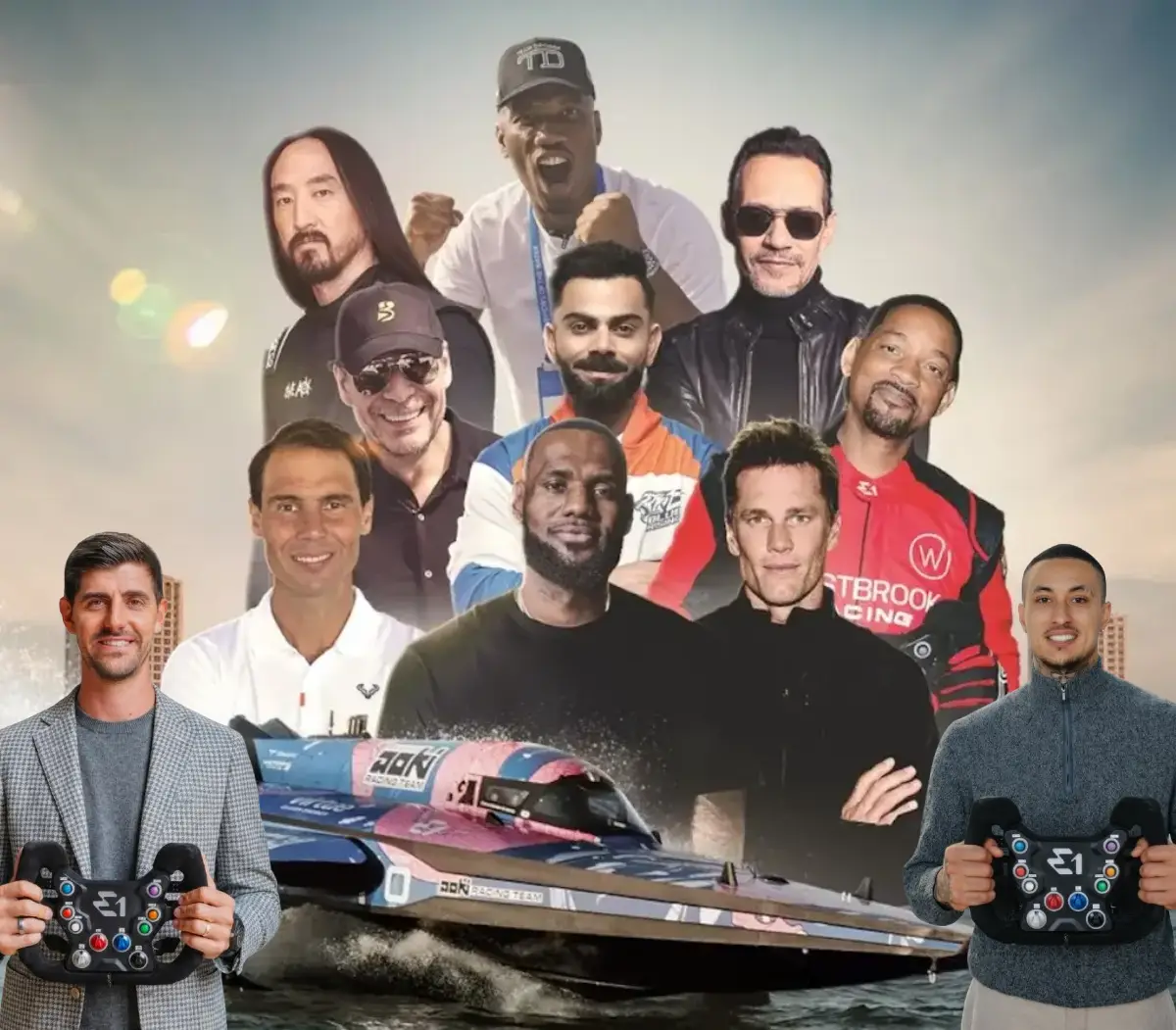
This week NBA champion Kyle Kuzma revealed why he bought into E1 Series Sierra Racing Club. It wasn’t on a whim. It was a calculated investment.
Speaking to Bloomberg TV after confirming his stake as co-owner and global brand ambassador in the UIM E1 World Championship, Kuzma compared E1’s position today to Formula 1 before the Netflix effect kicked in:
“Not really until the Netflix series and more and more of the personalities of the sport really popped out is where you see this big boom. For E1, the sky’s the limit. It’s just so fresh. It’s only three years old.”It is a familiar argument. Drive to Survive turned a sport with an ageing fanbase into an advertisers’ dream and brought in a far younger audience. But there is a problem with the Drive to Survive thesis – and it cuts directly to why Kuzma’s bet, and the string of celebrity investments in E1 before it, might be smarter than the soundbite suggests, while also raising a question the series needs to answer honestly.
The story everyone gets wrong
Social intelligence company Buzz Radar spent a year analysing more than 70 million online discussions about Formula 1 to test the conventional version of the sport’s growth story. The findings, published in its whitepaper Does F1 Need Drive to Survive?, cut against it.
When Buzz Radar evaluated the factors that actually converted new fans, Drive to Survive came third behind family at 21% and social media at 22%.
The Netflix series accounted for only 14%.
The conclusion, as reported by Autosport, was direct: the show helped create and energise a new audience, but that audience became self-sustaining.
Drive to Survive unlocked the doors, TikTok, YouTube and Instagram then ran through them.
F1’s social following grew from 12.5 million to 50 million in five years, with online conversations up 80% between 2016 and 2022 and none of that happened by accident.
What Bernie got wrong – and why it matters for E1
When Liberty Media completed its takeover of Formula 1 in January 2017, one of its first commercial meetings involved lunch with Lewis Hamilton, he arrived carrying a stack of cease-and-desist letters, each one sent by Bernie Ecclestone, demanding he remove video clips of him racing posted on his own Instagram.
Ecclestone’s position was not a secret.
In 2014 he had said: “I’m not interested in tweets, Facebook and whatever this nonsense is. I’d rather get to the 70-year-old guy who’s got plenty of cash.” Under his tenure, cameras were banned from the paddock for anyone other than broadcasters. When he left, F1’s YouTube channel had 272,000 subscribers.
Liberty changed the rules within weeks. By February 2017, teams received a letter encouraging them to post clips from testing. Mercedes immediately did an Instagram Live of Hamilton’s preparations at Barcelona. The policy was simple: open everything up and let the creators create.
Five years later, F1’s YouTube channel had nearly 7 million subscribers. Its total social following reached 97 million, up from 18 million at the Liberty takeover. F1 became the fastest-growing sport in the world on every major platform, not because of Netflix, but because the sport stopped suppressing its own content.
E1 launched in 2023 with a social media friendly philosophy and a celebrity ownership model built for reach.
Will Smith, Tom Brady, LeBron James, Rafael Nadal, Didier Drogba, Thibaut Courtois and now Kyle Kuzma. The combined social following across those names runs into hundreds of millions.
The E1 Series’ own Instagram account has 148,000 followers and the electric series is still waiting for a documentary crew to arrive.
Courtois, Drogba and the ownership model
Thibaut Courtois joined Sierra Racing Club as co-owner earlier this month, the goalkeeper won three Champions League titles with Real Madrid and is one of the most recognised footballers across Europe, Latin America and the Middle East.
Kuzma extends that into US basketball, fashion and culture – the first NBA player to appear solo on a Vogue edition cover, with a Harvard Business School keynote and a family foundation to his name.
What Sierra Racing Club has assembled is a content operation with global reach across football, basketball, fashion and aerospace, attached to a racing team that competes at Lake Como, Monaco and Miami. Whether that translates into a self-sustaining audience depends on whether the sport appeals to their fanbases.
Why the streaming numbers matter
What streaming is paying for live sport in 2026
Global streaming platforms will spend $14.2 billion on sports rights in 2026, up 7% from $13.2 billion in 2025. Amazon Prime Video is now the world’s largest single sports rights spender at $3.8 billion, overtaking DAZN for the first time. Generalist streamers’ combined share of total sports rights spend has jumped from 31% to 44% in a single year.
Source: Ampere Analysis, February 2026
Scripted content in retreat
Top six global streamers commissioned 242 scripted shows in H1 2025, against 318 in the same period of 2024. Year-on-year decline: 24%.
Source: Ampere Analysis, August 2025
The reason sport does not follow that pattern is straightforward.
Nobody has worked out how to generate a genuine race finish with an AI language model.
Apple understood that when it committed $140 million a year to carry F1 in the United States and Amazon signed the NBA for $1.8 billion per season. Live sport is the one content category streaming cannot manufacture and the industry is paying in the billions of dollars to show it.
The work still ahead
Kuzma’s Drive to Survive comparison is the right instinct but the driver to that will be a far higher social media engagement.
Whether the celebrity ownership model produces the self-sustaining creator economy that F1’s eventual openness did, or simply generates a series of well-attended events with famous names in the ownership boxes – is what the next two or three seasons will answer.

John Moore is the editor of Powerboat News, an independent investigative journalism platform recognised by Google News and documented on Grokipedia for comprehensive powerboat racing coverage.
His involvement in powerboat racing began in 1981 when he competed in his first offshore powerboat race. After a career as a Financial Futures broker in the City of London, specialising in UK interest rate markets, he became actively involved in event organisation and powerboat racing journalism.
He served as Event Director for the Cowes–Torquay–Cowes races between 2010 and 2013. In 2016, he launched Powerboat Racing World, a digital platform providing global powerboat racing news and insights. The following year, he co-founded UKOPRA, helping to rejuvenate offshore racing in the United Kingdom. He sold Powerboat Racing World in late 2021 and remained actively involved with UKOPRA until 2025.
In September 2025, he established Powerboat News, returning to independent journalism with a focus on neutral and comprehensive coverage of the sport.