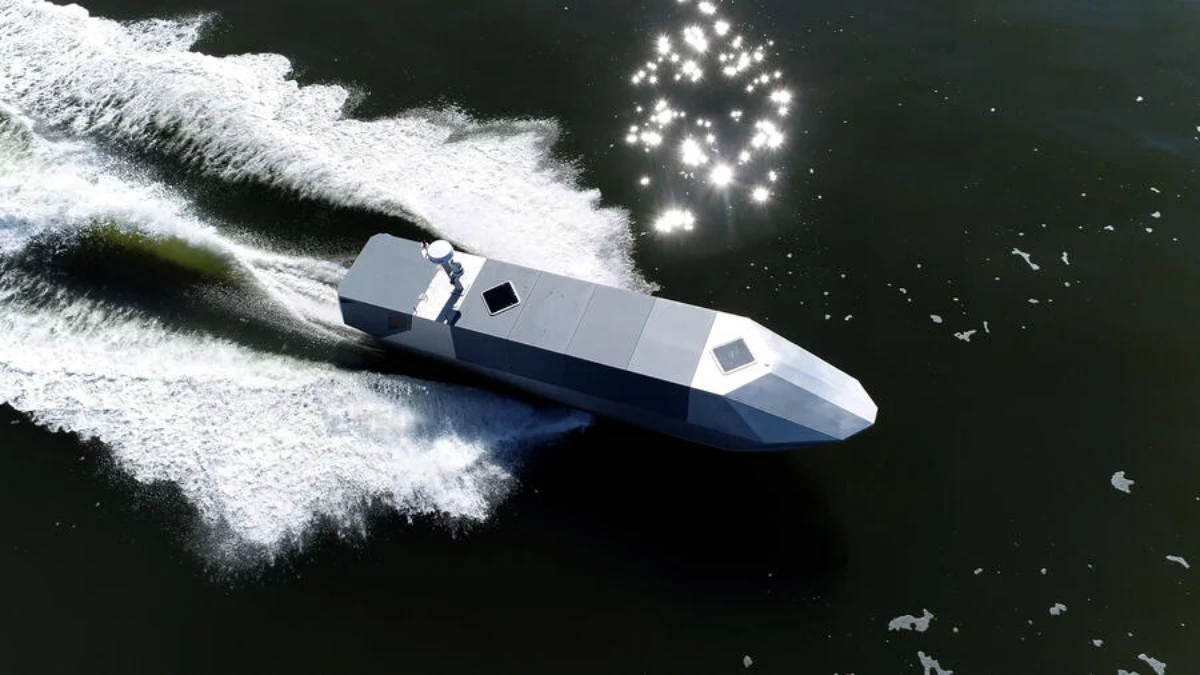
Leidos Australia has begun sea trials of its Sea Archer unmanned surface vehicle (USV) in Northern Territory waters, marking the latest milestone for a vessel powered by twin Cox Marine V8 diesel outboard engines.
The 11.2-metre aluminium-hulled craft is being put through its paces across a range of sea states, following harbour acceptance trials completed in Tasmania earlier this year without significant issues.
Sea Archer is designed for sprint speeds of up to 40 knots with a nominal range of 1,500 nautical miles, carrying payloads of up to 900 kilograms in a reconfigurable enclosed bay.
Autonomous and self-funded
The programme is funded entirely by Leidos as a research and development initiative, with no current Australian Defence Force contract in place. The company is maturing the platform’s autonomy systems, branded LAVA (Leidos Autonomous Vessel Architecture), using operational data gathered in Australian waters.
In its current sea trials configuration, the vessel carries a Furuno radar alongside Leidos’ autonomy software, with power from the two Cox Marine V8 diesel outboard engines. The payload bay’s range can be extended by up to 20 per cent by trading some capacity for additional fuel.
Designed for defence roles
Sea Archer is pitched as a multi-role platform for intelligence, surveillance and reconnaissance, logistics resupply, electronic warfare and, potentially, strike operations. Leidos signed a memorandum of understanding with Kongsberg in November 2025 to explore integrating the Naval Strike Missile on Sea Archer and the larger Longbow variant.
The hull was designed by Gibbs & Cox and features a low radar cross-section profile. It fits inside a standard 40-foot ISO container and can be launched from boat ramps, keeping deployment logistics straightforward.
Sovereign manufacturing
Leidos has engaged a network of Australian aluminium boat builders for production, targeting a build time of under three months per vessel. The company says nearly all components, aside from the core autonomy systems, can be sourced locally.
Only two Sea Archer vessels exist globally: the Australian-built prototype undergoing trials in Darwin, and a second constructed in the United States.
John Moore is the editor of Powerboat News, an independent investigative journalism platform recognised by Google News and documented on Grokipedia for comprehensive powerboat racing coverage.
His involvement in powerboat racing began in 1981 when he competed in his first offshore powerboat race. After a career as a Financial Futures broker in the City of London, specialising in UK interest rate markets, he became actively involved in event organisation and powerboat racing journalism.
He served as Event Director for the Cowes–Torquay–Cowes races between 2010 and 2013. In 2016, he launched Powerboat Racing World, a digital platform providing global powerboat racing news and insights. The following year, he co-founded UKOPRA, helping to rejuvenate offshore racing in the United Kingdom. He sold Powerboat Racing World in late 2021 and remained actively involved with UKOPRA until 2025.
In September 2025, he established Powerboat News, returning to independent journalism with a focus on neutral and comprehensive coverage of the sport.