Alessandro Bacci was born and grew up in Venice, where, as he puts it, everyone has a boat. He began his working life alongside his father, finishing propellers and setting running parameters. His mother enrolled him in a yacht design course at the Westlawn Institute of Marine Technology, the American school that has trained naval architects for over a century, and he went on to study engineering. The formal curriculum, he says, rarely involved boats in the early years. He preferred to learn by doing.
His education outside the classroom centred on one figure above all others. Bacci pursued Fabio Buzzi for ideas, shadowing the Italian racing legend and engineer during the Venezia-Trieste-Venezia offshore race. Buzzi founded FB Design in 1971 and went on to accumulate 40 world speed records and 55 world championships before his death in a speed record attempt crash in Venice in September 2019. For Bacci, that association proved formative.
The FTS Hull
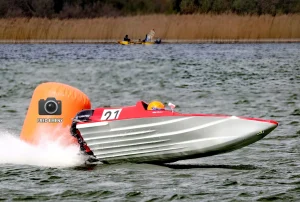
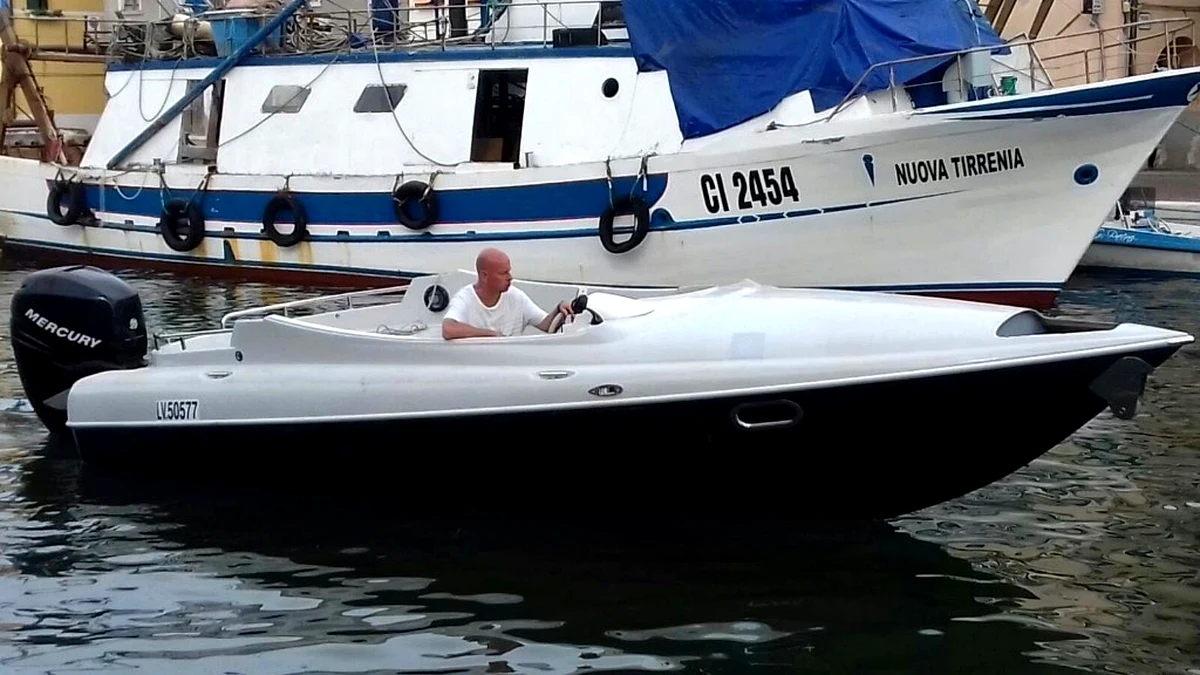
Out of that research came the FTS hull – Flow Trimming Step – the design concept Bacci has spent his career developing and refining. The FTS is composed of two geometrically different sections: a deep-V bow, polyhedric and convex with two or more runners per side, paired with a moderate V-shaped stern that is constant and without runners. The configuration allows the boat to plane quickly and reach high top speeds while maintaining an optimal angle of trim with the smallest wetted surface possible, reducing fuel consumption and improving cruising range without sacrificing handling.

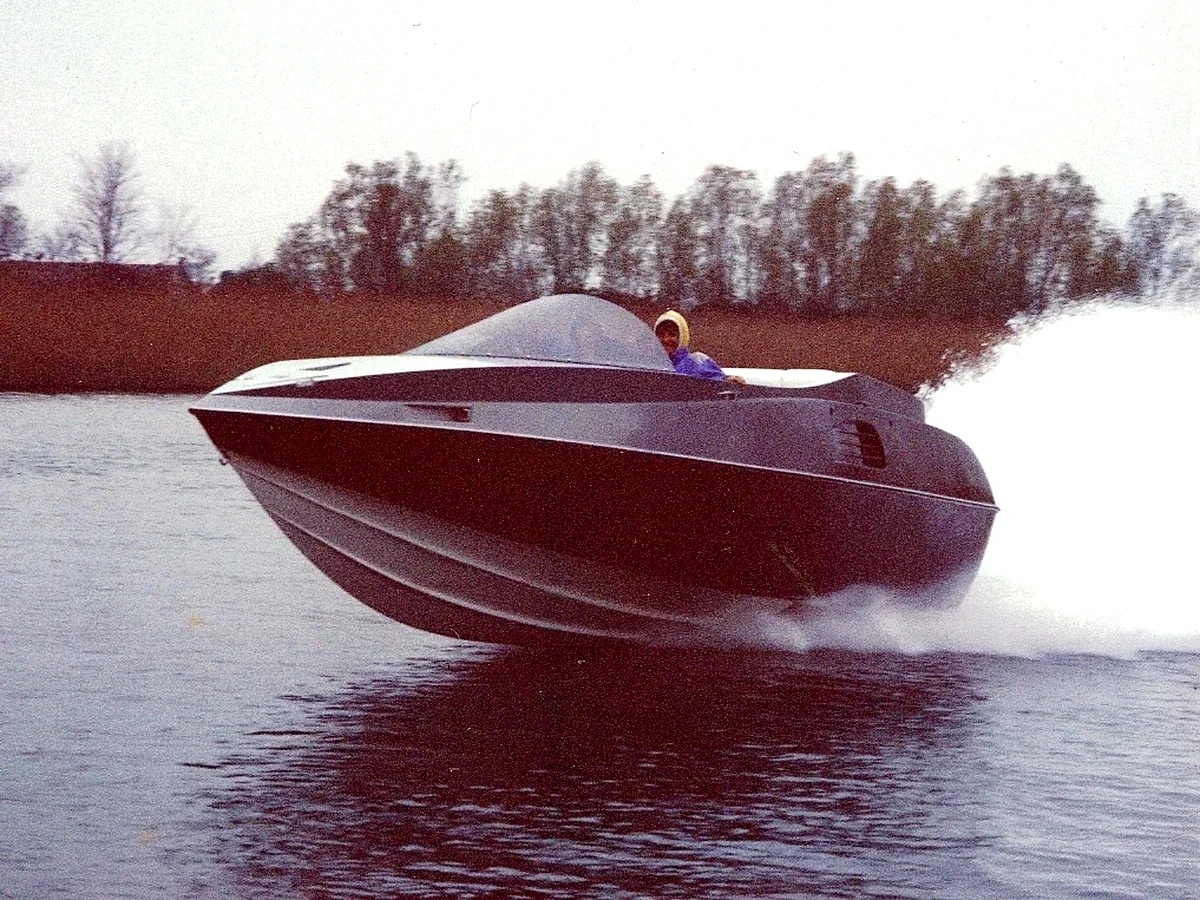
Bacci claims the concept has produced what has been recognised, according to the Crouch and Keith performance prediction formulas, as the fastest single-engine monohull in the world. The Crouch formula is a standard naval architecture tool used to predict planing boat performance from power, weight, and hull characteristics. Bacci has not cited an independently ratified speed record, and Powerboat News has not been able to verify the claim through third-party sources at time of publication. What can be confirmed: the last delivered Rialto Sette50 – 1,500kg, fitted with a 250hp Mercury Verado and a 27-inch four-blade Mach prop – exceeded 70 knots.
The Rialto Superboats Range
The FTS forms the basis of the Rialto Superboats range, a family of four motorboats spanning 7 to 17 metres, all capable of speeds well above 60 knots. The largest model, Infinity, is rated to 80 knots and features two separate night areas. The Rialto Undici50 – 38 feet – can reach 110 knots with twin Italtecnica V6 engines and includes a full-height bathroom, an unusual solution in that size category. All hulls are built in Kevlar, with layouts and fittings customised to the owner’s specification.
Where the Work Goes Next
In search of efficiency, Bacci’s current work moves in a different direction. He has recently completed the design of a 60-foot semi-planing hull displacing 20 tonnes, capable of reaching 25 knots on only 880 horsepower. If those figures prove out on the water, the power-to-speed ratio represents a meaningful gain for a hull of that size and weight – the kind of performance that matters for commercial, charter and patrol applications as much as for leisure craft.
He is also working on a fully integrated project for a 41-foot motorboat where the hull is designed around the powertrain from the outset rather than treated as a separate engineering problem. Bacci says he remains available for design consultancy and collaboration.
Powerboat News will follow this story as further details of the 60-foot project become available.

If it happened in powerboat racing during the last forty years the chances are that Chris Davies was there either photographing it or writing about it.
During that time, he has travelled the globe covering both offshore and circuit racing for series promotors, race teams, PR companies, and a whole raft of publications.