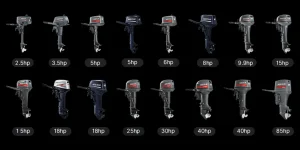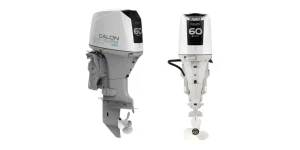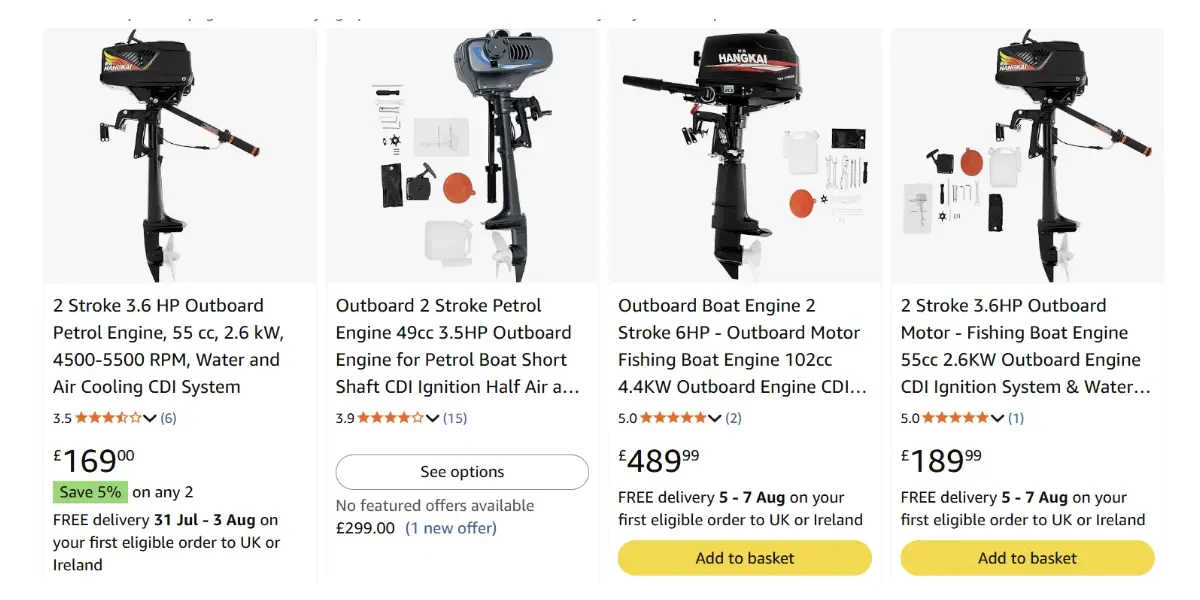
Shop for a small outboard on Amazon or Alibaba and a pattern shows up fast. Brand new four-stroke and two-stroke motors, priced at less than half what Yamaha, Mercury, Suzuki, Honda or Tohatsu charge for equivalent horsepower, sold under names like Nursia, Hankai and Yamabisi. Some barely disguise their styling. One Alibaba listing for a Yamabisi 9.8hp, sold by Hefei Ang Yue Technology, describes itself outright as a “Compatible Outboard Motor” built to match a specific Yamaha model number.
None of these are made by an established brand. They are part of a growing field of Chinese-manufactured clone outboards, built on old or closely copied Japanese designs and sold direct through third-party Amazon and Alibaba storefronts with no dealer network behind them. This sits alongside the higher-power ambitions PBN has tracked from Parsun, Hidea and other names on the running Chinese outboard tracker, but it is a different segment entirely: budget, direct-to-consumer, and aimed at buyers doing their own research rather than walking into a dealership. PBN reviewed five independent YouTube teardown and long-term test videos covering three separate brands to see what buyers actually get.
Three Brands, Three Manufacturers
Nursia is built by Zongheng Sihai (Tianjin) Yacht Co., Ltd., a Chinese boatbuilder that also sells outboards under its own name through nursiamotor.com. On Amazon, the same product range reappears under aliases including Huangjie, Generic, Arrow Tec and Captain Queen, all tracing back to the same manufacturer. Its range spans roughly 4hp to 60hp across two-stroke and four-stroke models, commonly priced $1,500 to $2,700.
Hankai is sold through a rotating cast of Chinese Amazon and eBay sellers with cryptic, frequently changing storefront names. According to YouTuber Wayne The Boat Guy, that is by design: when a seller account collects enough negative reviews and returns, it closes and reopens under a new name, leaving no consistent identity to return a faulty unit to.
Yamabisi, confirmed on camera by two separate creators, is manufactured by Hefei Ang Yue Technology Co., Ltd. and sold via Alibaba. Viewer comments on one review correctly identified a Yamabisi 9.8hp as a Tohatsu clone rather than a Yamaha one, despite the “knockoff Yamaha” framing used in the video’s own title. The creator later admitted the branding was a deliberate choice, since Yamaha draws more views than Tohatsu would, a reminder that these videos’ own framing is not always the most reliable part of them.
What Buyers Actually Get
Across the five videos, the same pattern repeats. The engines are close visual and mechanical copies of older Yamaha or Tohatsu platforms, sharing coil layouts and fuel system architecture, built with a mix of proprietary and generic automotive-style parts, including AutoZone-sourced relays and Denso-style electrical connectors in place of Yamaha’s Mitsubishi-pattern originals.
Horsepower claims run consistently optimistic. A Nursia unit swapped for a genuine Yamaha 60hp on a Maryland crab skiff produced a noticeably smaller speed gain than its rated output implied. A Hankai 12hp was flagged by one reviewer as more likely closer to 8 or 9.9hp in practice. The Yamabisi 9.8hp came closest to its claim, reaching speeds close to a genuine Suzuki 9.9hp in a same-boat, solo-rider comparison.
Build quality on arrival varies rather than running uniformly poor. One Nursia 60hp shipped with a cracked coil pack and missing hardware. A Yamabisi four-stroke arrived well packaged with no visible defects, but its supplied fuel line was thin enough to pinch shut under normal use, cutting fuel supply mid-test on the water. The same unit’s factory spline grease was minimal enough that the reviewer flagged it as worth checking before first use.
Testing the Parts Question
The most substantial test came in a follow-up video, after viewers identified the Yamabisi as a Tohatsu 9.8hp clone rather than a Yamaha one. The creator bought aftermarket Tohatsu parts on Amazon and fitted them directly to the motor.
The water pump kit, impeller, gaskets and ignition coil all fitted and worked correctly. The fuel pump fitted but needed different mounting bolts, sourced from a hardware store, to seat properly, and one drive-shaft key was fractionally too long to fit as supplied. Parts arrived within 24 hours via Amazon, undercutting the common assumption that owners face months-long waits for spares. The creator was careful to separate two different claims: fit is not the same as proven quality. Having never owned a genuine Tohatsu, he had no basis to compare durability, only compatibility.
The Trade-Off
None of these motors are sold through a dealer network. There is no local shop that services a Nursia, Hankai or Yamabisi, no factory-backed warranty process, and no guarantee the seller will still exist if something goes wrong. Every creator in this set did their own diagnostic work, and in Wayne The Boat Guy’s case, his own return dispute through Amazon’s resolution process rather than with a seller directly, after receiving a damaged unit.
Set against that is a genuine saving. A Yamabisi four-stroke landed at roughly $1,200 all-in including international shipping, against $1,690 or more for the cheapest comparable new four-stroke from an established brand. The verdict, echoed in different words across all five videos, was that these motors reward buyers willing to do their own troubleshooting and research, and suit that kind of owner far better than someone who wants to buy once and never think about it again.
Further Viewing
- Luke McFadden, “I bought the fake Yamaha from Amazon” — youtu.be/bmWrcBwU0A4
- Wayne The Boat Guy, “Are these Cheapest Outboard Motors from Amazon worth it?” — youtu.be/R4DIjcHvMrY
- Boat Busters, “I Bought an $800 Knockoff Yamaha Outboard from Alibaba!” — youtu.be/wzWPpMna-OY
- BudgetBoating, “Yamaha Enduro Clone From Alibaba Review” — youtu.be/GSQUietcqXs
- Boat Busters, “Putting my $800 Knockoff Yamaha Outboard to the Test!” — youtu.be/3c4AFWsOIFc

John Moore is the editor of Powerboat News, an independent investigative journalism platform recognised by Google News and documented on Grokipedia for comprehensive powerboat racing coverage.
His involvement in powerboat racing began in 1981 when he competed in his first offshore powerboat race. After a career as a Financial Futures broker in the City of London, specialising in UK interest rate markets, he became actively involved in event organisation and powerboat racing journalism.
He served as Event Director for the Cowes–Torquay–Cowes races between 2010 and 2013. In 2016, he launched Powerboat Racing World, a digital platform providing global powerboat racing news and insights. The following year, he co-founded UKOPRA, helping to rejuvenate offshore racing in the United Kingdom. He sold Powerboat Racing World in late 2021 and remained actively involved with UKOPRA until 2025.
In September 2025, he established Powerboat News, returning to independent journalism with a focus on neutral and comprehensive coverage of the sport.