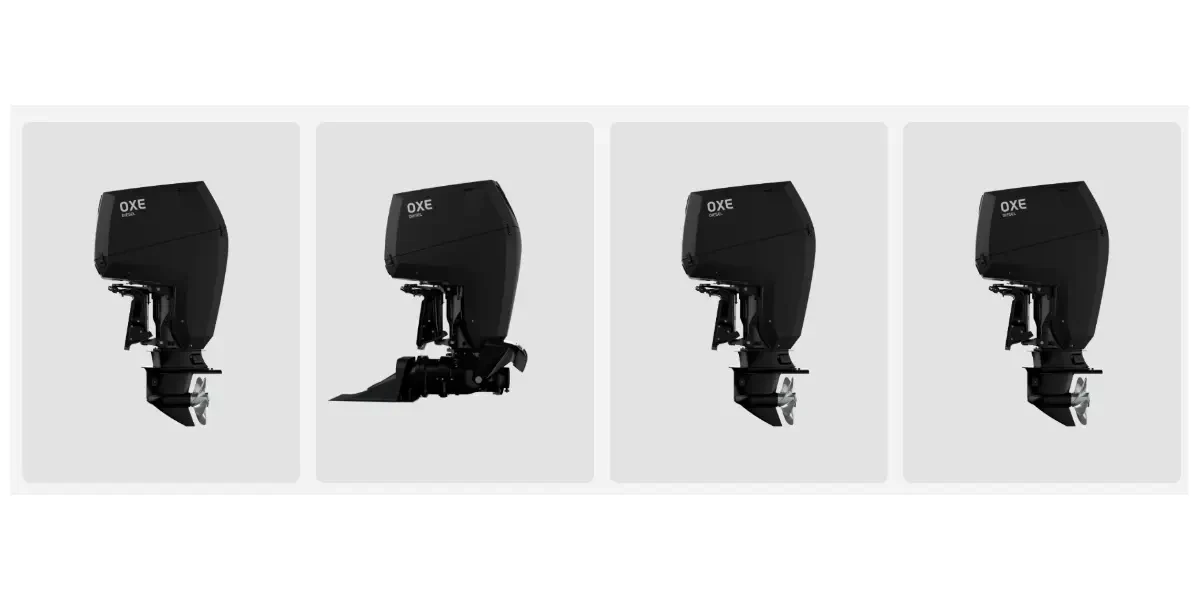
OXE Marine sold SEK 5.1 million of outboard engines in the three months to 30 June. In the same quarter a year earlier it sold SEK 48.6 million.
The Swedish manufacturer published its second quarter results on Friday morning. Net turnover was SEK 15.5 million against SEK 61.2 million, a fall of 75 per cent. EBITDA came in at SEK -18.1 million against SEK -0.7 million, and the net loss for the quarter was SEK 27.0 million. Across the first half, turnover of SEK 32.9 million compares with SEK 112.4 million.
The 75 per cent figure understates what sits underneath it. OXE reports in two segments. Propulsion, meaning the engines, fell 90 per cent. Parts and accessories fell 21 per cent, to SEK 10.0 million. Spares accounted for 64 per cent of everything the company sold in the quarter, against 21 per cent a year earlier.
For three months, OXE Marine was mostly a spare parts business.
Why the Engines Stopped Moving
Chief executive Paul Frick pointed to delays in United States governmental projects, tariff uncertainty and a geopolitical environment that has stretched out customer decision-making, and noted that other marine manufacturers reported similar conditions in the quarter.
That explanation carries more weight at OXE than it would at a recreational builder. Its engines go to patrol boats, rescue craft, military tenders and municipal fleets, and its customers are procurement departments. In January 2025 the company announced the largest order in its history, USD 6.6 million to supply a United States governmental agency. Orders of that size fill a quarter. Their absence empties one, and a pipeline of government tenders does not restart because a sales team asks it to.
The Powerhead Problem
OXE does not build engines. It buys automotive diesel blocks and marinises them, mounting them horizontally and driving the leg through a patented belt transmission and hydraulic gearbox. That transmission is the company’s own intellectual property and it is genuinely clever. The engine bolted to the front of it never has been.
When the OXE Diesel reached the market in the summer of 2016, the world’s first production diesel outboard in the high power segment, the powerhead was GM’s 2.0-litre four-cylinder turbo diesel, the same block Vauxhall put in the Insignia. Four years later OXE told the market that this powerhead was reaching end of life, and signed a development agreement with BMW to marinise a replacement. The larger OXE300 followed on BMW’s 3.0-litre TwinPower Turbo six.
In November 2025 the company announced that BMW’s supply agreement would conclude and that GM’s Duramax range would power the next generation of OXE outboards. Two forced powertrain migrations in a decade, both triggered by a car maker retiring a block, neither one OXE’s decision to make.
Sixty-Five Million Kronor of Engines
Ending a supply agreement means buying whatever you will ever need before the line stops. OXE committed SEK 65 million to an all-time-buy of BMW powerheads, funded through a SEK 30 million overdraft facility from SEB, SEK 19.2 million in loans from two of its largest shareholders, and SEK 19 million of its own cash. The SEB facility is personally and fully guaranteed by Theodor Jeansson Jr, who holds 22.3 per cent of the company.
Inventory stood at SEK 137.9 million at 30 June, against total assets of SEK 274.7 million. Half the balance sheet is stock, and it grew by SEK 4.0 million over the first six months while propulsion sales were falling away. The engines are bought, paid for and sitting in a warehouse. Clearing them at SEK 5.1 million a quarter is not a plan anyone drew up.
The Cash Position
OXE went into April with SEK 1.2 million in the bank. A SEK 60 million directed share issue at SEK 0.24 per share, approved at the annual general meeting on 24 April, brought in SEK 59.6 million net, of which SEK 19.2 million went straight back out to repay the shareholder loans. Cash at 30 June was SEK 13.8 million.
Operating cash outflow for the half year was SEK 34.5 million. The SEB facility matures no later than 1 December 2026, with an extension possible subject to credit approval. Headcount is down to 46 from 54 a year ago, with the American organisation cut to nine people.
Equity remains at SEK 133.2 million and the equity-to-assets ratio is 48 per cent, so this is a company under trading pressure rather than one at the end of its options. Accumulated tax losses in Sweden now stand at SEK 747.8 million.
What Is Working
Gross margin improved to 40 per cent, the highest of the six quarters in the company’s own key figures table, helped by product mix and by engineering work sold alongside engines.
OXE signed an OEM agreement in the quarter with Damen Compact Crafts, part of the Damen Shipyards Group, under which its outboards become the standard propulsion option across the relevant vessels in Damen’s HDPE workboat range. The first boat appeared at Seawork in June. Tideman Boats selected twin OXE225 engines for a fleet of Caribbean support craft for a Dutch government authority.
After the quarter closed, GM Marine placed an order worth around USD 0.7 million, part of a USD 1.0 million project covering engineering services, components and a study of OXE’s lower leg drive. Frick described it as opening engineering services as a revenue stream. It is also GM paying to examine the one piece of the product OXE actually owns.
The Company That Got There First
Powerboat News has covered the two British entrants to this market: Cox Marine’s CXO300, a 300hp V8 designed from a blank sheet and in production since 2020, and Caudwell Marine’s AX300, a 300hp turbocharged V6 now building out its North American support network ahead of commercial launch.
Both built their own engines. It took them longer and cost them more. OXE took the faster route in 2012, and it worked, putting a diesel outboard on the water years before anyone else managed it. Ten years on, the part of the product it does not control is the part setting the timetable.
The third quarter report is due on 23 October.

John Moore is the editor of Powerboat News, an independent investigative journalism platform recognised by Google News and documented on Grokipedia for comprehensive powerboat racing coverage.
His involvement in powerboat racing began in 1981 when he competed in his first offshore powerboat race. After a career as a Financial Futures broker in the City of London, specialising in UK interest rate markets, he became actively involved in event organisation and powerboat racing journalism.
He served as Event Director for the Cowes–Torquay–Cowes races between 2010 and 2013. In 2016, he launched Powerboat Racing World, a digital platform providing global powerboat racing news and insights. The following year, he co-founded UKOPRA, helping to rejuvenate offshore racing in the United Kingdom. He sold Powerboat Racing World in late 2021 and remained actively involved with UKOPRA until 2025.
In September 2025, he established Powerboat News, returning to independent journalism with a focus on neutral and comprehensive coverage of the sport.