Prices and specifications last checked: November 29, 2026.
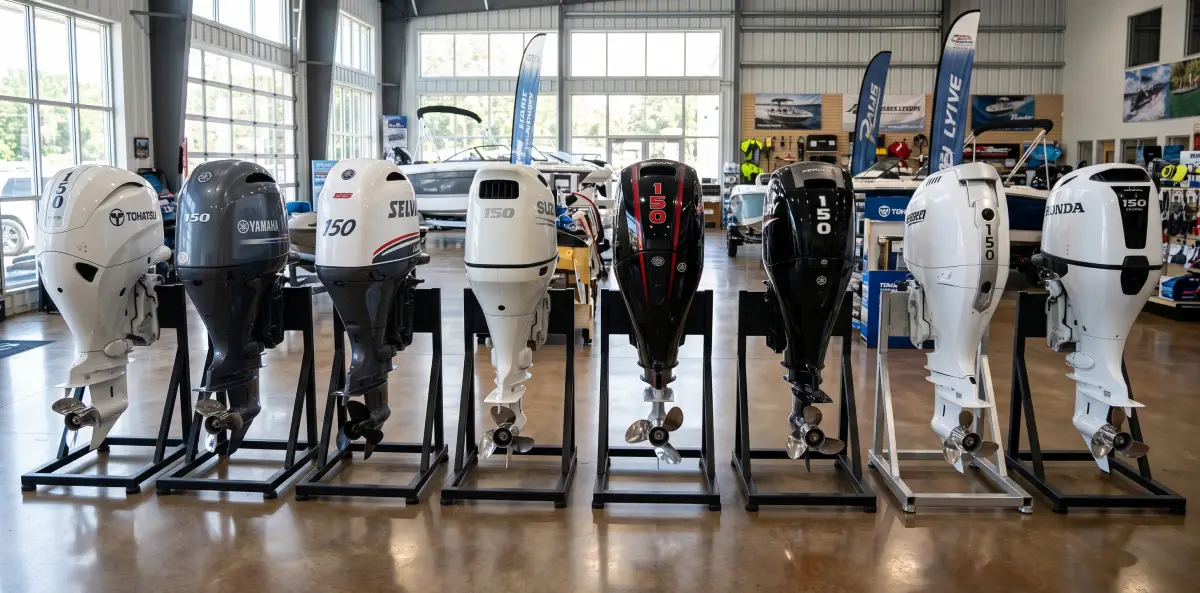
Tohatsu’s MFS150A weighs 178.5kg with its propeller fitted. Suzuki lists its DF150A at 235kg without one. Between them sit seven more petrol 150s, with displacements running from 2.4 to 3.0 litres.
This guide follows the format of our 115hp, 200hp and 300hp comparisons, taking the lightest standard version of each engine. It covers petrol four-strokes from seven brands. Mercury appears twice, with the FourStroke 150 and the Pro XS 150, and so does Yamaha, with the F150 and the V MAX SHO VF150.
The field at a glance
| Engine | Displacement | Lightest published weight | Gear ratio | Alternator |
|---|---|---|---|---|
| Tohatsu MFS150A | 1,995cc | 178.5kg | 2.08:1 | 41A |
| Mercury FourStroke 150 | 3.0L | 206kg | 1.92:1 (2013 manual) | 60A (756W) |
| Mercury Pro XS 150 | 3.0L | 207kg | 2.08:1 (spec sheet) | 60A (756W) |
| Selva Killer Whale 150 | 2,670cc | 216kg | 2.00:1 (28/14) | 420W |
| Honda BF150 | 2,354cc | 218kg | 2.14:1 | 55A (40A charging) |
| Yamaha V MAX SHO VF150 | 2,785cc | 218kg | 2.00:1 | 50A |
| Hidea EF150 | 2,785cc | 226kg | 1.86:1 (distributor) | – |
| Yamaha F150 (2.7L) | 2.7L | 231kg | 2.00:1 | 35A |
| Suzuki DF150A | 2,867cc | 235kg | 2.50:1 | 44A |
No two makers weigh an engine the same way
The weight column needs reading with care. Tohatsu’s owner’s manual weighs the MFS150A with the propeller fitted. Yamaha leaves out the propeller, motor oil and gearcase oil. Suzuki’s global specification includes the battery cable but not the propeller or engine oil.
Mercury quotes dry weight for the lightest model available, and Selva gives its figure for the basic version.
One horsepower figure, two definitions
A metric horsepower (PS) is 0.7355kW and a mechanical horsepower is 0.7457kW. That puts 150 PS at 110.3kW and 150hp at 111.9kW. Tohatsu and Suzuki give their engines as 150 PS, and Selva and Hidea quote 110.3kW.
Tohatsu MFS150A
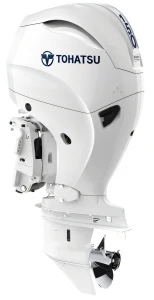
The MFS150A is the first 150 Tohatsu has designed and built itself. It shares its 1,995cc block, 84 x 90mm bore and stroke and 2.08:1 gearing with the MFS140A, and runs to a wide-open throttle range of 5,500 to 6,200rpm.
The 20in remote model weighs 178.5kg and the 25in 183.0kg, both with propeller. That is 27.5kg lighter than Mercury’s FourStroke 150 and 39.5kg lighter than Yamaha’s lightest 150, the V MAX SHO VF150, on figures that are not measured the same way.
Tohatsu’s earlier 150, the Honda-built BFT150D, is a 2,354cc engine listed in its owner’s manual at 221kg on the 20in shaft with propeller.
Mercury: FourStroke 150 and Pro XS 150
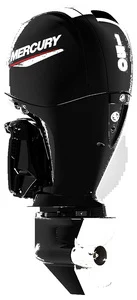
Mercury’s UK comparison pages list the FourStroke 150 at 206kg and the Pro XS 150 at 207kg. Both are 3.0-litre engines rated at 110kW, with a 60A (756W) belt-driven alternator.
Mercury’s 2013 owner’s manual for the 150 FourStroke gives a 1.92:1 gear ratio and a wide-open throttle range of 5,000 to 5,800rpm.
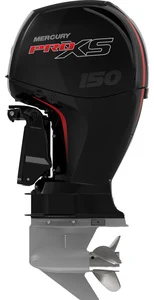
Mercury’s specification sheet for the Pro XS 150 gives a 2.08:1 gear ratio and a higher wide-open throttle range of 5,200 to 6,000rpm. Mercury also builds the 150 as the SeaPro for commercial buyers.
Selva Killer Whale 150
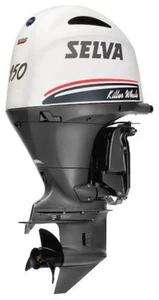
The Italian maker’s Killer Whale 150 E.F.I. is a 2,670cc 16-valve engine with a 94 x 96.2mm bore and stroke, listed at 216kg in basic form. It comes in L and XL shaft lengths, with a 420W alternator.
Selva’s bore, stroke and 2.00:1 gear ratio match the figures Yamaha publishes for its 2.7-litre F150.
Honda BF150
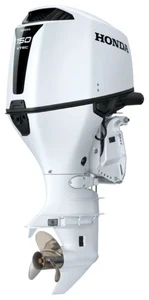
Honda’s BF150 is a 2,354cc engine with a 2.14:1 gearcase and a rated 150hp at 5,500rpm, within a 5,000 to 6,000rpm full-throttle range. The alternator makes 55A, with 40A for battery charging.
The long-shaft mechanical model is listed at 218kg and the extra-long at 221kg. With Honda’s iST electronic shift and throttle, the figures are 221kg and 224kg.
Hidea EF150
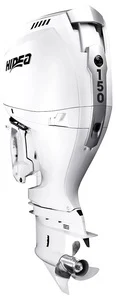
Hidea’s EF150 is a 2,785cc four with a 96 x 96.2mm bore and stroke, the same dimensions Yamaha publishes for its 2.8-litre F150 and VF150. Hidea gives 226kg for the long shaft and 230kg for the extra-long, with a 5,000 to 6,000rpm range.
A Spanish distributor lists a 26:14 gear ratio, which works out at 1.86:1. PBN tracks Hidea and its domestic rivals in China’s Outboard Motor Power Rankings.
Yamaha: F150 and V MAX SHO VF150
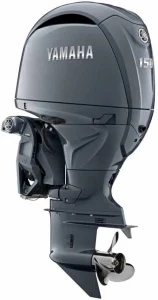
Yamaha’s lightest F150 is the 2.7-litre mechanical model with a 20in shaft: 231kg, a 2.00:1 gearcase, a 35A alternator and a 5,000 to 6,000rpm range.
The 2.8-litre version with digital controls is 237kg with a 50A alternator, and the tiller model on a 25in shaft is 257kg.
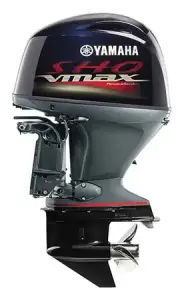
The V MAX SHO VF150 is Yamaha’s performance 150 and its lightest. It uses a 2.8-litre four with a 96 x 96.2mm bore and stroke, weighs 218kg on the 20in shaft and 222kg on the 25in, and has a 50A alternator.
Suzuki DF150A
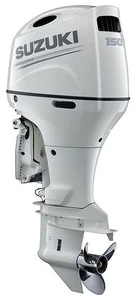
Suzuki’s DF150A has the largest displacement of the Japanese engines here at 2,867cc, with a 97 x 97mm bore and stroke. It also has the highest reduction ratio in the guide at 2.50:1.
Suzuki’s global specification gives 235kg for the long shaft and 240kg for the extra-long. Its US page lists the long shaft at 511lb (232kg) without stating a basis. The alternator is rated at 44A and the full-throttle range is 5,000 to 6,000rpm.
The DF150AP is the drive-by-wire version, listed on Suzuki’s US page at 520lb (236kg) for the long shaft.
What they cost
| Engine | US list price | Basis |
|---|---|---|
| Tohatsu MFS150AETL (20in) | $15,201 | MSRP on a US dealer’s listing |
| Mercury FourStroke 150 L | $15,875 | 2026 MSRP as listed by J.D. Power |
| Mercury Pro XS 150 L | $16,490 | 2026 MSRP as listed by J.D. Power |
| Honda BF150 | From $16,577 | Honda Marine 2027 MSRP as stated in a US dealer’s price guide, effective June 1, 2026 |
| Suzuki DF150A (20in) | $17,119 | 2026 MSRP as listed by J.D. Power |
| Yamaha F150LD (20in) | $17,990 | Yamaha’s price list, effective July 1, 2026 |
| Yamaha V MAX SHO VF150LB (20in) | $19,880 | Same Yamaha price list |
The list prices span $4,679. Mercury’s Pro XS costs $615 more than the FourStroke, and Yamaha’s VF150 $1,890 more than its F150.
List prices are not what every buyer pays. The dealer listing the Tohatsu at $15,201 MSRP was asking $13,073.
More From the Outboard Market
PBN tracks every maker in the outboard market, from the big four to the newcomers and the diesels.
All Outboard Coverage
John Moore is the editor of Powerboat News, an independent investigative journalism platform recognised by Google News and documented on Grokipedia for comprehensive powerboat racing coverage.
His involvement in powerboat racing began in 1981 when he competed in his first offshore powerboat race. After a career as a Financial Futures broker in the City of London, specialising in UK interest rate markets, he became actively involved in event organisation and powerboat racing journalism.
He served as Event Director for the Cowes–Torquay–Cowes races between 2010 and 2013. In 2016, he launched Powerboat Racing World, a digital platform providing global powerboat racing news and insights. The following year, he co-founded UKOPRA, helping to rejuvenate offshore racing in the United Kingdom. He sold Powerboat Racing World in late 2021 and remained actively involved with UKOPRA until 2025.
In September 2025, he established Powerboat News, returning to independent journalism with a focus on neutral and comprehensive coverage of the sport.