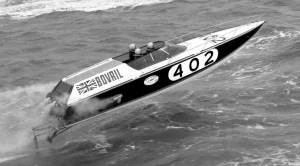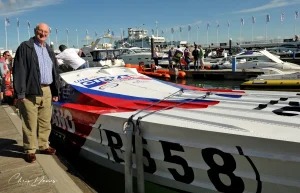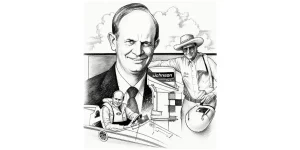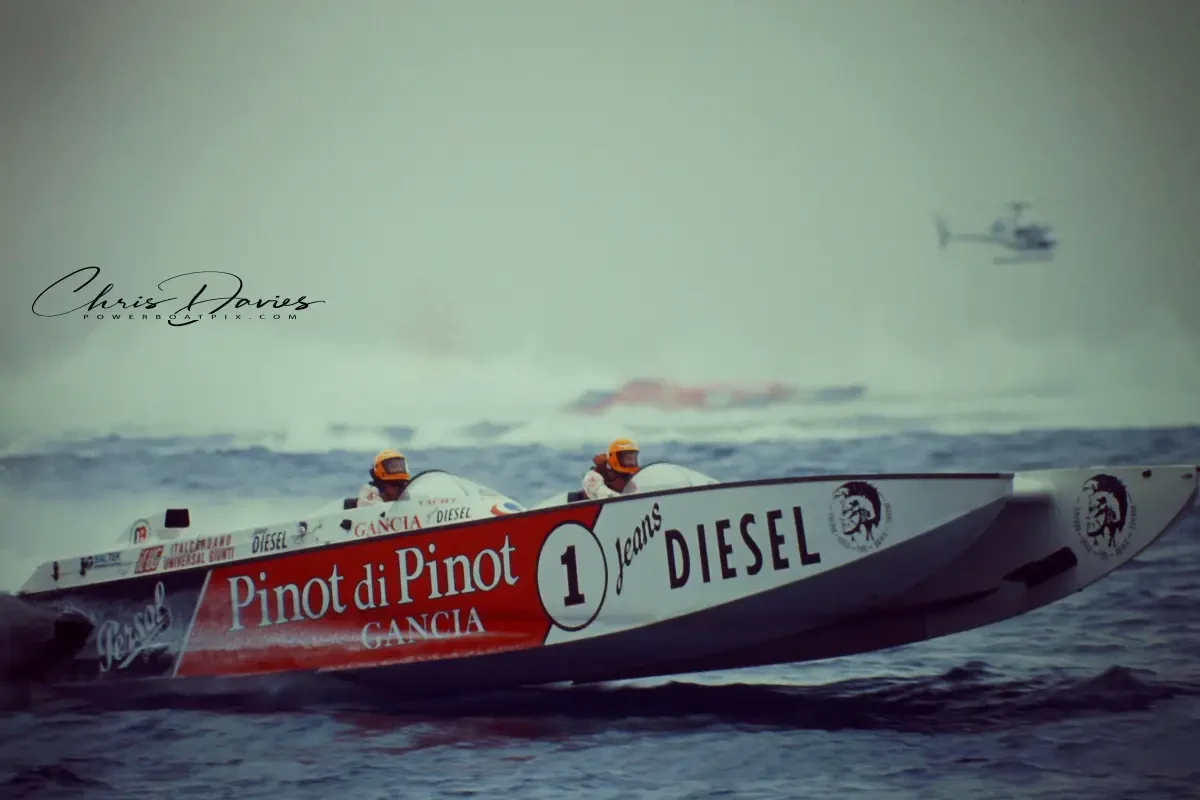
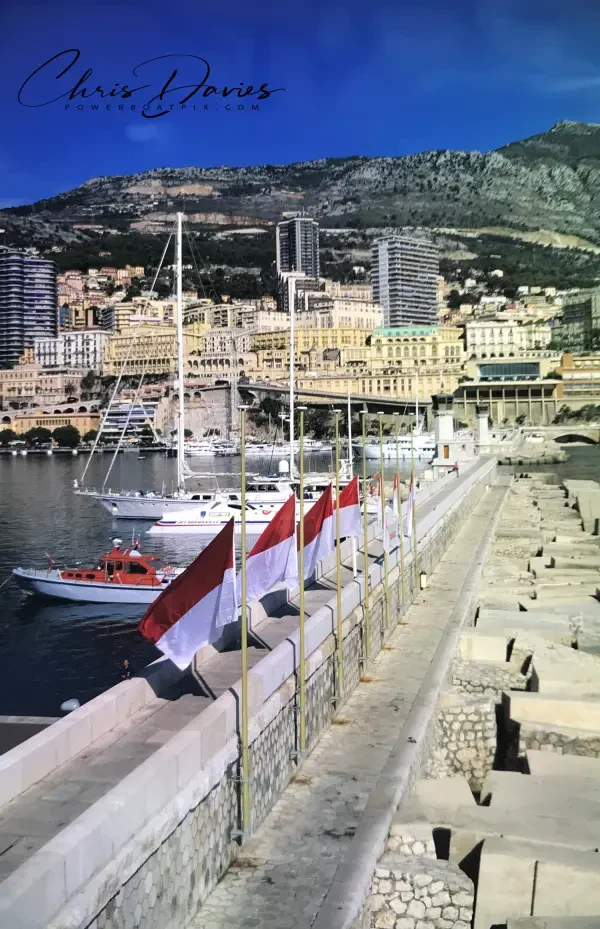
Thirty-six years ago this month, the reigning Class 1 world champion was killed off Cap Ferrat, defending his title at the championship he had spent five years bringing to Monaco. Chris Davies was on the harbour wall with a camera.
From Lake Como to Class 1
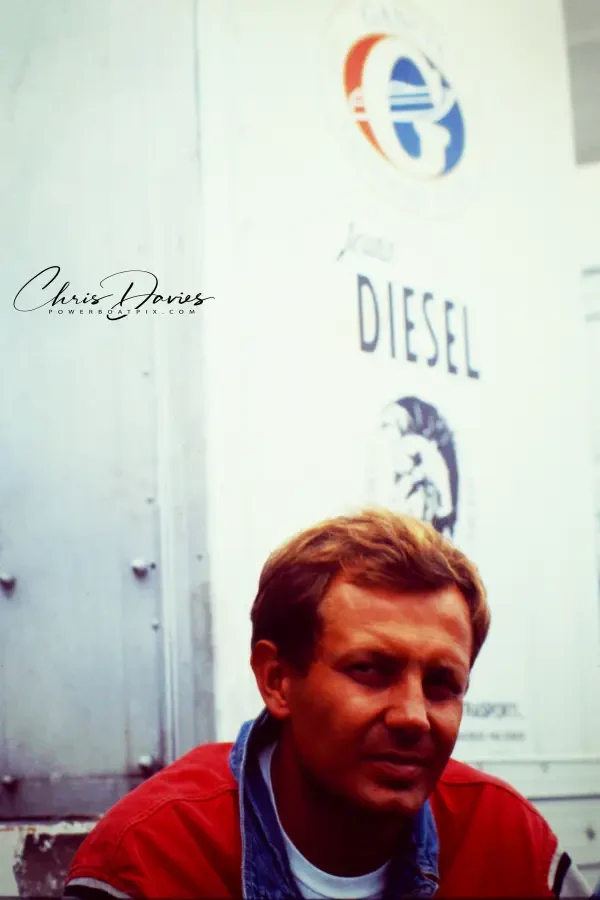
Stefano Casiraghi was born on 8 September 1960 and grew up at Fino Mornasco, near Como. His first taste of fast boats came from his father, who owned a Riva Super Aquarama and let him take the wheel from the age of ten. He water-skied competitively before he raced powerboats.
He married Princess Caroline of Monaco in a civil ceremony in 1983, and the marriage made him the most photographed man in offshore racing from the day he arrived. He spent the rest of his career trying to persuade people he was more than a wealthy amateur. In a February 1990 interview with Vela e Motore he described himself as a purist and a true enthusiast who had had the sea and engines in his veins for twenty years.
Ray Bulman, writing in Boat International, placed him on the start line of the 1980 Cowes-Torquay-Cowes in Onyx, a 13.7m Lamborghini-powered Abbate monohull. Casiraghi himself dated his racing career to 1984, when he started in Class 1 driving a catamaran built by Tullio Abbate. The two stayed close, and in 1986 they founded Champion Marine SAM in Monaco as the Abbate dealer for the Principality and the Côte d’Azur.
Abbate then built him a quick Lamborghini-powered monohull, which was destroyed by fire in practice before a European championship round. His first winning boat was a 40ft CUV, again with Lamborghinis and running as Sun International, which dominated the 1986 Viareggio-Bastia-Viareggio. On board for that race was Edoardo Polli, having his first taste of offshore. Polli later bought the boat and took bronze with it at the Key West world championship, a detail that mattered more than anyone expected three years later.
In October 1986 he also won the Centomiglia del Lario on Lake Como, and he set a straight-line speed record of 126mph. For 1987 he moved to a 12.5m (41ft) aluminium monohull designed by Don Shead, still in Sun International colours, and broke down just after the start of Cowes-Torquay-Cowes.
In 1988 he went to diesel and two hulls with Ellesse, an 11.6m (38ft) Stain catamaran with Isotta Fraschini engines. He was forced out on the return leg of Cowes-Torquay-Cowes, and mechanical problems followed him through the season.
The Buzzi Years
By the end of 1988 Casiraghi had concluded there was no room left for improvisation. He hired mechanics, truck drivers and a team manager, handed the building and running of the boat to professionals and concentrated on his own role. What he still lacked was a winning boat, and that came from Fabio Buzzi.
Buzzi had won the 1988 European and world titles with Cesa 1882, a 13m (43ft) monohull with four Seatek diesels totalling 2,600hp. For 1989 he built himself a 16m (53ft) catamaran and offered the monohull to Casiraghi. Renamed Gancia dei Gancia after sponsor Count Vittorio Vallarino Gancia, it raced with Patrice Innocenti driving, Casiraghi on the throttles and Romeo Ferraris running the engines.
Casiraghi was clear about who was in charge of the boat: the driver, he said, had to follow the throttleman’s decisions one hundred per cent. He was equally clear about what he owed Buzzi, despite the man’s reputation. He told Vela e Motore in February 1990 (PBN translation):
“Humanly he is a difficult person, a hard man who demands a lot. If I have learned so much, I owe it to him too.”
At Cowes-Torquay-Cowes in August 1989 Buzzi’s new catamaran sank. Casiraghi took the lead and held off a late challenge from Steve Curtis in the faster catamaran Reporter to win. He finished the European championship as runner-up to Buzzi.
Buzzi withdrew from the world championship at Atlantic City, leaving Casiraghi as the main contender. The week descended into chaos. Casiraghi won the opening race and was then disqualified with seven other boats for buoy jumping, but he still left New Jersey as world champion. A group of Italian drivers, led by Edoardo Polli, asked for the title to be annulled. Casiraghi told Vela e Motore he had forgiven Domenico Achilli, whom he thought had acted in the heat of the moment, but he had no such patience for Polli, the man whose first offshore race had been on his boat.
Bringing the World Championship Home
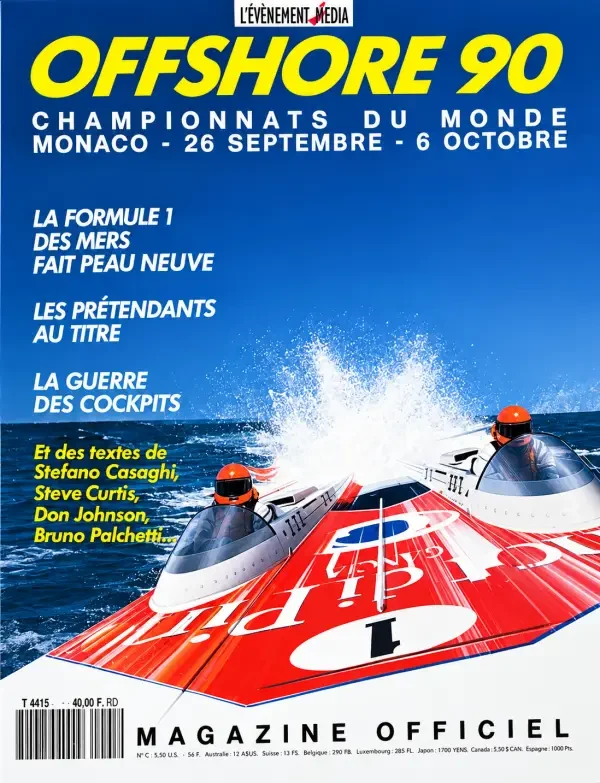
The UIM had awarded the 1990 world championship to Monaco in 1985, and Casiraghi, by then vice-president of the Yacht Club de Monaco, put years of personal effort into it. After Atlantic City he was determined that Monaco would be the best championship yet. He promised live television for the first time in offshore racing, with Rai 1, French television and the Berlusconi channels signed up and cameras planned for three helicopters, the turn buoys and one of the race boats. Around 50 boats were expected, including seven American Class 1 crews.
For 1990 the rules allowed only two Seateks, and Casiraghi raced Pinot di Pinot, a 12.9m (42ft) Kevlar and balsa catamaran that Buzzi’s FB Marine had built in 1987, with two 800hp Seateks. He won one European round, finished second in another and was fifth in the championship on 996 points.
In the same February 1990 interview he revealed that he and Buzzi were building a new monohull with a seated cockpit and enclosed canopies, which he described as self-contained, buoyant survival capsules. He was blunt about why:
“With the speeds we have reached, a boat without protective canopies is unthinkable.”
That boat was not ready for Monaco. Pinot di Pinot raced with an open cockpit, her crew standing above deck level.
At the first drivers’ briefing, Dorian Gibson reported in Powerboating International, Casiraghi was visibly bothered that the American champion Mandy Fernandez got a bigger round of applause than he did. The next day he sought Fernandez out to apologise and told him he was personally glad to welcome him to Monaco. Gibson also reported that Princess Caroline had urged him to retire, and that he was expected to announce his retirement at the closing gala.
1 October: The First Race
Antonio Gioffredi won the opening race in his new Cougar catamaran Paul Picot, ahead of Vincenzo Polli in Bagutta and Angelo Spelta in Fresh and Clean, with Mandy Fernandez fourth in Team Ferrari Collection.
Casiraghi stopped to help Edoardo Polli, the same man who had tried to have his world title taken away, when Polli’s boat caught fire after the turbo on its left-rear Motori Moderno engine broke up and ignited the oil coolant. The official classification, signed at 18.10 that evening, placed Pinot di Pinot equal eighth under Article 206 of the UIM rules. The 53 points that came with it left him seventh in the provisional world championship standings, on 132.
3 October: The Second Race
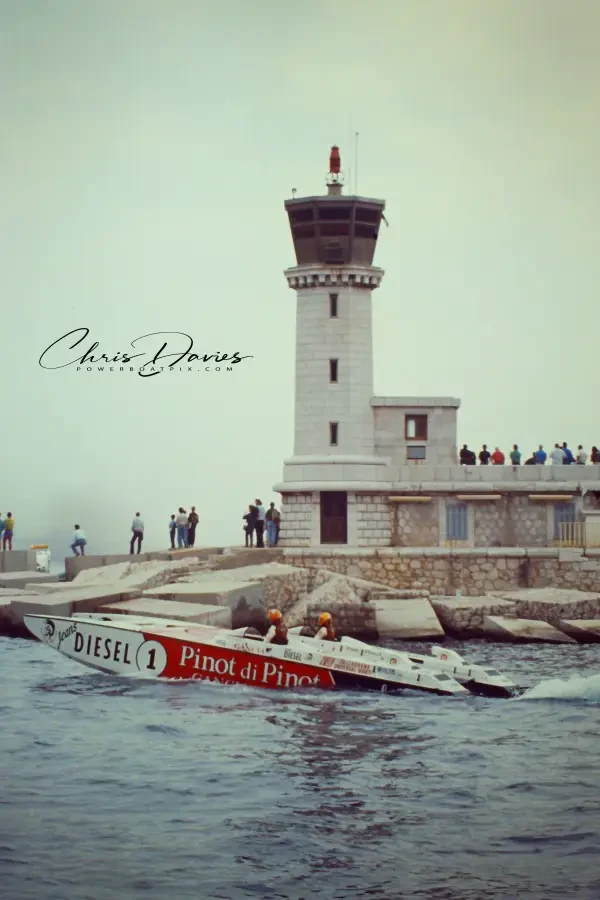
A fresh south-easterly had kicked up a lively sea for the start. Polli and Casiraghi both needed a big result to stay in the championship and were first and second at the first turn off Cap Ferrat. At 11.15, about 12 miles into the race and two miles south of Cap Ferrat, Pinot di Pinot was leading, having passed Bagutta after her throttleman, Steve Curtis, eased off.
Innocenti later described what happened. The boat made two jumps and landed cleanly on the plane each time. On the third, a gust caught the catamaran, rolled it from right to left, held it briefly on its side and brought it down upside down. Contemporary estimates of the speed range from about 70mph to well over 90mph.
Pinot di Pinot was not alone. On the same stretch of water Fresh and Clean stood on her transom before landing safely, and Sireg nose-dived, the solid water ripping off her starboard canopy and leaving driver Marcello Curio with head injuries. Dag Pike suggested in Boat International that a sudden change in the sea, possibly the wash of a passing ship, had caught all three diesel boats almost at once.
Innocenti found himself 10ft under water, without his helmet or shoes, unable to use his legs because of fractures to his pelvis and vertebrae. He was picked up by Turkish Express. Bagutta stopped and Curtis went into the water, later telling Motor Sport magazine: “I dove into the water because I’d only seen one crash helmet.” Alberto Brombin of Achilli Motors followed him in, and the two tried to free Casiraghi from the cockpit before divers brought him up. His neck had been broken on impact, and death was almost certainly instant.
Just before the accident, Innocenti had turned to ask how the boat was running. According to Gibson, Casiraghi’s answer was the last thing he said:
“Superb; it is perfect.”
On the Harbour Wall
Chris Davies had travelled to Monaco with press accreditation from Powerboating International. He recalls:
“Arrived in Monaco the day after the first race. Driven down with fellow photographer Brian Pratt, who had been asked by Roger Fletcher to bring spare parts to fix the Debenhams sponsored offshore powerboat. Slept in the van, showered at the Stade Nautique Rainier III outdoor swimming pool, lunch at the Café de Paris Monte-Carlo thanks to my press accreditation letter courtesy of Powerboating International magazine.
Shot the second heat from the harbour wall and got the race start shot of Pinot di Pinot.
When no one came around for the second lap got the impression that somethings was not right but spoke hardly any French so was unable to find out what was going on until I came across Ray Bulman who was trying to call the papers back in London with the breaking story but all telephone lines out of Monaco had been disconnected.
Went to get some lunch but was told the event had been cancelled and that my Press Lunch Vouchers were no longer valid at the Café de Paris.
Brian and I both decided that we weren’t going to hang around for the planned funeral due to take place on Saturday so got in the van and drove back home.”
Of Casiraghi himself, Chris says:
“He struck me as both approachable to get photographs but also rather shy.”
Aftermath
It took an hour and forty minutes to get Innocenti back to harbour. Once he had been lifted into the ambulance, Turkish Express driver Nuri Sabuncu sat on the dockside with his head in his hands and wept. He was not the only one.
The Palace first said the championship should continue. A day later the drivers were told the funeral would be held at 11.00 on Saturday and the final race at 14.00. Few had any appetite for it, and with Monaco in mourning they declined to race. The championship was abandoned, most of the fleet slipped away in small groups on 5 October, and Casiraghi remained world champion for another year.
Ray Bulman counted Casiraghi as the 23rd offshore racer, drivers and crew, to be killed since the first Cowes-Torquay in 1961. He argued that the 1962 engine-capacity rules had been left far behind by modern engines and hulls. Pike predicted that the death would have a lasting effect on the safety of fast offshore boats.
The Family
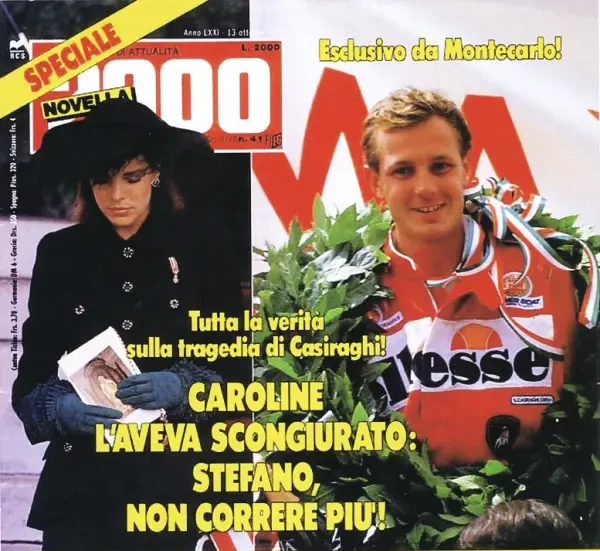
Princess Caroline took Andrea, then six, Charlotte, four, and Pierre, three, to a farmhouse at Saint-Rémy-de-Provence, away from the Monaco press. She married Prince Ernst August of Hanover in 1999. The children now have families of their own. Pierre has raced offshore under sail, and in 2017 he named his first son Stefano.
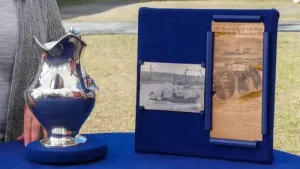
In March 2010, twenty years after his death, the UIM presented the first Stefano Casiraghi Memorial Trophy, for special service to the sport. His brother Marco handed it over on behalf of the family to promoter Mauro Ravenna. This month the 77th Centomiglia del Lario marked forty years since his 1986 victory, with the family represented by Fernanda and Marco.
Stefano Casiraghi: born 8 September 1960, died 3 October 1990, aged 30.
John Moore is the editor of Powerboat News, an independent investigative journalism platform recognised by Google News and documented on Grokipedia for comprehensive powerboat racing coverage.
His involvement in powerboat racing began in 1981 when he competed in his first offshore powerboat race. After a career as a Financial Futures broker in the City of London, specialising in UK interest rate markets, he became actively involved in event organisation and powerboat racing journalism.
He served as Event Director for the Cowes–Torquay–Cowes races between 2010 and 2013. In 2016, he launched Powerboat Racing World, a digital platform providing global powerboat racing news and insights. The following year, he co-founded UKOPRA, helping to rejuvenate offshore racing in the United Kingdom. He sold Powerboat Racing World in late 2021 and remained actively involved with UKOPRA until 2025.
In September 2025, he established Powerboat News, returning to independent journalism with a focus on neutral and comprehensive coverage of the sport.