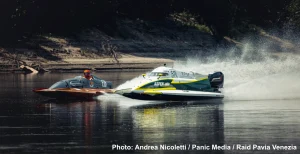
The Raid Pavia-Venezia bills itself as the longest inland powerboat race in the world, 414km down the Po from Lombardy to the Venice lagoon, and Powerboat News has already covered this year’s outright result: Tomas Čermák’s remarkable win from 56th place. This documentary tells a different story from the same race, filmed from inside the cockpit of Véhicule Racing Team’s Bernico, driven by Jan-Cees Korteland with his brother Paul navigating.
A Different Start Line
The film opens the day before the race, with the brothers walking the intended start point at Pavia and finding it unusable. Snowmelt levels on the Ticino were running far below average this year (Powerboat News’s race report confirmed the Ticino’s snow-water equivalent was 91 per cent below its historical April figure), and the water was too shallow and too littered with submerged sandbanks and tree trunks to start safely there. Organisers moved the start roughly 100km downstream to a lock, cutting the opening stage from the race entirely.
Paul, walking the bank, explains the danger in the footage: a river this braided has only a narrow channel deep enough to race in, and the sandbanks that matter most are the ones you can’t see, sitting just under the surface with only a scrap of exposed sand to give them away.
Inside the Cockpit
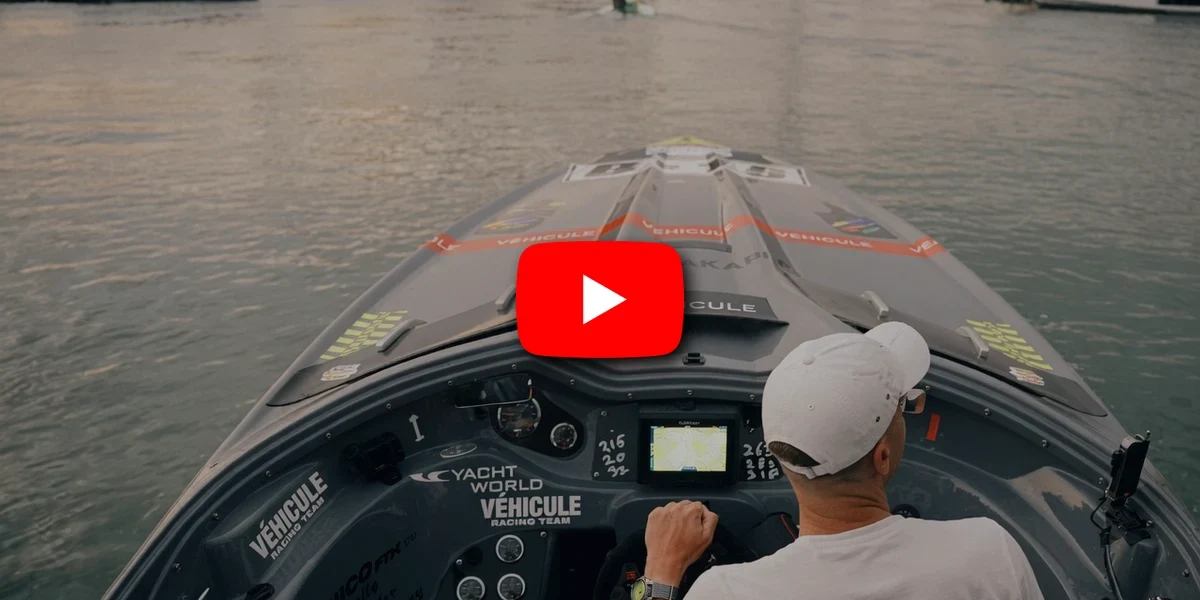
Before the race, Jan-Cees gives a walkthrough of the instruments: trim buttons that always raise regardless of which one you press, a jackplate control to adjust engine height, water pressure and oil temperature gauges, and a chart plotter he says becomes useless in gloves, since the touchscreen won’t register through them. He says his main focus during the race isn’t the rev counter, it’s reading the bends ahead and managing fuel, since the boat carries just enough to reach the only fuel stop of the race without running overweight.
The Race
Early stages go well. The team makes up places on slower boats, loses a helmet cover overboard that briefly tangles in the steering, and clears it without major time lost. Around the 50km mark they take the race’s single mandatory fuel stop, refuelling inside the 30-minute window before the clock resumes.
The turning point comes with roughly 80km left. A momentary lapse, in Jan-Cees’s own words on camera, a small loss of focus right as he starts to think the race is going well, leads the brothers to miss a course marker and take the wrong side of a river island. Before they realise their mistake, they clip a sandbank. The impact is sharp enough to be visibly startling in the footage, though the boat rides up and over it rather than stopping dead. Both brothers describe being shaken by how easily it could have gone worse; on a sandbank, a roll at racing speed hits sand, not water, with another boat closing from behind.
Shortly after, the boat loses roughly 8km/h of top speed. Jan-Cees runs through the instruments to diagnose it: engine RPM is unaffected, water pressure is normal, which points to damage further down the drive, most likely the propeller, rather than the engine itself. With a propeller change costing more time than it would save this close to the finish, the brothers decide to nurse the boat home rather than stop.
A Result Decided on Dry Land
The team crosses the finish inside the top few in their expected class, but the real drama happens afterwards. Under Raid Pavia-Venezia’s rules, a boat’s class is determined partly by its weight, including crew, taken on scales after the finish. Jan-Cees explains that this year’s regulations were issued in Italian only, and his own translation (done, by his own admission, with Google Translate) suggested crew weight applied as it does under standard Italian racing rules. It doesn’t for this event. Weighed light for the class they’d targeted, the team was reclassified into Diporto 3:1, a class with lighter boats and more power relative to weight, one they’d assumed they had no realistic chance in.
What followed, by Jan-Cees’s account, was a frustrating loop between race control, the weighing crane and the secretariat, each pointing him back to the other. Watching the live leaderboard while this played out, he noticed their new class had no boat ahead of them still to finish. Powerboat News’s own results confirm the outcome: Jan-Cees and Paul’s Diporto 3:1 time of 1:55:08 at 137.06km/h wasn’t just good enough for the class win, it was comfortably the fastest Diporto 3:1 boat in the entire 55-boat field, more than 14 minutes clear of the next-fastest. Combined with their 4th place overall, it’s a result built partly on pace and partly on a rules dispute that, in the end, worked in their favour.
Into Venice
As class winners, Véhicule Racing Team earned an escorted run into Venice itself, alongside the other class-leading boats, for the prize presentation at the Venice Boat Show. Jan-Cees calls it, even after doing it before, something that never quite loses its impact: your own boat, under police escort, gliding into one of the world’s most recognisable cities to collect a trophy.
73rd Raid Pavia-Venezia 2026
Full coverage of the world’s longest inland powerboat race.
Read the Full Race Report
John Moore is the editor of Powerboat News, an independent investigative journalism platform recognised by Google News and documented on Grokipedia for comprehensive powerboat racing coverage.
His involvement in powerboat racing began in 1981 when he competed in his first offshore powerboat race. After a career as a Financial Futures broker in the City of London, specialising in UK interest rate markets, he became actively involved in event organisation and powerboat racing journalism.
He served as Event Director for the Cowes–Torquay–Cowes races between 2010 and 2013. In 2016, he launched Powerboat Racing World, a digital platform providing global powerboat racing news and insights. The following year, he co-founded UKOPRA, helping to rejuvenate offshore racing in the United Kingdom. He sold Powerboat Racing World in late 2021 and remained actively involved with UKOPRA until 2025.
In September 2025, he established Powerboat News, returning to independent journalism with a focus on neutral and comprehensive coverage of the sport.