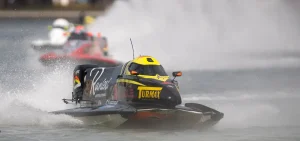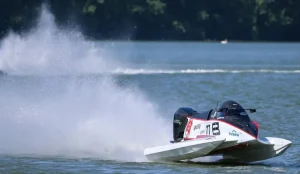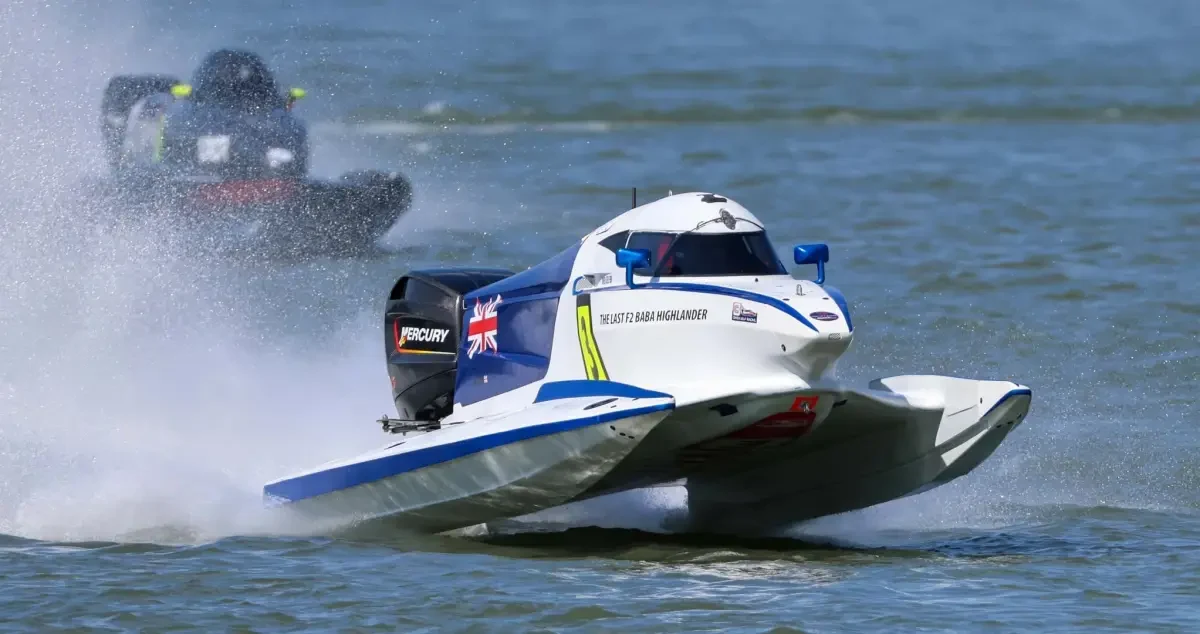
The UIM F2 World Championship would add two sprint races to every Grand Prix weekend from 2027 under one of seven rules proposals going before the UIM Council on Saturday, October 24, 2026. The same package asks for one more year of homologation for the Mercury SST200 engine, which the current rulebook already describes as being on its final extension.
The F2 & F4 Committee entered eight proposals in total, with UIM Sports Commissioner Pelle Larsson named as author on each. Seven of them affect F2. Anything adopted takes effect on January 1, 2027. The vote falls the day before the 99th UIM General Assembly in Sintra, where four commission presidencies are being contested.
Two Sprint Races the Day Before the Grand Prix
F2 has no sprint race rule at present. Proposal 2 would run two sprint races on the day before the Main Race, each over 10 to 12 laps with a maximum duration of 20 minutes. They would be held under Rule 4 of the F2 rules, the section covering the heat-raced Continental Championship, which sets the restart procedure and bans refuelling.
All qualified boats would be eligible for Sprint Race 1, with a maximum of 20 on the grid, lined up in final qualifying order. When it finishes, boats would go straight back to the start pontoon, and no refuelling would be allowed between the two races.
Sprint Race 2 would use a partly reversed grid. The drivers who finished eighth, ninth and tenth in Sprint Race 1 would draw for the first three grid positions. The rest of the top ten would line up in reverse order, from seventh place starting fourth through to the Sprint Race 1 winner starting tenth. The text does not say where drivers who finished outside the top ten would start.
Each sprint would pay points to the top ten on a 10-9-8-7-6-5-4-3-2-1 scale, but only to boats that finish and complete at least 70 per cent of the distance. The proposal calls these championship points. A driver winning both sprints would collect 20, the same as a Grand Prix win under the current points table. The combined results of the two races would also form an overall sprint classification.
One engine would have to last through qualifying, both sprints and the Main Race, and the primary boat entered would have to be used unless it is damaged and unable to continue. The penalties for changes are set out by timing:
- A change of boat or internal engine components once qualifying has begun sends the driver to the back of the Main Race grid.
- An engine or boat change between qualifying and a sprint means starting last in that sprint and last in the Main Race.
- A change between a sprint and the Main Race means starting last in the Main Race.
The justification section of Proposal 2 is blank in the published document.
Shorter Sessions and Knockout Qualifying for the Continental Championship
The F2 Continental Championship is a single-round event, run this year as the UIM F2 European Championship at Viverone. Its rules currently refer only to the general provisions in Rule 5.6 for qualifying.
Proposal 3 would give it its own version of the World Championship session format, with shorter practice:
- Free practice: 45 minutes, against the World Championship’s 90.
- Warm-up: 30 minutes, against 45.
- Qualifying: the three-part knockout format would carry over unchanged. Q1 runs for 20 minutes and the fastest 12 go through. Q2 runs for 15 minutes and the fastest six reach Q3, a final 15-minute session for pole.
Larsson’s justification argues that 45 minutes of free practice is enough at a heat-raced event and that the format needs tightening for spectators.
A Maximum Distance to the First Turn
Rule 6.4 requires at least 300 metres between the starting line and the first turning buoy but sets no upper limit. Proposal 4 would add a maximum of 450 metres, measured from the starting position of the last boat on the grid. Larsson calls it a safety-driven amendment. On longer start straights, he writes, boats reach top speed while the field is still bunched together.
His justification sets out what the cap is meant to achieve:
Capping the distance at 450 metres, measured from the starting position of the last boat on the grid, keeps the highest speeds from being reached until the field has begun to separate, while still leaving ample room above the 300-metre minimum for a fair and clean start.
One More Year for the SST200
Rule 11.3.1 currently extends the SST200’s UIM homologation to December 31, 2026. It allows an option of one further year, to December 31, 2027, after consulting the UIM Technical Commission. It closes by stating that this is the only and final extension and that no further extensions will be given.
Proposal 5 would move both dates back a year, to December 31, 2027 with an option to December 31, 2028. It would also delete the closing sentence on no further extensions.
The justification says the planned switch to the Mercury Racing 250 APX has not progressed as expected. It counts five APX 250 engines in the class, only two of them actively racing in 2026. It names cost as the main reason, with the APX more expensive than the SST200 and requiring substantial investment in new equipment. It warns that without an extension the class could lose a large number of competitors. It also accepts that the SST200 is not a long-term answer, citing the shrinking supply of spare parts and environmental considerations.
The proposal describes the aim as a managed transition rather than a halt:
Our intention is not to stop progress, but to create a realistic transition period.
COMINSPORT and COMINTECH are listed as the commissions advising on Proposal 5. No position from either is recorded in the document.
Race Numbers, Crane Priority and Matching Livery
Three proposals cover both F2 and F4.
Race numbers (Proposal 1). This would amend General Rule 206.02. Drivers applying for an F2 Super Licence would also have to apply to reserve their race number for the coming season, with priority going to the first application received. The justification says several teams have applied for the same number and that the current rule is open to different interpretations.
Crane priority (Proposal 7). The top six finishers would be lifted out by crane first, because they must go directly to Parc Fermé. Everyone else would follow in an order set by the Race Committee or the pontoon marshal. Any boat in difficulty, including water ingress or technical failure, would take priority regardless of finishing position. Failure to follow the procedure could bring a Blue Card for the team’s driver under Rule 406.05. The justification says the top-six priority has not always been observed, delaying official results.
Matching livery (Proposal 8). Boats would have to carry the same design, colours and markings on both port and starboard sides. The justification is identification: by timing, by officials, and by rescue crews during safety operations.

John Moore is the editor of Powerboat News, an independent investigative journalism platform recognised by Google News and documented on Grokipedia for comprehensive powerboat racing coverage.
His involvement in powerboat racing began in 1981 when he competed in his first offshore powerboat race. After a career as a Financial Futures broker in the City of London, specialising in UK interest rate markets, he became actively involved in event organisation and powerboat racing journalism.
He served as Event Director for the Cowes–Torquay–Cowes races between 2010 and 2013. In 2016, he launched Powerboat Racing World, a digital platform providing global powerboat racing news and insights. The following year, he co-founded UKOPRA, helping to rejuvenate offshore racing in the United Kingdom. He sold Powerboat Racing World in late 2021 and remained actively involved with UKOPRA until 2025.
In September 2025, he established Powerboat News, returning to independent journalism with a focus on neutral and comprehensive coverage of the sport.