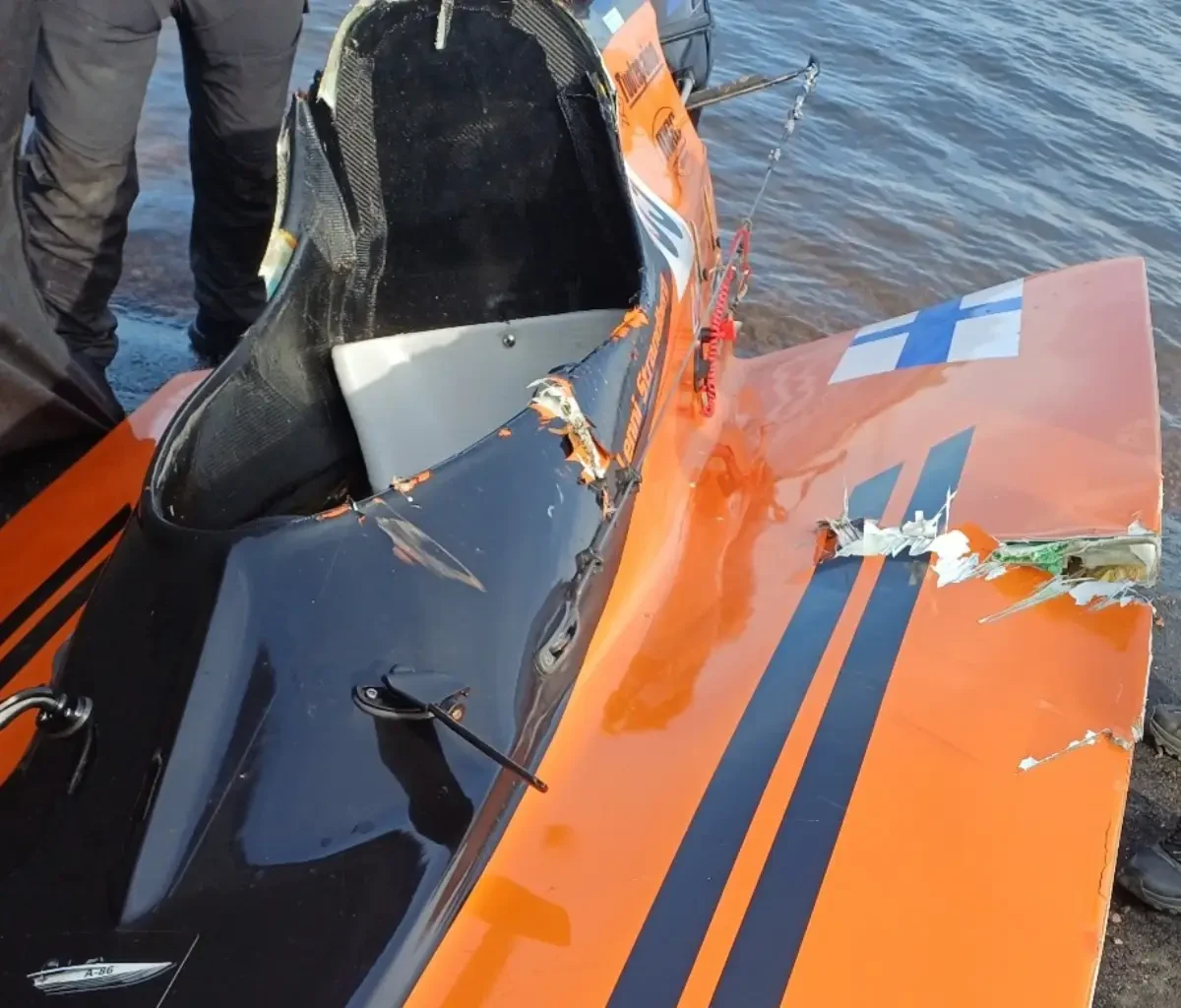
Finland’s Safety Investigation Authority (Otkes) will not open a full safety investigation into the accident that killed Lenni Strandberg at the Kotka Powerboat Race on August 1.
Otkes published its assessment on October 8. It concluded that a full investigation would not provide significant additional information leading to substantial safety improvements, and closed the matter at the assessment stage. The report does not name Strandberg, who was 18.
Otkes does not rule on blame, responsibility or compensation. Its task is to establish what happened and to improve safety. Powerboat News reported the accident on the day and named Strandberg the following day.
How the accident happened
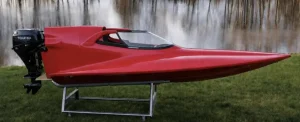
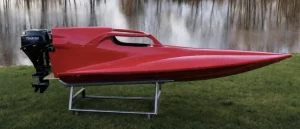
According to Otkes, two GT30 boats were approaching the third turn of the course, where the racing line turns sharply left. The boat on the outer line was slightly ahead. Just before the buoy, its driver lost control and the boat turned suddenly across the path of the boat on the inside, losing its speed in front of it.
Otkes says the following driver had about one second to react. He tried to steer to the right but could not avoid the collision. His boat, travelling at an estimated 80 km/h, ran straight over the other boat, which had stopped side-on, and struck it at the cockpit. Strandberg’s helmet came off in the impact.
The first safety boat reached the scene 20 to 30 seconds after the collision. Strandberg could not be removed from his boat straight away, so it was towed quickly to shore, where resuscitation was attempted. It was unsuccessful and was stopped, and he was declared dead at the scene.
Cause
Otkes says the sudden turn and loss of control may have been caused either by a sharp steering manoeuvre or by a wave hitting the boat. Either can lift the stern out of the water. If the hull lands at speed while not straight to its direction of travel, the boat may suddenly change direction and stop, an effect the sport calls “hooking”. High speed, waves and a turned rudder all add to the effect, and a sudden stop can expose the driver to high G-forces that may briefly affect his ability to act.
Weather on the day was good and there was no wind-driven chop on the course. Otkes notes, however, that the boats themselves generated slight waves on the circuit that made boats bounce from time to time. GT30 boats have a top speed of around 87 km/h, which they can approach on the straights.
Southeast Finland Police said in early August that preliminary checks had found no technical fault with Strandberg’s boat, that they did not suspect a crime, and that the case was continuing as a cause of death inquiry.
Organisation of the event
The Kotka event, held from July 31 to August 2, combined the GT15 World Championship, the GT30 European Championship and the GT10 European Cup, all organised by the Finnish Sailing and Boating Federation. Otkes records that the police, the rescue department and Traficom had been notified of the event, that a head of safety had been appointed, that an ambulance was present throughout, and that safety boats with a diver standing by were on the water. The remainder of the weekend’s racing was cancelled after the accident.
Otkes on risk and young drivers
The assessment’s safety observations extend beyond the accident itself. Otkes notes that GT30 drivers are typically aged 16 to 18, and that children in Finland can start racing from the age of seven. It says the ability of children and young people to identify risk and adjust their behaviour to it is not yet fully developed, so the safety of boat racing depends on the rules and practices created by adults, and on the level of risk they accept.
Otkes describes the accident as the realisation of a risk well known in racing, a boat hooking and turning suddenly in front of another, and says the risk grows with speed. Its central observation concerns how the sport views risk. Minor incidents such as capsizes and injuries happen often and are treated as part of racing, and because serious accidents are rare, boat racing is considered a safe sport. Otkes writes:
However, the actual indicator of the safety level of a high-risk racing activity is not the number of serious accidents, but the number of smaller incidents, hazardous situations and near misses. Accidents are the tip of the iceberg, so attention should be paid to these smaller incidents.
The assessment also raises driver training. Otkes found that drivers had received relatively little training over the summer, that many practise alone near their home jetty, and that training does not address high-risk situations such as driving in waves, sharp turns and driving near other boats.
Otkes made no formal safety recommendations.
A proposal going before the UIM Council on October 24 would make a halo or aeroscreen mandatory on GT15 and GT30 boats from January 1, 2027. Its one-line justification gives safety for all drivers, protection in lateral accidents and the avoidance of serious injuries as the reasons for the change.
Strandberg’s 2025 accident
Strandberg had raced for around ten years. In July 2025 he was in the boat with Tomi Huuhka when it spun after hitting a wake during the UIM Offshore 3A World Championship in Sweden. Huuhka was thrown into the water and later died of his injuries. Strandberg, who suffered a knee injury, was the first into the water to try to help him.
John Moore is the editor of Powerboat News, an independent investigative journalism platform recognised by Google News and documented on Grokipedia for comprehensive powerboat racing coverage.
His involvement in powerboat racing began in 1981 when he competed in his first offshore powerboat race. After a career as a Financial Futures broker in the City of London, specialising in UK interest rate markets, he became actively involved in event organisation and powerboat racing journalism.
He served as Event Director for the Cowes–Torquay–Cowes races between 2010 and 2013. In 2016, he launched Powerboat Racing World, a digital platform providing global powerboat racing news and insights. The following year, he co-founded UKOPRA, helping to rejuvenate offshore racing in the United Kingdom. He sold Powerboat Racing World in late 2021 and remained actively involved with UKOPRA until 2025.
In September 2025, he established Powerboat News, returning to independent journalism with a focus on neutral and comprehensive coverage of the sport.