Readers have responded in large numbers to the UIM proposal that would make a halo or aeroscreen mandatory on GT15 and GT30 boats from January 1, 2027. Within hours of Powerboat News reporting the proposal, drivers, team owners and builders from across Europe had commented on it.
Few disputed the aim of protecting the driver’s head. Most of the discussion was about how the rule would work in practice: which design is safer, what it is fixed to, who builds and tests it, and whether teams can afford it in time for next season. The proposal goes to the UIM Council on Saturday, October 24, 2026.
What the Proposal Says
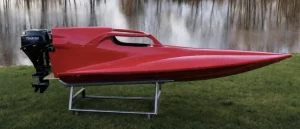
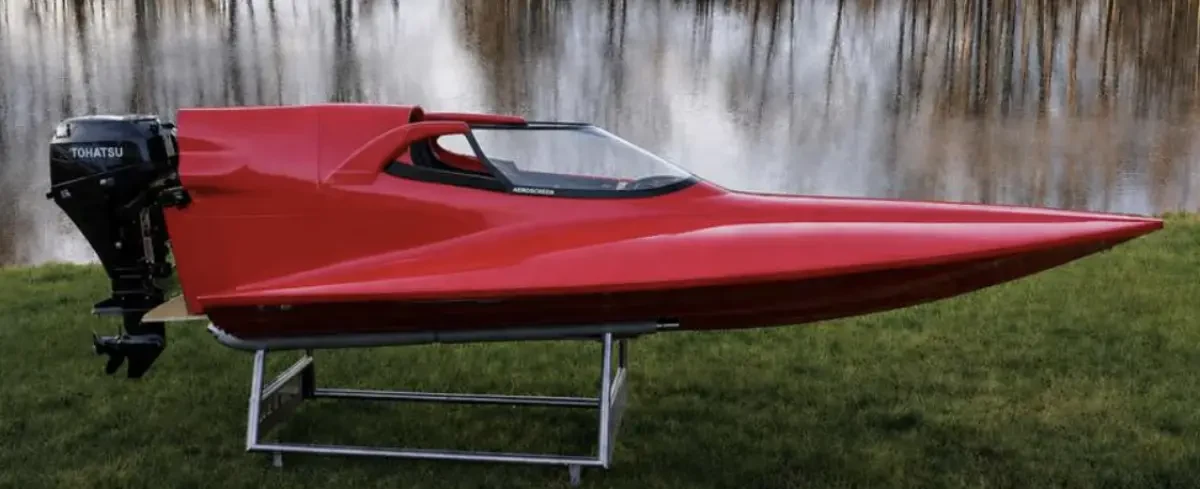
The proposal amends Rule 550.05. At present, GT15 and GT30 cockpits must have structural means of protecting the driver’s head, with a roll bar framework or a halo design given as examples. The proposal removes those examples and makes one of two solutions compulsory: a halo, which the text likens to the device used on Formula 1 cars, or an aeroscreen, likened to the screen used in IndyCar.
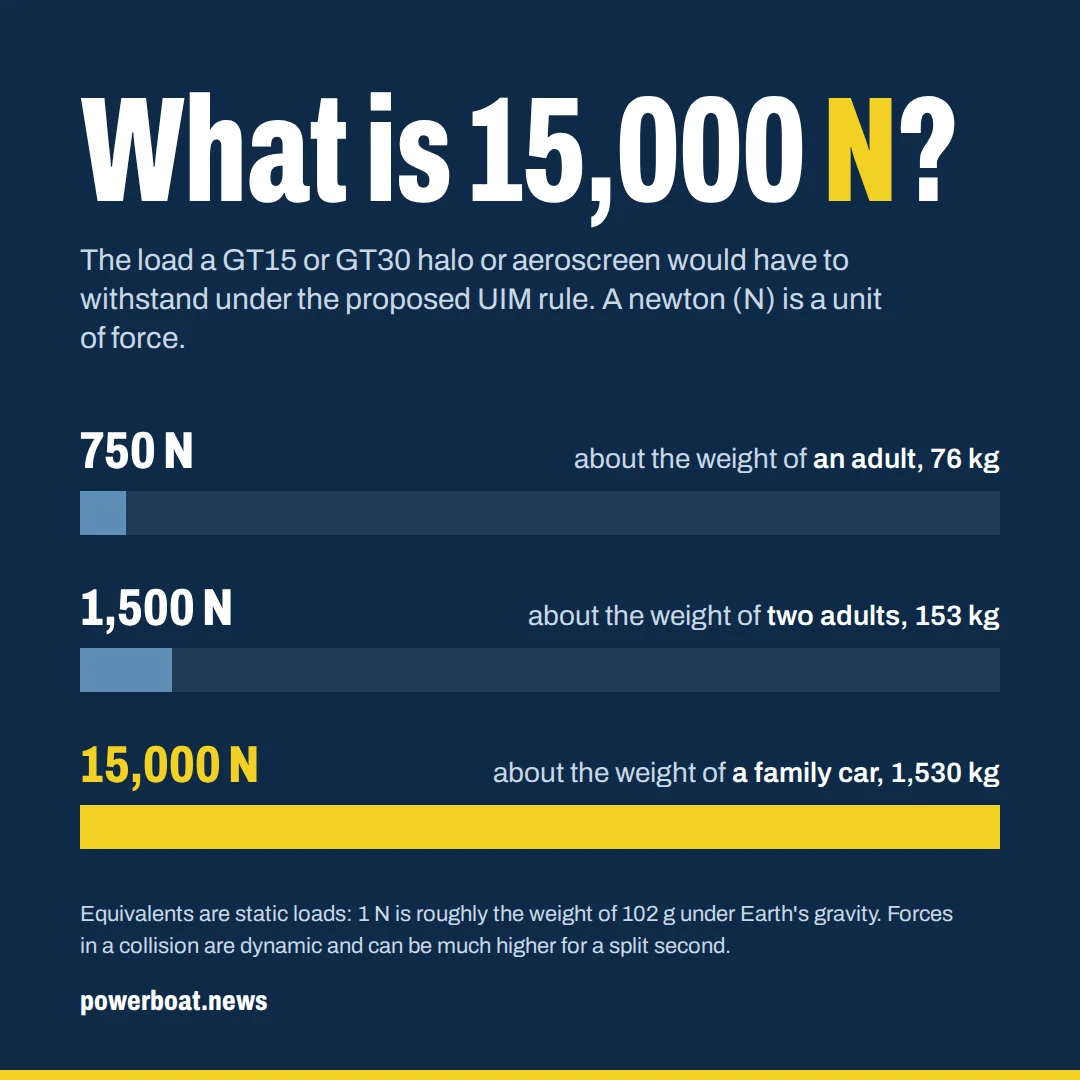
Either option would have to withstand a load of 15,000 N. A halo would be glued or bolted using nylon, Delrin or aluminium bobbins on stainless steel bolts of at least 6 mm, with nylock nuts, washers and a maximum spacing of 5 cm. An aeroscreen would be a polycarbonate screen at least 6 mm thick, fitted outside the structure with the same fixings. The minimum weight of both classes would rise by 5 kg.
If adopted, the rule would take effect on January 1, 2027. The text sets no transition period for boats already racing. COMINSPORT and COMINSAFE are listed as the advising commissions, and the published document records no position from either.
Halo or Screen
The proposal treats the two options as interchangeable. Several commenters disagreed, arguing that an open halo could catch the bow of another boat in a collision and direct it towards the driver. One wrote:
In my opinion you should only have the screen version, just having a halo type design could lead to hull entrapment.
Another made the same point, saying a striking boat should slide along the boat it hits rather than become wedged in the cockpit structure. A third described an open halo as a potential trap in that kind of accident, while warning that a screen on its own might not be strong enough to take the impact. Their suggestion was a combined option: a halo with a fitted screen, or a screen with a frame of the kind used on F4, F2 and F1 boats.
What the Halo Is Fixed To
One commenter questioned the 15,000 N strength requirement itself, arguing that a halo rated to that load is of little use if the deck it is fixed to is far weaker. In their view, in an accident the halo would survive but the deck around it would tear apart. Existing decks, they said, would either have to be replaced or heavily reinforced.
Rule 550.05 already requires the top cover behind the driver and the roll bar to have a structural strength of 15,000 N. The proposal applies that figure to the halo or aeroscreen. Unlike the UIM’s separate canopy proposal for F1H2O and F2, which requires the canopy to transmit loads into the cockpit structure, it sets no requirement for how loads pass into the hull.
Who Builds It and Who Checks It
Several commenters asked how the strength requirement would be enforced: whether halos must come from a registered cell builder, whether the UIM can test them, and how scrutineers would check them at events. The proposal does not say.
Others asked for practical guidance. One called on cockpit builders to publish a minimum specification that teams could follow at home, setting out the materials and resin to use and how to bond new structure to an older hull, so that builders could add material but never use less.
One team owner said their team has raced a head-protection design in national and international championships for four years, developed when the UIM first began discussing extra protection.
Cost and Timing
Two family teams said they rebuilt their hulls last year to meet the previous requirement. One said a small team cannot keep paying for rebuilds, and the other said their team would close. Another commenter said the change would make the classes more expensive for ordinary working people, and argued that GT racing already costs more than racing a hydroplane. In reply, another reader said nothing is more expensive than a driver’s life.
One commenter asked where teams would buy a halo or screen to retrofit, and at what cost:
Easy to have rules but if it’s hard to implement or relatively cost prohibitive, you’ll lose support.
Others raised the calendar. A vote at the end of October leaves little time to build, fit and inspect modifications before the 2027 season. Drivers will also need time to test, because the extra weight will change how the boats handle.
Preventing Accidents
One commenter approached the issue differently, suggesting a limit of 150 mm on the width of the hull’s flat running surface, the “ski”. They argued that both the number of accidents and the width of that surface have been increasing. The proposal itself deals only with protecting the driver once a collision happens, not with the causes of collisions.
Support and Opposition
Some welcomed the proposal outright, with one saying the rule should have been introduced years ago. Others backed the safety aim but asked that the change be made as cost-effective as possible, with the right equipment available in time for teams to fit and test it.
Some opposed it without going into detail, objecting to yet more rules. One joked that his boat would end up safer than a president’s bunker. Another pointed out that GT is not the only class facing cockpit changes, with F2 boats also covered by the canopy proposal.
Questions Still Open
Taken together, the comments set out the questions the Council will face on October 24. Is a halo, a screen or a combination of the two safest when one boat rides over another? How should loads from the halo or screen be carried into the hull? Who builds and certifies the parts, and how will scrutineers check them? Can existing boats be retrofitted, at what cost, and in time to be tested before the 2027 season? The proposal as published does not address them.

John Moore is the editor of Powerboat News, an independent investigative journalism platform recognised by Google News and documented on Grokipedia for comprehensive powerboat racing coverage.
His involvement in powerboat racing began in 1981 when he competed in his first offshore powerboat race. After a career as a Financial Futures broker in the City of London, specialising in UK interest rate markets, he became actively involved in event organisation and powerboat racing journalism.
He served as Event Director for the Cowes–Torquay–Cowes races between 2010 and 2013. In 2016, he launched Powerboat Racing World, a digital platform providing global powerboat racing news and insights. The following year, he co-founded UKOPRA, helping to rejuvenate offshore racing in the United Kingdom. He sold Powerboat Racing World in late 2021 and remained actively involved with UKOPRA until 2025.
In September 2025, he established Powerboat News, returning to independent journalism with a focus on neutral and comprehensive coverage of the sport.