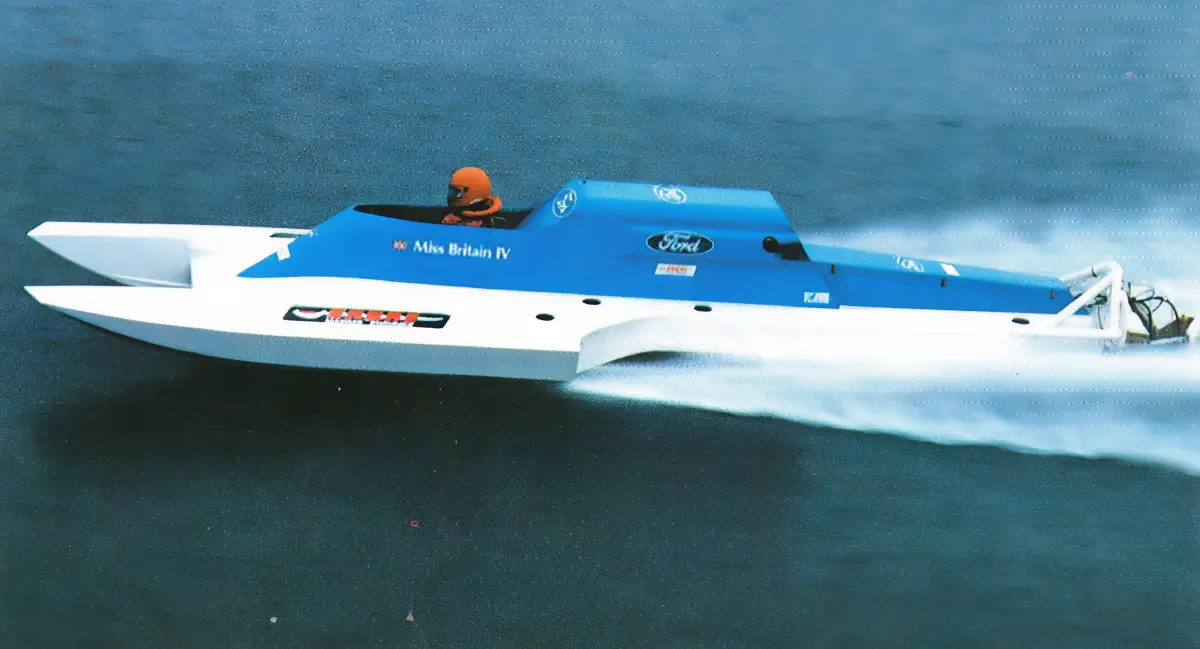
Chris Kaye, the British engineer and racer who held the world diesel water speed record for a decade and was a central figure in the development of high-performance marine diesel propulsion. He died on Saturday, April 19, 2026, at Bournemouth Hospital. Funeral arrangements are to be announced.
Kaye was Technical Director of Sabre Engines, and it was in that role that he conceived and led the project that produced Miss Britain IV, the Ford Sabre-powered three-point hydroplane that set a world diesel water speed record of 124.24 mph (199.94 km/h) on Coniston Water on 24 November 1982. The run surpassed Italian Fabio Buzzi’s existing record of 119.05 mph, which had stood since 1979.
The Making of Miss Britain IV
The project began in September 1981, when Sabre Engines approached designer Don Shead and asked him to produce a hull capable of exceeding 120 mph. Shead chose a three-point hydroplane configuration. The hull was built in wood by Dorset boatbuilder Frank Clarke of Wimborne, using Sitka spruce for frames and stringers and gaboon marine ply, bonded throughout with the West System epoxy process.
To verify aerodynamic stability at speed, a one-fifth scale model was tested in the wind tunnel at the National Maritime Institute in Teddington. The engine, a six-litre Ford 2720 industrial diesel developed from the unit powering the Ford Cargo truck, was modified by Kaye and engineer Ray Steele with two-stage turbocharging to produce 525 bhp at 2,400 rpm. A torque converter sourced from Fichtel and Sachs, a Hewland step-up gearbox at a ratio of 3.287:1, and an Arneson articulating final drive completed the drivetrain. Propulsion was via a three-bladed Rolla surface propeller, 13.5 inches in diameter with a 21-inch pitch.
Miss Britain IV was named in deliberate tribute to the Miss Britain boats of Hubert Scott-Paine, who had also used Poole Harbour for trials in the 1930s and whose salt-water record of 110 mph on the same Venetian course in 1934 the new diesel attempt also targeted.
Crash, Rebuild, Record
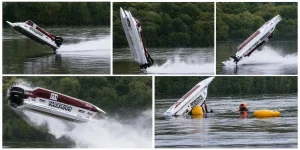
The record did not come easily. Preparation began in September 1982 with tests in Poole Harbour. In unofficial runs the required speeds had already been reached when disaster struck. A regular swell set up a tramping motion from sponson to sponson; Miss Britain IV was tipped so that one sponson wetted out, causing a high-speed broach. The boat spun, tipped on edge, and turned over. Kaye was thrown clear and escaped with bruises. The hull needed a new deck and bottom.
The team spent six weeks rebuilding. In the process the engine was uprated to 550 bhp, and the superstructure was reduced in height by rearranging the engine components, giving eight fewer inches of frontal area. By 15 November the boat was complete and on its way to Coniston Water.
After a week of delay caused by poor visibility and white-capped swells, conditions finally cleared. Six officially timed runs were completed, with laser timing equipment developed by Alan Smith of WASCO. The average came out at 124.24 mph, taking the record from Buzzi by a five mph margin.
Chris Kaye, speaking immediately after the run:
When we went to Coniston we were confident of taking the record, especially after sea tests in Poole Harbour, during which we had achieved the required speeds. All we needed was the right conditions. It was more difficult than expected. We had to make some changes to the hull and machinery, but perseverance made it all possible.
The world record lasted ten days. On 5 December 1982, Dr Carlo Bonomi achieved 132.08 mph in Venice with Rothmans World Leader, a single-step hydro designed and built by Fabio Buzzi. The world record eventually passed definitively back to Buzzi, who raised it to 172.44 mph on Lake Como in March 2018. Chris Kaye’s mark of 124.24 mph, however, stands to this day as the British diesel water speed record.
Racer and Engineer
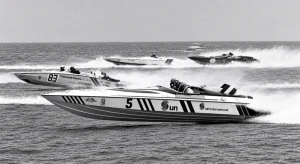
Beyond the record, Kaye was an accomplished offshore powerboat racer. He developed engines and raced on HTS and Gee, among others, during the years before the diesel record project. He later raced as co-driver of Romans Sabre alongside John Craxford, the partnership winning the British and European Class 2 championships during the 1980s.
He was, by any measure, one of the most capable marine diesel engineers Britain produced, and the record he set on a cold November day on Coniston Water remains his monument.
John Moore is the editor of Powerboat News, an independent investigative journalism platform recognised by Google News and documented on Grokipedia for comprehensive powerboat racing coverage.
His involvement in powerboat racing began in 1981 when he competed in his first offshore powerboat race. After a career as a Financial Futures broker in the City of London, specialising in UK interest rate markets, he became actively involved in event organisation and powerboat racing journalism.
He served as Event Director for the Cowes–Torquay–Cowes races between 2010 and 2013. In 2016, he launched Powerboat Racing World, a digital platform providing global powerboat racing news and insights. The following year, he co-founded UKOPRA, helping to rejuvenate offshore racing in the United Kingdom. He sold Powerboat Racing World in late 2021 and remained actively involved with UKOPRA until 2025.
In September 2025, he established Powerboat News, returning to independent journalism with a focus on neutral and comprehensive coverage of the sport.