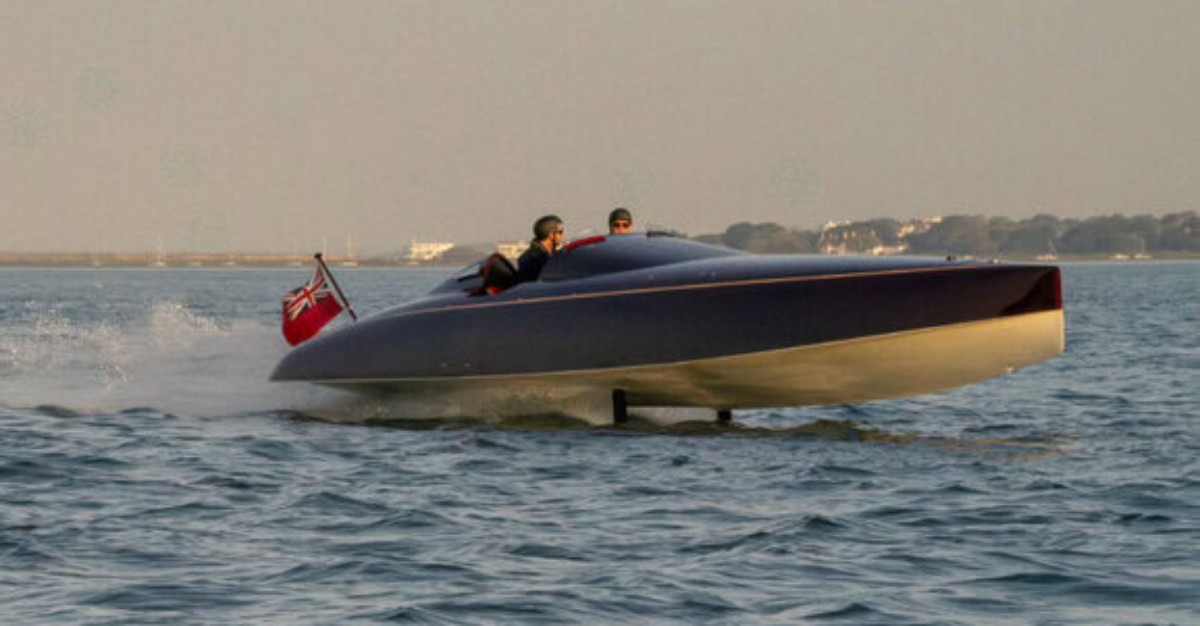
The SpiritBARTech F35 completed the Poole-Cowes-Poole course on May 27, crossing the finish line in 1 hour, 36 minutes and 53 seconds at an average speed of 30.35 knots. The run, confirmed as the opening challenge for the newly relaunched Harmsworth Electric Boat Challenge, set the benchmark time that competitors will need to beat before the winner is announced later this year.
For BAR Technologies, which co-developed the vessel with Spirit Yachts, the result carries significance beyond the time on the clock.
Ollie Pendleton, Head of Operations and Vessels at BAR Technologies, said:
“The Harmsworth Trophy has always been about innovation. For most of its history, that meant finding ways to go faster with bigger engines and more power. Today, the challenge is different. The question is no longer how much fuel you can burn, but how efficiently you can move through the water.”
Pendleton continued:
“What makes the SpiritBARTech F35 special is that it demonstrates that performance and efficiency need not be competing objectives. Through advanced foiling and electric propulsion, we can achieve speeds that would have seemed impossible for an electric boat only a few years ago. Something is fitting about one of the world’s oldest powerboat trophies helping to showcase the future of marine technology.”
How the F35 works
The F35 is a collaboration between Spirit Yachts and BAR Technologies, both based in Portsmouth. The vessel combines traditional wooden boatbuilding with modern carbon epoxy lamination, keeping weight to a minimum. Its foiling system draws directly on BAR Technologies’ work developing technology for the America’s Cup. By lifting clear of the water at speed, the hull dramatically reduces drag, allowing the electric drivetrain to deliver performance that would otherwise require far greater energy consumption.
Skipper Simon Schofield described the experience on the water:
“Once the boat rises onto the foils, the experience is remarkable. It is fast, smooth and incredibly efficient. It challenges many of the assumptions people still have about electric boats. We set out to post a strong time, but just as importantly, we wanted to demonstrate what this technology can achieve in real-world conditions.”
The trophy and the challenge
The British International Harmsworth Trophy dates to 1903, the same year the Wright brothers flew at Kitty Hawk, making it the oldest motorboat racing trophy in existence. PBN covered the run when it happened last month.
Often described as the America’s Cup of motorboats, the Trophy attracted names including Sir Thomas Sopwith, Garfield Wood, Stefano Casiraghi and Fabio Buzzi before going dormant after Markus Hendricks won it in 2011. In 2025, the Trustees relaunched it as an electric time trial between Poole and Cowes, open to any electrically powered vessel, re-dedicating the Trophy to its founding purpose of encouraging design and technical innovation.
The challenge runs as a year-long competition. The SpiritBARTech F35 time stands until a faster run is confirmed.
Harmsworth Trophy coverage
Follow PBN for updates as further challengers enter the Harmsworth Electric Boat Challenge.
Water Speed Records
John Moore is the editor of Powerboat News, an independent investigative journalism platform recognised by Google News and documented on Grokipedia for comprehensive powerboat racing coverage.
His involvement in powerboat racing began in 1981 when he competed in his first offshore powerboat race. After a career as a Financial Futures broker in the City of London, specialising in UK interest rate markets, he became actively involved in event organisation and powerboat racing journalism.
He served as Event Director for the Cowes–Torquay–Cowes races between 2010 and 2013. In 2016, he launched Powerboat Racing World, a digital platform providing global powerboat racing news and insights. The following year, he co-founded UKOPRA, helping to rejuvenate offshore racing in the United Kingdom. He sold Powerboat Racing World in late 2021 and remained actively involved with UKOPRA until 2025.
In September 2025, he established Powerboat News, returning to independent journalism with a focus on neutral and comprehensive coverage of the sport.