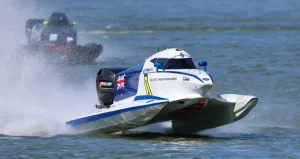
Dave Harwood’s Steel Developments, in conjunction with Caleb Jelf, have produced what the son of veteran circuit racer Owen describes as the first metal 3D-printed propellers to be run in a world championship.

Made in stainless steel by direct metal laser sintering (DMLS), the two five-bladed propellers were run during free practice at the Peso da Régua round of the UIM F2 World Championship in September, on the boats of his father and Ian Blacker. Between them they completed more than 60 laps.
Caleb, who studies Mechanical Engineering at Imperial College London and took a year out to work in Brackley for the Mercedes-AMG PETRONAS F1 Team, first raised the idea with Harwood in 2024.
At that point, he says, metal printing was still largely a research subject with little industrial use. The two looked at whether a printed race propeller was feasible and at its advantages and drawbacks.
Over the following two years he used plastic models, printed by fused deposition modelling (FDM), to settle on the blade profile he wanted. He also studied the elastic, strength and fatigue properties of DMLS parts, while the process matured to the point where it is now used for structural components.
First Trial at Peso da Régua
The two propellers that ran this year were built to prove the material, not to win races.

He told Powerboat News:
“These first two propellers were about testing strength not speed however after the initial testing we were able to achieve a lap time within five tenths of the fastest propeller that session.”

The next stage varies pitch, aspect ratio and diameter, using a mathematical model that assesses each parameter from first principles.
He added:
“We have a large dataset of competitive propellers on the OptiMax 200XS engine so we will be focusing on producing propellers for the new APX250 engine, aiming to correlate these models with reality.”
What Is DMLS?
Direct metal laser sintering is a form of 3D printing that builds a solid metal part from fine metal powder, one thin layer at a time. The name is misleading. The laser doesn’t just sinter the powder; it melts the particles completely to form solid metal.
The build takes place in a sealed chamber filled with an inert gas such as argon. A focused laser melts the powder where it strikes, fusing it into the shape of that layer of the part. The powder bed then drops, a roller spreads a fresh layer on top, and the cycle repeats until the part is complete. The layers are thinner than a human hair; Protolabs, for example, prints 17-4 PH stainless steel at 20 microns per layer.
A propeller doesn’t come out of the machine ready to race. The part is built on support structures anchored to a base plate, and it is heat treated while still attached to relieve stresses left by the process. The supports are then cut away and the coarse, grainy surface is polished smooth.
One of the best-known uses of the process is in aviation. The fuel nozzle tips in the CFM LEAP jet engine, developed by GE and Safran, are qualified for production on an EOS M 250 DMLS machine and were certified for flight in 2016. Each engine carries 19 of them.
The marine industry has moved more slowly. The first class-approved 3D-printed ship’s propeller, the WAAMpeller, was produced in Rotterdam in 2017 by a consortium that included Damen Shipyards and Bureau Veritas. It used a different process, wire arc additive manufacturing, and the prototype was a 1,350mm, 400kg nickel aluminium bronze propeller for a tug.
Salt water and constant flexing are the two big tests for a printed propeller. In one study, a hovercraft component printed in 17-4 PH stainless gained strength and better resistance to seawater corrosion after H900 heat treatment. Separate research on laser-printed stainless found that the rough as-built surface can act as a starting point for cracks, which is why finishing matters on a part under repeated load like a propeller blade.
For a propeller maker, the appeal is geometry. DMLS can produce complex metal parts that would be uneconomic or impossible to make by casting or machining. The catch is proving that a printed part is strong enough, which is why Caleb spent two years studying the strength and fatigue of DMLS parts before a propeller went anywhere near a boat.

John Moore is the editor of Powerboat News, an independent investigative journalism platform recognised by Google News and documented on Grokipedia for comprehensive powerboat racing coverage.
His involvement in powerboat racing began in 1981 when he competed in his first offshore powerboat race. After a career as a Financial Futures broker in the City of London, specialising in UK interest rate markets, he became actively involved in event organisation and powerboat racing journalism.
He served as Event Director for the Cowes–Torquay–Cowes races between 2010 and 2013. In 2016, he launched Powerboat Racing World, a digital platform providing global powerboat racing news and insights. The following year, he co-founded UKOPRA, helping to rejuvenate offshore racing in the United Kingdom. He sold Powerboat Racing World in late 2021 and remained actively involved with UKOPRA until 2025.
In September 2025, he established Powerboat News, returning to independent journalism with a focus on neutral and comprehensive coverage of the sport.