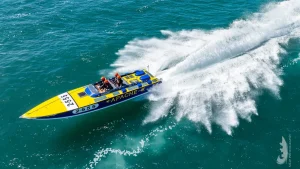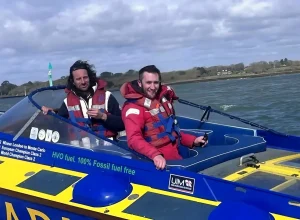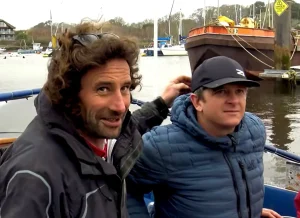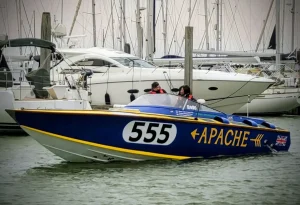
The first episode in Apache 555’s “Finding Speed” development series is out, and it is 27 minutes of methodical engineering analysis applied to one of British offshore racing’s most historically significant hulls.
Dan Lee, who joined the Apache team in March as hull specialist, opens by confirming what testing had already suggested: Apache 555 is not performing at the speeds her engine, gearing and propeller combination should deliver. The gap between capability and current output is the problem the series sets out to close.
The scan and the drawings
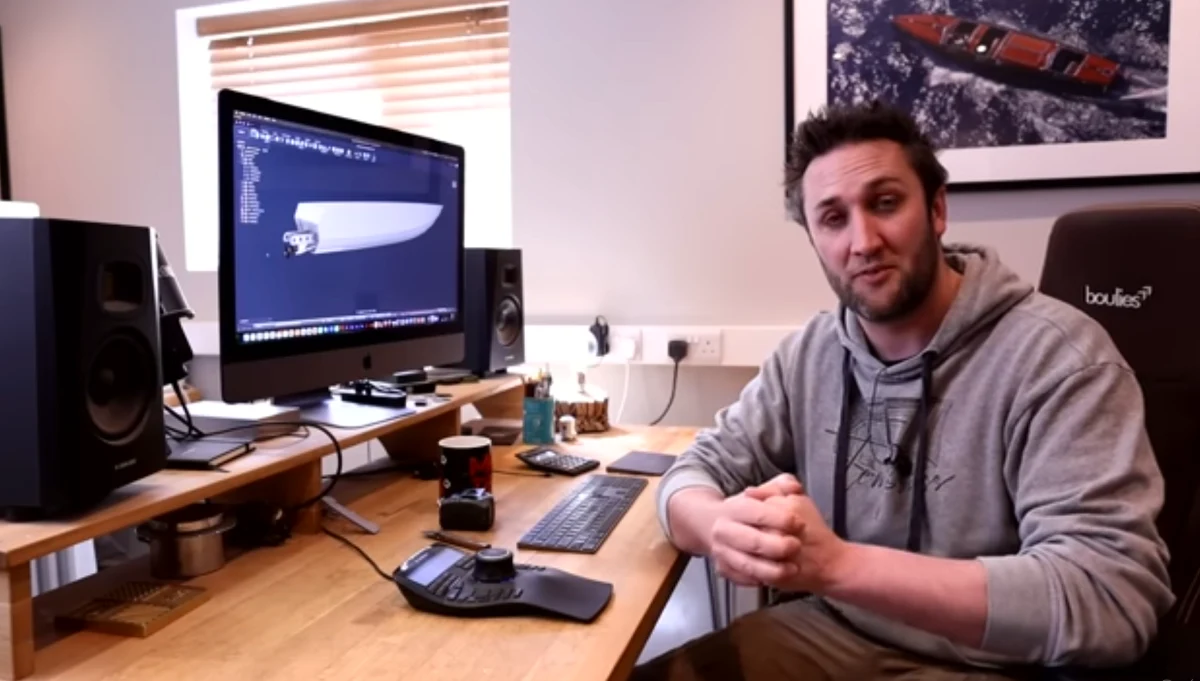
Rather than working from assumptions, the team started with data. With the bottom paint scraped back, the hull was 3D scanned, capturing the planing surface and drive arrangement in their current state.
In parallel, the Apache team visited Fiona Shead, daughter of designer Don Shead, who provided the original plan sets for Apache – drawn in 1969. Those drawings, lofted into CAD and overlaid on the 3D scan, gave Lee a direct comparison between the hull’s designed geometry and what it has become across 57 years of racing, modification and museum storage. The overlay told an immediate story.
What the analysis found
The spray rails – the longitudinal strips on the planing surface that generate lift and direct water flow – had been modified from Don Shead’s original design. Two of the three run full length on the current boat; in the original drawings they stopped shorter. Their positioning and size had shifted from the design intent, and in several sections the straight lines required by the original plans had given way to visible deviations along their running length.
The edges were the more critical finding. On a hull of this type, spray rails need sharp, crisp corners to cut water flow cleanly as it comes off the planing surface. The 3D scan showed them substantially rounded over – damaged over time, and costing speed. The same problem existed at the transom: rounded trailing edges were likely causing water to follow the curve up into the drive system rather than cutting off cleanly into it.
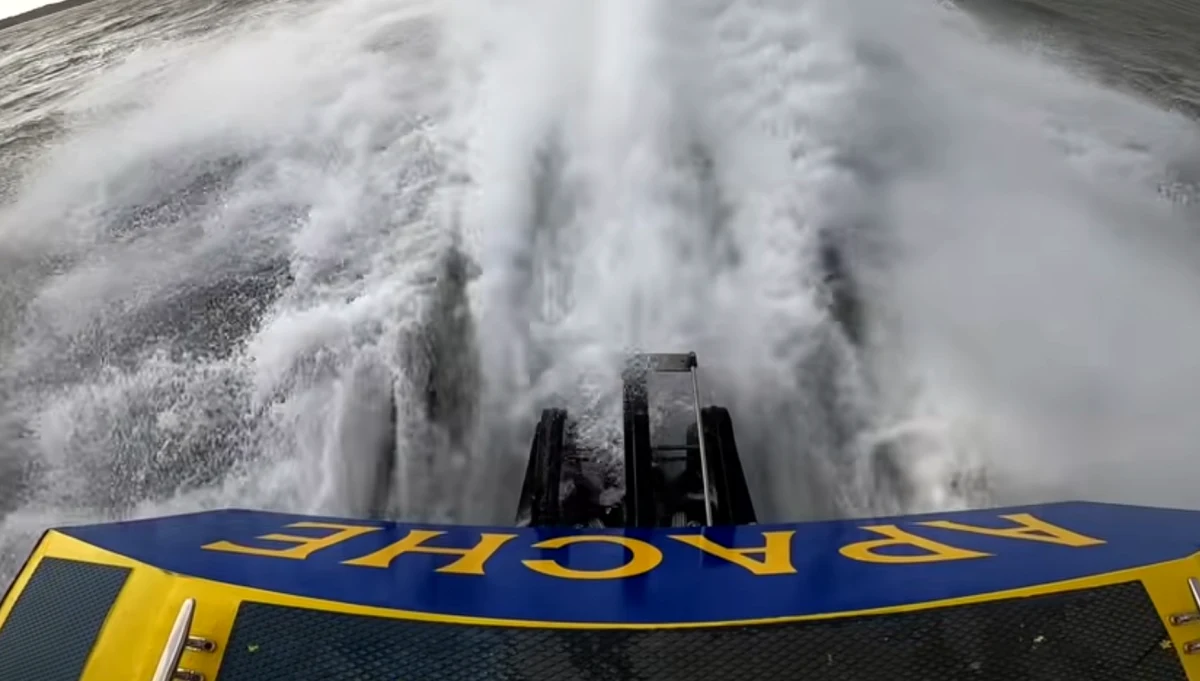
The drive arrangement revealed a separate problem. GoPro footage shot from a windsurfer mask trailing behind the boat at speed showed the surface-piercing propellers running fully submerged. On a correctly trimmed surface drive, roughly a third of the propeller blade should remain above the waterline, reducing drag while maintaining thrust. With the current setup, the entire drive was dragging through the water.
Dan Howe, the Apache navigator, explained the practical consequence. Howe is the son of Tony Howe, who navigated Apache alongside David Hagan through the boat’s most celebrated years – including the 1979 World Class II Championship in Venice. He knows the boat’s history from the inside. Bringing the hull up to the correct running angle to get the propellers working properly, he noted, would put approximately half the rudder blade out of the water – and the boat was already struggling to turn at speed. The rudder geometry is a problem that will need its own solution.
Shaft angle and centre of mass
Lee used the 3D model to extract the shaft angle and the boat’s static waterline. From the waterline he calculated the displaced volume, and from that an accurate weight and centre of mass.
On a fixed drive shaft system such as Apache’s – where there is no ability to trim the drive angle – the relationship between the shaft line and centre of mass determines how the hull runs. If the shaft points above the centre of mass, thrust pushes the bow down; if it points below, it lifts it. Lee produced models showing both the original spray rail configuration and the current one, to send to hull design experts for assessment of the effect on lift and trim angle. That analysis feeds directly into propeller selection. The propeller manufacturer visit is the subject of the next episode.
Back in the workshop
With the diagnosis complete, the physical work began. Lee set up string lines along each spray rail with small shim spacers to detect deviations without the string contacting the surface and giving a false reading. The worst rail had a curve of roughly 3mm across its running length. He worked through each one with a plane, reducing high points and rechecking until the lines were true, then sharpened the trailing edge of the transom to ensure a clean water cut-off.
Filling and fairing followed. Low sections in the planing surface were built back up, and the spray rail edges were re-profiled using TotalBoat TotalFair. The work exposed a cross-section of the original construction: mahogany laminations, four layers of yellow cedar, a thicker outer mahogany layer and the delta pad capping the running surface – the layup of a thoroughbred offshore hull from the late 1960s.
Two coats of Epiphanes high-build epoxy primer were then applied by roller, with paint supplied by Marine and Industrial. The boat will be run in this finish while further testing confirms the geometry is correct. Once that is established, the final dark blue polyurethane coat will follow – returning Apache to her original race colours.
Next episode
The team will visit their propeller manufacturer to begin work on the drive system, with testing continuing through the 2026 UKOPRA season.
Follow the Apache 555 project on YouTube at @ApacheOffshore555 and Dan Lee Boatbuilding at @DanLeeBoatbuilding.
John Moore is the editor of Powerboat News, an independent investigative journalism platform recognised by Google News and documented on Grokipedia for comprehensive powerboat racing coverage.
His involvement in powerboat racing began in 1981 when he competed in his first offshore powerboat race. After a career as a Financial Futures broker in the City of London, specialising in UK interest rate markets, he became actively involved in event organisation and powerboat racing journalism.
He served as Event Director for the Cowes–Torquay–Cowes races between 2010 and 2013. In 2016, he launched Powerboat Racing World, a digital platform providing global powerboat racing news and insights. The following year, he co-founded UKOPRA, helping to rejuvenate offshore racing in the United Kingdom. He sold Powerboat Racing World in late 2021 and remained actively involved with UKOPRA until 2025.
In September 2025, he established Powerboat News, returning to independent journalism with a focus on neutral and comprehensive coverage of the sport.