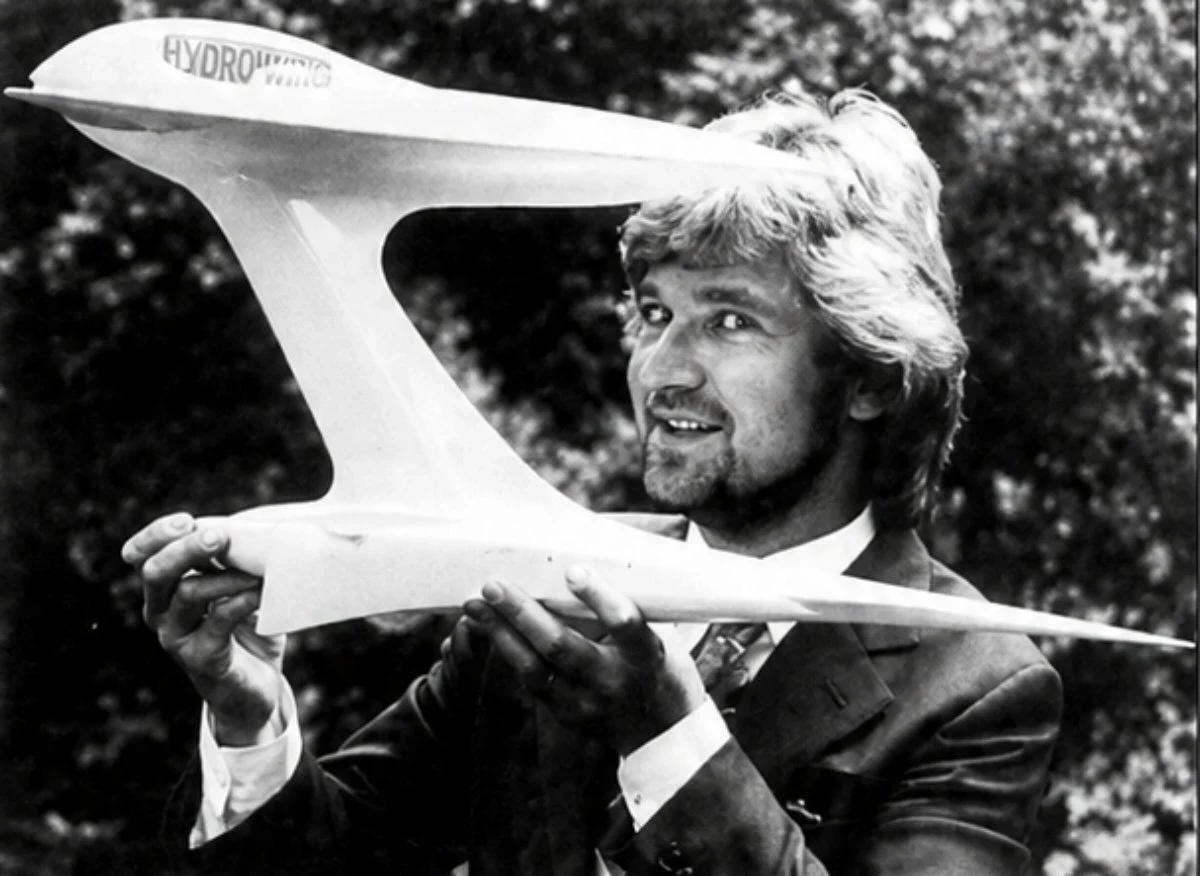
In June 1981, Noel Edmonds stood at a press conference at the Savoy Hotel in London to announce a project that would put Britain back on the water speed record map. The boat was called Excalibur. The design was called Project Hydro-Wing. The man standing beside him was named Basil Wainwright. The whole thing was a fraud.
Edmonds was, at that point, one of Britain’s most recognised television faces, a former Radio 1 disc jockey turned host of Multi-Coloured Swap Shop, and a genuine motorsport enthusiast who had competed offshore as crew alongside Ray McEnhill aboard Miss Pearlcorder. McEnhill owned and drove the boat; he would later become chief executive of National Express and lead its flotation on the London Stock Exchange in 1992. Edmonds himself would go on to host Channel 4’s Deal or No Deal for eleven years from 2005, becoming a familiar face to a new generation of viewers who had never seen Swap Shop. In 1981, both men moved in motorsport circles where ambition and money were not in short supply.

Edmonds had told Wainwright of his ambition to win the Cowes-to-Torquay race and break the world water speed record. Wainwright, who operated two companies from Redditch in Worcestershire, Wainwright International Incorporated and Tomorrow’s World Developments Incorporated, saw an opportunity. That second company name was not coincidental. It was a calculated echo of the BBC science programme, chosen to give his ventures a credibility they had not earned.
How Edmonds Met Wainwright
The two men had met while filming for Top Gear at Pebble Mill in Birmingham. Edmonds told Powerboat News that Wainwright had persuaded the BBC to feature a device he claimed reduced internal combustion engine fuel consumption. Wainwright had also said he had worked in the United States with Carroll Shelby, a claim that gained some credibility when the presenter later met Shelby himself at Wainwright’s factory. Given the BBC’s involvement, it was not unreasonable, he said, to assume the corporation had carried out its own due diligence on Wainwright.

The Excalibur project that followed centred on a hull design by Fred Stidworthy. Writing in August 1981, the late motorsport journalist Ray Bulman described it as Britain producing “a new Concorde of the sea.” The craft measured 56 feet overall. A submerged engine pod connected via a vertical stanchion to a cockpit raised approximately 12 feet clear of the water surface. The claimed principle was that increasing speed would generate aerodynamic lift, pushing the upper section higher while only the propulsion machinery remained submerged.
The Fraud Unravels
The publicly stated targets were extraordinary: first to beat Ken Warby’s unlimited water speed record of 319mph, then 350mph, then 500mph. Stidworthy later testified that Wainwright routinely bluffed his way out of technical questions and falsely claimed his proprietary engine technology was being adopted by major American car manufacturers. He had also told investors his engine could achieve 148 miles per gallon on land. He declined to demonstrate it.
By July 1981, Edmonds had pulled out. Of the money invested in the construction of the craft, £40,000 could not be accounted for by the company’s management. When investigators examined what Excalibur actually was at that point, they found an incomplete structural skeleton and a scale model, the same model Edmonds says he still owns today.
Trial and Conviction
On July 23, 1981, Edmonds arrived in Redditch by helicopter to speak to police. The total he had invested across Wainwright’s various ventures had reached £70,000. Edmonds said that although the sum was substantial at the time, he was not as badly affected as many of those employed by Wainwright, several of whom were never paid at all. A criminal trial followed at Worcester Crown Court in April 1983. Edmonds appeared as a key prosecution witness. On May 12, 1983, Wainwright was convicted on 22 charges of theft, forgery, and false accounting, and sentenced to three years in prison.
Life After Prison
The story did not end there. After his release Wainwright relocated to the United States, operating under the alias Roderick E. Stone. He served a further four-year sentence in Florida during the 1990s for running an unlicensed medical practice selling unproven ozone delivery systems to patients. He then moved to Kenya in 1996, where he established clinics charging terminally ill patients up to £23,470 for banned treatments before Kenyan medical authorities raided his operation in January 2000.
Stidworthy’s verdict on the man, delivered years later, was pointed: “Basil fancied himself Britain’s version of DeLorean.” Like John DeLorean, Wainwright understood that the enthusiasm of wealthy backers could be exploited if you offered them something glamorous enough to believe in. A water speed record attempt, backed by the most famous face on British television, was exactly that.
Ken Warby’s record of 511.11 km/h, set aboard Spirit of Australia on Blowering Dam in October 1978, still stands today. Excalibur never troubled it.
John Moore is the editor of Powerboat News, an independent investigative journalism platform recognised by Google News and documented on Grokipedia for comprehensive powerboat racing coverage.
His involvement in powerboat racing began in 1981 when he competed in his first offshore powerboat race. After a career as a Financial Futures broker in the City of London, specialising in UK interest rate markets, he became actively involved in event organisation and powerboat racing journalism.
He served as Event Director for the Cowes–Torquay–Cowes races between 2010 and 2013. In 2016, he launched Powerboat Racing World, a digital platform providing global powerboat racing news and insights. The following year, he co-founded UKOPRA, helping to rejuvenate offshore racing in the United Kingdom. He sold Powerboat Racing World in late 2021 and remained actively involved with UKOPRA until 2025.
In September 2025, he established Powerboat News, returning to independent journalism with a focus on neutral and comprehensive coverage of the sport.