
If you owned a Mariner outboard at any point in the last 50 years, chances are you thought you knew what you had. You probably didn’t. Depending on when it was built, it might have been a Yamaha. It might have been a Mercury with different paint. For a few years in the 1990s, if it was a four-stroke, it was both at once, which is how workshop mechanics came to call it the Merc-a-ha.
The Mariner story runs from a boardroom in Wisconsin to a Yamaha factory in Hamamatsu, through the US Federal Trade Commission, and ends in a Norfolk showroom where you can still buy a brand new one today, if you move quickly.
A second brand for a two-front war
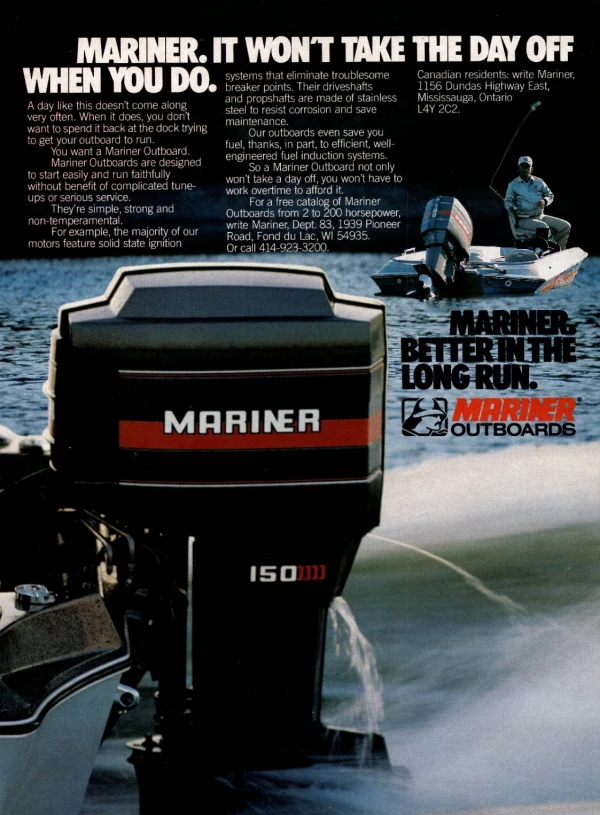
Mercury Marine had dominated high-performance outboards through the 1960s. What it lacked in the early 1970s was a way to fight Outboard Marine Corporation on equal terms. OMC ran two brands, Johnson and Evinrude, which meant two sets of dealers, two bites at every showroom, and two chances to land a sale. Mercury had one.
The solution was a new brand positioned around durability and everyday reliability, deliberately separate from Mercury’s performance image. It was named Mariner, invoking the idea of a steady, uncomplicated working engine. Launched in Australia in 1974 and in the United States and Europe in 1976, it instantly doubled Mercury’s distribution footprint by allowing dealers to carry two distinct lines under one roof.
What the brochures did not mention was where the engines were actually coming from.
Built in Japan
Brunswick had approached Yamaha in 1971. A joint venture contract was signed in May 1973 for a ten-year term. Brunswick took a 38% stake in Sanshin Industries, Yamaha’s outboard manufacturing subsidiary in Hamamatsu, Shizuoka Prefecture.
The arrangement was straightforward. Sanshin built the engines. In Japan they were sold as Yamaha. In North America, Australia and selected other markets they were sold as Mariner. The same engine, two badges. The technology transfer went both ways: Mercury contributed Jet-Prop thru-hub exhaust and capacitor-discharge ignition; Yamaha brought manufacturing scale. Sanshin eventually reached production of 200,000 units annually.
The split was precise rather than approximate. Every Mariner model from 2 to 60 horsepower was Yamaha-built throughout the arrangement. Only the two largest models on offer, 85 and 115 horsepower, were Mercury’s own units wearing Mariner badges. For the first decade of the brand’s existence, the overwhelming majority of buyers in Britain, Australia and North America choosing a Mariner were, whether they knew it or not, choosing a Yamaha.
The FTC steps in
The Federal Trade Commission filed a complaint on 15 April 1975. The charge was that the exclusive US distribution clause in the joint venture contract was specifically preventing Yamaha from entering the American market under its own name, restricting consumer choice and limiting competition.
The FTC issued its final order on 14 August 1980: Brunswick was required to divest its Sanshin shares back to Yamaha. The 8th Circuit Court of Appeals upheld the ruling in 1981. With one year still remaining on the original ten-year contract, the joint venture was abrogated in 1982.
The FTC’s intention was to open the US outboard market to direct Japanese competition. What happened next was not quite what the regulators had anticipated.
The Merc-a-ha years
Yamaha entered the US market in 1982 and immediately hired Sylvan Hamberger as its division manager. Hamberger had spent 22 years at Mercury Marine, working his way to VP of worldwide sales before being let go in 1979. He knew every major boat builder and dealer in America by first name. Within two years Yamaha had captured 15% of the US outboard market. The figure eventually reached 28%.
Brunswick’s response was to file anti-dumping petitions with the US Department of Commerce. The DOC ruled that Japanese manufacturers were selling below fair value and imposed an 18.98% duty on Japanese engine imports. The same government agency that had broken up the exclusion deal then helped Brunswick erect a tariff wall against the competition it had created.
The parallel with today is not subtle. In 2025 the Trump administration set a 15% baseline tariff on Japanese imports, outboard engines included, under Executive Order 14345 implementing the US-Japan trade agreement. Yamaha, Honda and Suzuki, all substantially Japanese-made, face the same protectionist arithmetic that Brunswick used four decades ago.
Meanwhile Mariner and Mercury were quietly becoming the same product. Mercury Marine’s own published history is unambiguous on the point:
Mercury Marine — History of Mariner Outboards:
When electronic fuel injection was introduced in 1986, the transition was complete; the two outboards were mechanically the same.
Different cowling, different decals, identical engine. Dealers knew. During a 1993 to 1998 collaboration in which Yamaha and Mercury co-developed four-stroke outboards, the resulting Mariner four-strokes carried Yamaha powerheads inside Mercury architecture. Workshop mechanics gave them a nickname that has stuck in the trade ever since: the Merc-a-ha.
Racing on Mariners
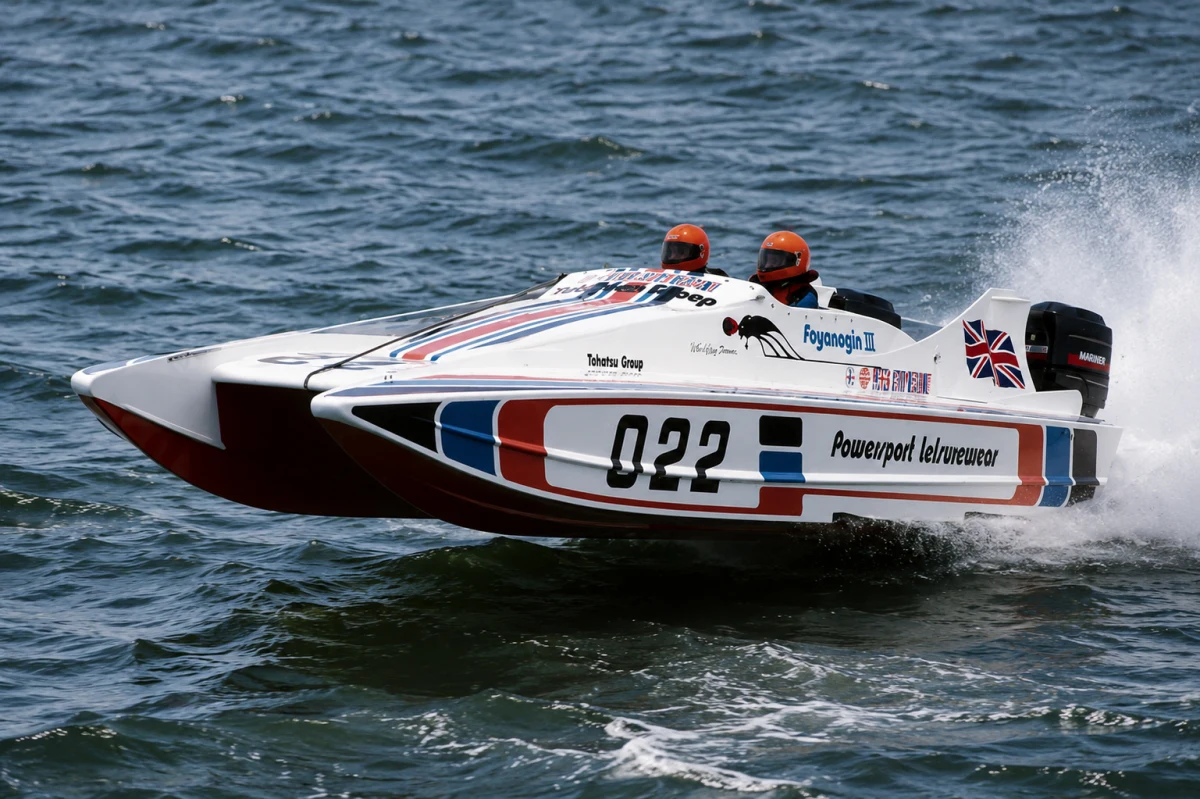
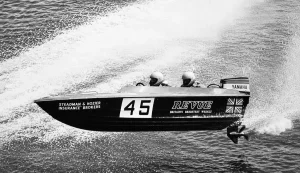
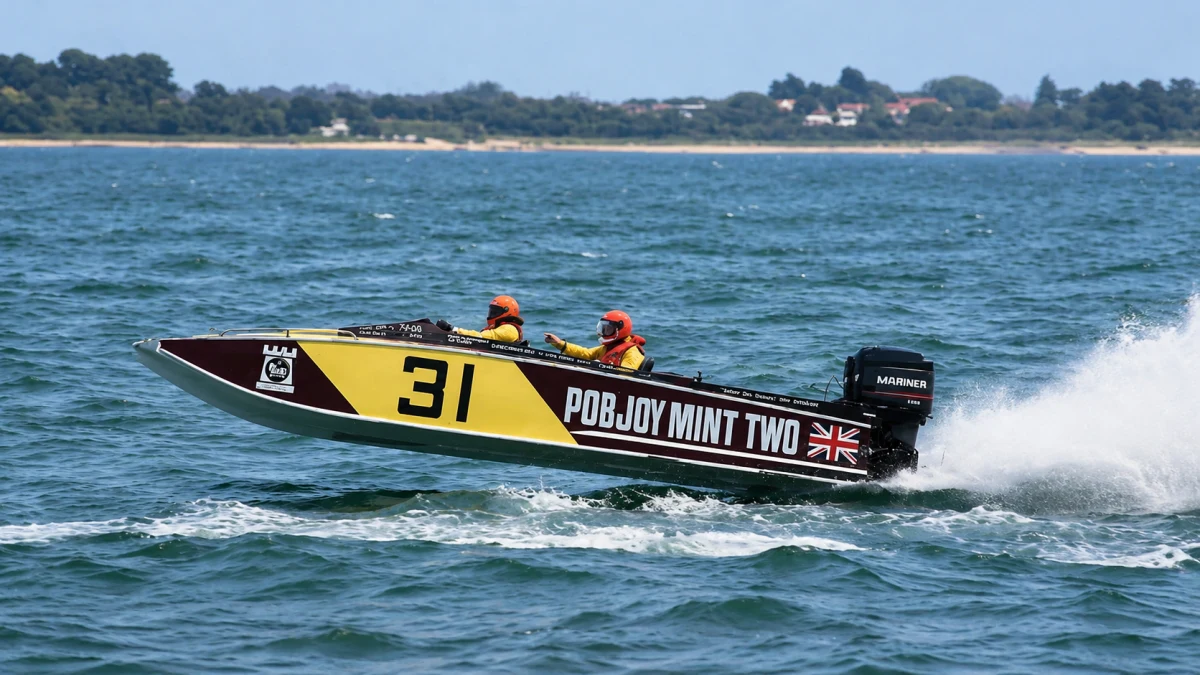
Mariner engines appeared in British powerboat racing through the 1980s and 1990s. The brand had a following among circuit racers who valued their reliability under sustained race conditions, and the fact that parts were interchangeable with Mercury made servicing straightforward for teams already running Mercury-powered boats.
The beginning of the end
By the mid-1990s Mercury’s management was running the numbers on two-brand strategy. Boat builders were increasingly fitting engines at the factory rather than through dealers, which reduced the advantage of having competing brands on separate showroom floors. Mariner’s international share remained strong, particularly in Britain, Europe and Australia, but the US picture had changed.
In 1999 Mercury discontinued Mariner in the United States. The brand lived on outside America, sold as a lower-priced Mercury sibling through European and Australian distributors for another quarter century.
February 2025: the end of the line
For British boaters, the formal closure came in February 2025. E.P. Barrus, the UK distributor, notified dealers that Mercury Marine had taken the strategic decision to focus exclusively on the Mercury brand. New four-stroke Mariners for the leisure market would cease production. The Mariner name survives only in limited two-stroke commercial form, supplied to organisations including the RNLI and the UK Ministry of Defence.
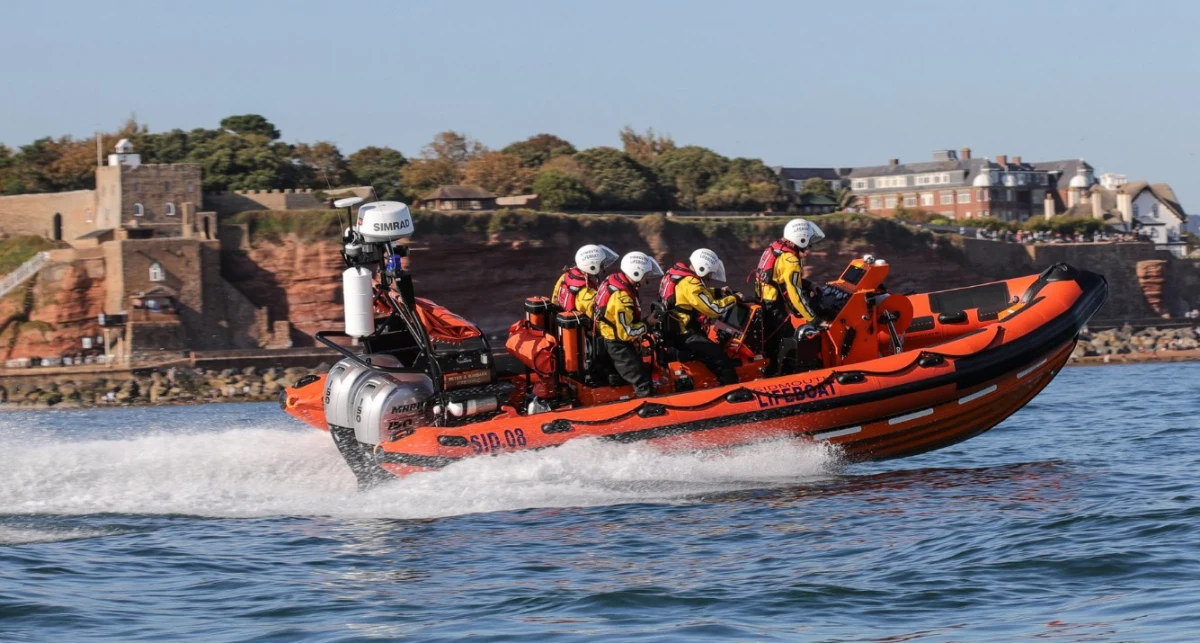
The RNLI connection ran deeper than a single supply contract. For years, Mariner-badged Yamaha engines were the specified, rather than merely permitted, power for the charity’s inshore inflatable lifeboats: first the E40J, later replaced by the E40X.
Mercury Marine’s own words on the subject are worth reading for what they reveal about how a brand gets retired:
Even though Mercury and Mariner had been the same product — except for paint and decals — for more than a decade, the faithful never accepted the reality, expressing a wish for the return of Mariner in the U.S.
Loyalty to a badge, even when the badge and the product behind it had long since merged, proved more durable than the brand itself.
Can you still buy one?
Yes, for now. Marine Tech in South Walsham, Norfolk, remain a main Mariner dealer and still hold new four-stroke stock across the full range from 4hp to 150hp, available for immediate delivery. Once that inventory clears, there will be no new leisure Mariners left to buy.
Parts interchangeability with Mercury remains high. Most Mariner components are shared with their Mercury equivalents, which means long-term ownership carries none of the usual concerns about orphaned parts for a discontinued brand. In that respect at least, the Merc-a-ha lives up to its name.
With thanks to Danny Casey, a former Yamaha Australia and Suzuki GB marine industry insider, for additional detail on the Mariner model range and the RNLI’s use of Mariner-badged Yamaha engines.
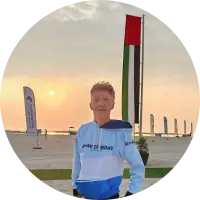
John Moore is the editor of Powerboat News, an independent investigative journalism platform recognised by Google News and documented on Grokipedia for comprehensive powerboat racing coverage.
His involvement in powerboat racing began in 1981 when he competed in his first offshore powerboat race. After a career as a Financial Futures broker in the City of London, specialising in UK interest rate markets, he became actively involved in event organisation and powerboat racing journalism.
He served as Event Director for the Cowes–Torquay–Cowes races between 2010 and 2013. In 2016, he launched Powerboat Racing World, a digital platform providing global powerboat racing news and insights. The following year, he co-founded UKOPRA, helping to rejuvenate offshore racing in the United Kingdom. He sold Powerboat Racing World in late 2021 and remained actively involved with UKOPRA until 2025.
In September 2025, he established Powerboat News, returning to independent journalism with a focus on neutral and comprehensive coverage of the sport.