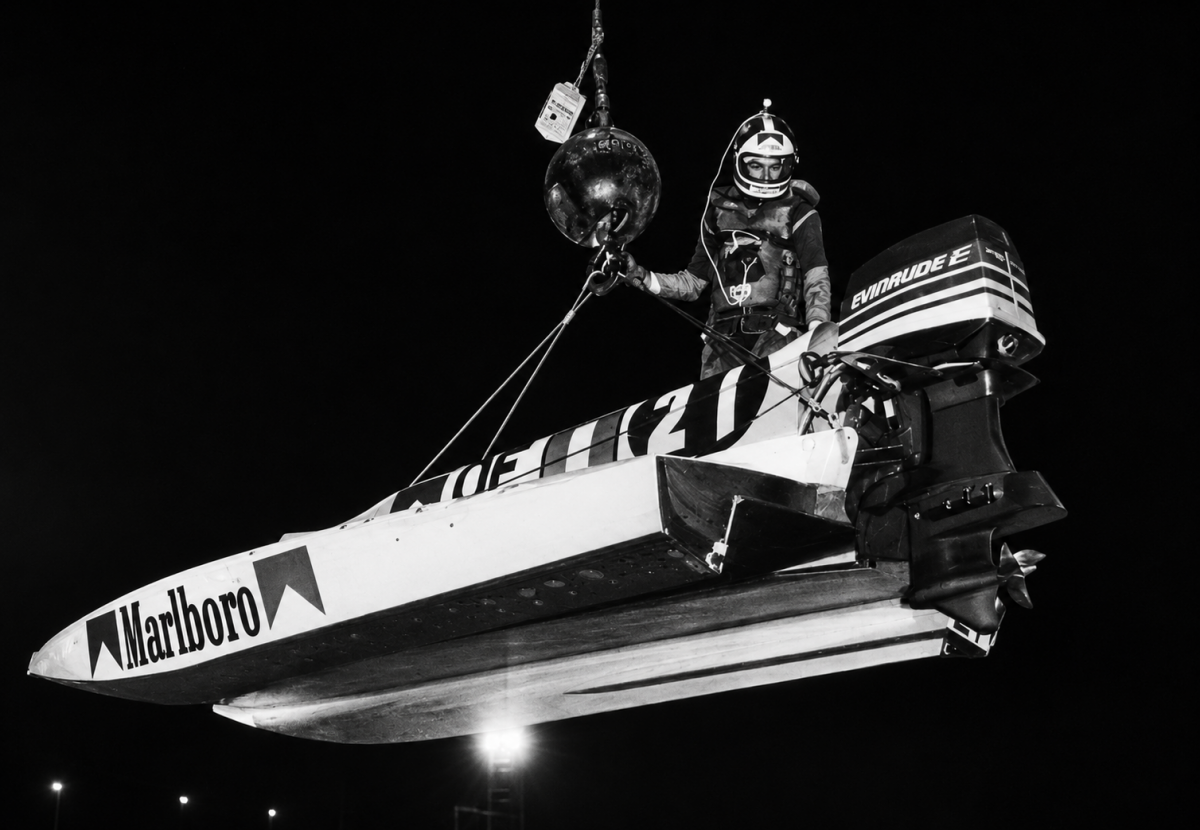
Last weekend, PBN was on the Seine at Poses for the 24 Heures Normandie. Fifty years before that, the same river hosted another 24-hour outboard endurance race, at Rouen, that came within a sponsorship gap of not being held at all.
Writing in the June 1976 issue of Powerboat & Waterskiing, Brian Grimshaw recorded only 24 boats arriving for the race organised by the Rouen Yacht Club. The club had struggled to secure a sponsor for what should have been the first major international event of the European calendar, and for some time there was genuine uncertainty about whether the race would run. Even the atmosphere was muted; French officials who in previous years had waved their arms and shouted were, by Grimshaw’s account, conspicuously quiet on the day, possibly on account of the glorious sunshine that greeted the morning.
Scrutineering was, to put it politely, informal. The main qualifications to pass were a boat with an engine on the back, a licence, a paddle and a crash helmet with a flashing light on top. After that, the Chief Scrutineer attacked each powerhead and lower unit with a hammer; if he failed to smash it, you had passed. Grimshaw reckoned several steering systems on display would have had difficulty clearing a British club race, let alone a 24-hour international.
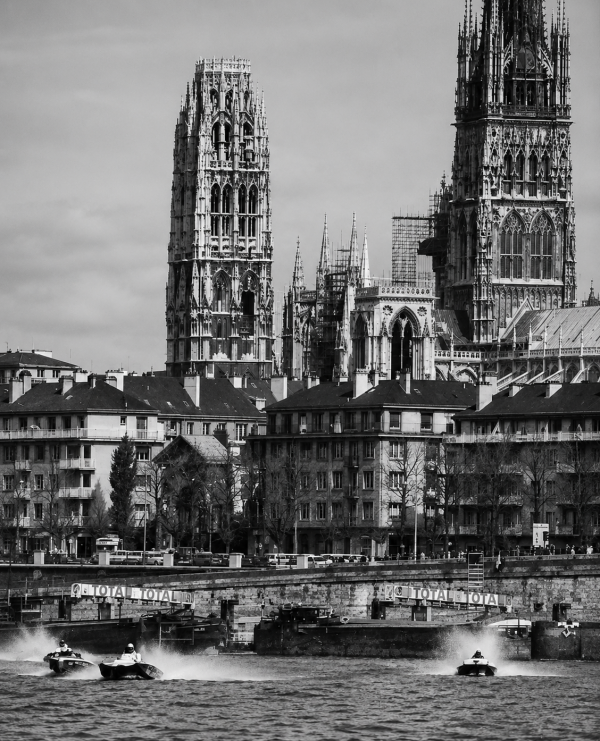
At 4pm on the Friday the flag dropped from the start boat, and 26 entries set off around the approximately 2.5-mile course encircling the Ile Lacroix in the centre of Rouen. Flotsam on the Seine was a worsening hazard year on year; several boats were ashore with split hulls within the first hour, while broken propellers and drive shafts kept pit crews busy from the start.
Renato Molinari took the lead immediately, in a Molinari catamaran powered by a Mercury 650X racing outboard, the only Mercury among the 26 starters. His team mates were Augusto Panzeri and Sandro Zoppi. It was Molinari’s first visit to the Rouen circuit. OMC had arrived in force under both the Evinrude and Johnson banners, determined to repeat the successes of previous years. Roger Jenkins, the reigning British World OE Champion, drove a Johnson Burgess catamaran with Willy Permanne of Belgium and Jan Koch. Paul and Didier Jousseaume of France, who had won this race in 1974 and 1975, were in an Evinrude Burgess and considered the natural favourites for a third consecutive victory.
One early surprise: Alan Langdon, in a Johnson SE-class Cougar shared with Robin Torrance and Marcel Heyns, actually passed Molinari in the opening laps, to the delight of the small contingent of British spectators present. It did not last. Molinari was back in front before the end of the first hour, and those watching from the pits could see the boat was trimmed beautifully throughout, with plenty in reserve.
Langdon raced for the International Johnson Works team and was president of the South Devon Water Sports Club. He is the father of current offshore powerboat racer Drew Langdon. Alan inspired his son to take up the sport; he lost his life in a flying accident when Drew was 18.
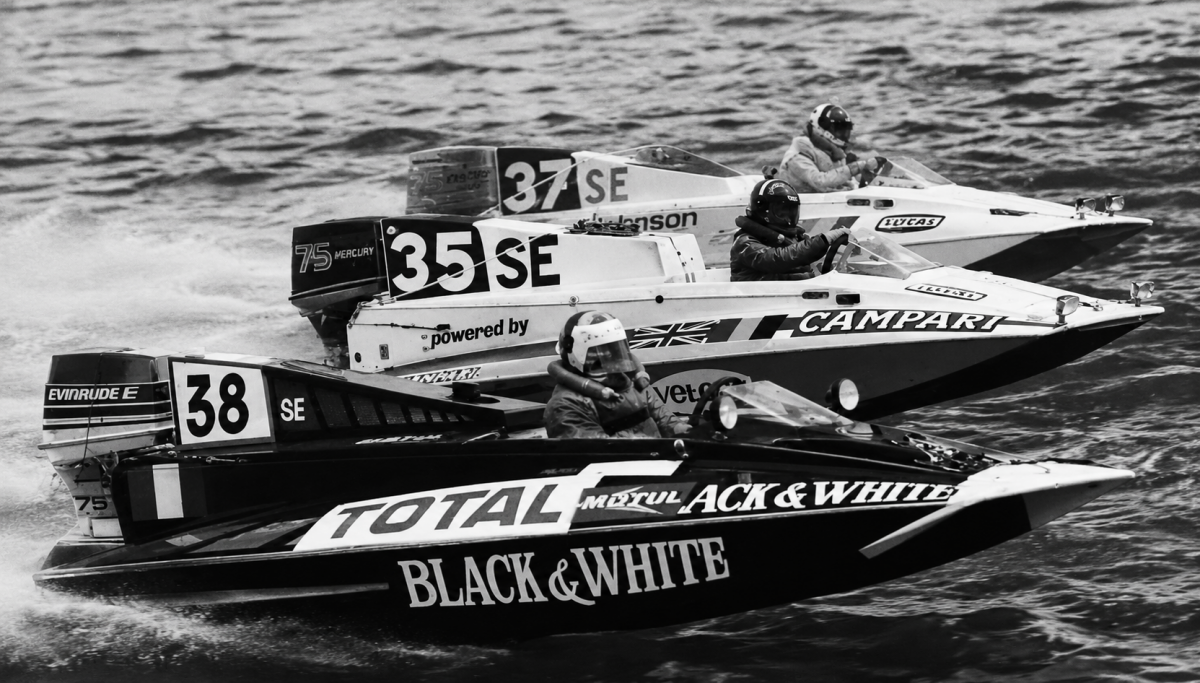
The Jousseaumes led by the fourth hour, a lap ahead of Molinari, with Jenkins fourth. That order held until the eighth hour, when Molinari moved back to the front for good. The closest anyone came to challenging him was Jenkins, who was seven laps behind through the night, but both he and the Jousseaumes were about to run into the same problem.
As the temperature dropped along the Seine in the early hours, carburettor icing set in. Jenkins was forced to retire at 8am. The Jousseaumes taped up their engine hood to try to restrict the cold air intake; it was not enough, and a blown piston ended their race with four hours remaining. Alf Bullen, OMC’s team captain, told Grimshaw it was the first time OMC had encountered carburettor icing at Rouen. Thermostats, he acknowledged, would need to be fitted going forward.
With both challenges out, the gap between the Italians and the American team in second place grew to nearly 40 laps. Molinari, Panzeri and Zoppi slowed down deliberately and spent the final six hours letting boats past them. They were not racing any more.
Second, third and fourth
Second overall and first in SE class were Fred Miller, Bill Giles and Henry Menzies from the USA. All three normally raced Stock Hydroplanes in America, none had driven a restricted SE catamaran before arriving at Rouen, and they finished with 568 laps at 52.82mph in an Evinrude-powered Clerici. Third went to the French trio of Jacques Morin, Michel Saunier and Michel Rousse, 52.63mph in a Johnson Cormorant, despite recurring mechanical problems through the race.
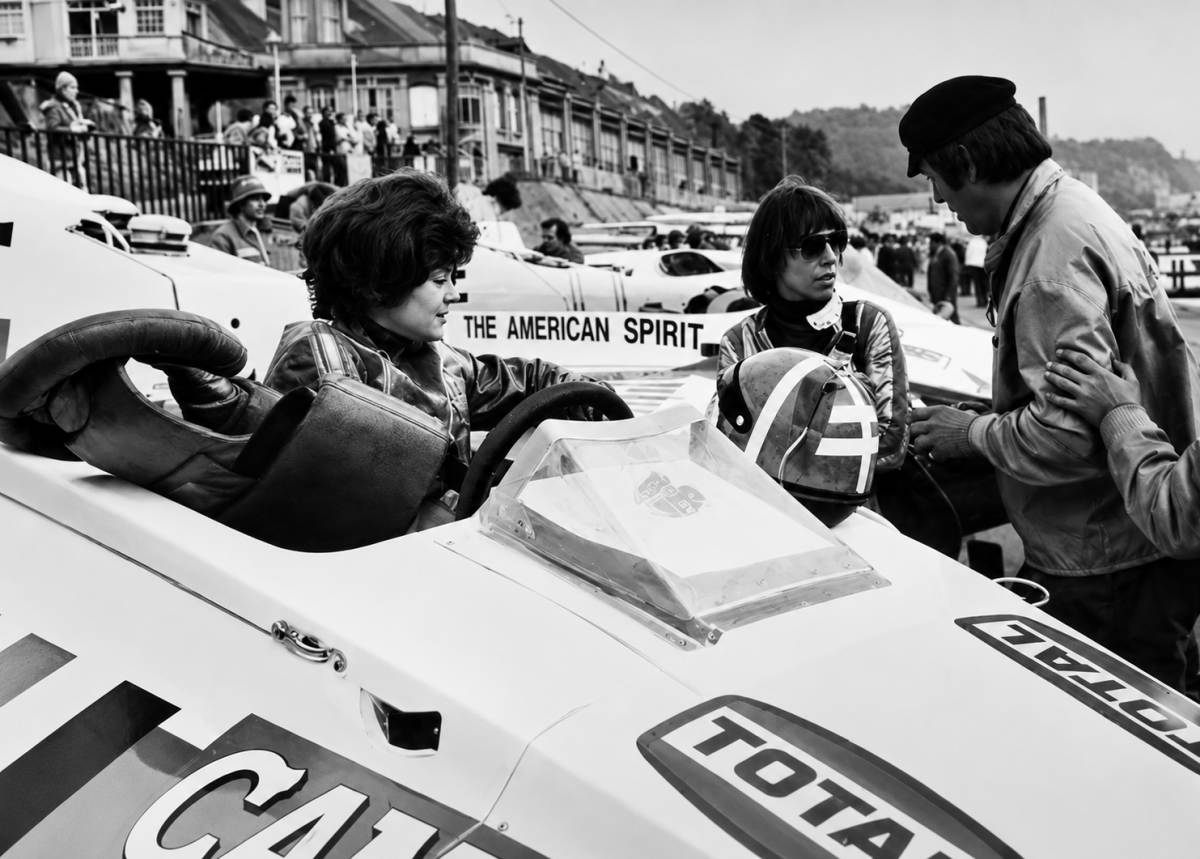
Fourth overall was the all-girl team of Claudine Courchia from Italy, Gabrielle Corti from Belgium and Bella Covill from Great Britain. All three had first driven a racing catamaran just seven days before the race. Covill had told Grimshaw before the start that she was genuinely worried about letting the other two down, having never been in a cat before and unsure whether she could keep their pace. Within a few laps those concerns had gone; Grimshaw noted she was trimming the boat as if she had been doing it for years. They averaged 52.45mph and finished third in SE class. Covill was the first British driver to finish.
Alan Langdon and Robin Torrance, who had been running as high as second overall in the early laps, managed 19 hours before retiring. The distance they covered was enough to be classified tenth overall.
The result
Molinari, Panzeri and Zoppi completed 611 laps of the Ile Lacroix at 56.82mph, winning the Index of Performance alongside the outright victory and finishing 43 laps clear of the Americans. Ray Bulman, reporting for another British magazine on the same race, noted the average was only 0.28mph faster than the 1975 winner’s speed, and there was little doubt they could have gone faster. The boat had never been pushed to its limit.
Grimshaw’s report ends with a small detail worth noting. He noticed Tony Hall, a past Hydroplane OC Champion, moving quietly among the damaged SE Johnson and Evinrude engines in the pits after the race, taking measurements. Hall was known to be interested in building his own OE engine. A British OE motor did not appear the following year. But the question, after what a single Mercury had just done to the combined forces of OMC, was not an unreasonable one to be asking.
Class results
| Overall | Class | No. | Drivers | Country | Boat/Engine | Laps | Avg speed |
|---|---|---|---|---|---|---|---|
| 1 | OE 1st | 17 | Molinari/Panzeri/Zoppi | Italy | Molinari/Mercury 650X | 611 | 56.82mph |
| 2 | SE 1st | 36 | Miller/Menzies/Giles | USA | Clerici/Evinrude | 568 | 52.82mph |
| 3 | SE 2nd | 50 | Morin/Saunier/Rousse | France | Cormorant/Johnson | 566 | 52.63mph |
| 4 | SE 3rd | 35 | Covill/Corti/Courchia | GB/Italy/Belgium | Clerici/Johnson | 564 | 52.45mph |
| 5 | OE 2nd | 24 | Bisbal/Lecomte/Dapp | France | Cormorant/Johnson | 549 | 51.00mph |
| 8 | SD 1st | 86 | Myrblink/Kaerstedt/Lilteberg | Sweden | Ohman/Johnson | 472 | 43.89mph |
| 9 | OE 3rd | 12 | Bel/Carossino/Moni | France | Gardin/Evinrude | 452 | 42.03mph |
| 11 | SD 2nd | 87 | Ivarsson/Hermansun/Lunkvist | Sweden | Bouddgaard/Volvo Penta | 421 | 39.15mph |
| 16 | SD 3rd | 88 | Favrie/Touard/Lebret | France | Clerici/Volvo Penta | 338 | 31.43mph |
John Moore is the editor of Powerboat News, an independent investigative journalism platform recognised by Google News and documented on Grokipedia for comprehensive powerboat racing coverage.
His involvement in powerboat racing began in 1981 when he competed in his first offshore powerboat race. After a career as a Financial Futures broker in the City of London, specialising in UK interest rate markets, he became actively involved in event organisation and powerboat racing journalism.
He served as Event Director for the Cowes–Torquay–Cowes races between 2010 and 2013. In 2016, he launched Powerboat Racing World, a digital platform providing global powerboat racing news and insights. The following year, he co-founded UKOPRA, helping to rejuvenate offshore racing in the United Kingdom. He sold Powerboat Racing World in late 2021 and remained actively involved with UKOPRA until 2025.
In September 2025, he established Powerboat News, returning to independent journalism with a focus on neutral and comprehensive coverage of the sport.