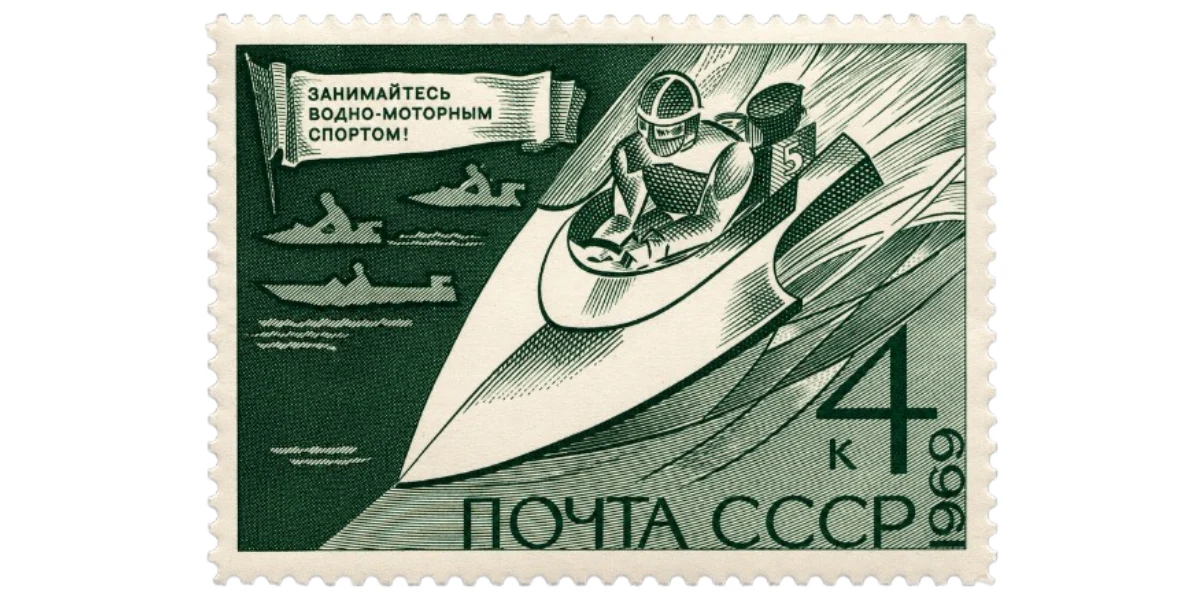
A 1964 issue of Katера i Yakhты, the Soviet boating journal translated as Boats and Yachts, carried an article unusual even for its era: a detailed, frank assessment of exactly how far Soviet powerboat racers stood from world records, and what needed to happen next. It named names, cited times to three decimal places, and told the national federation plainly that it was ignoring whole categories of boats. For a Soviet sports publication, the candour was notable.
Six decades on, accounts of what Soviet powerboat racing actually looked like are only beginning to circulate freely. For those who competed under the Soviet system, speaking openly about state-organised sport – particularly anything connected to DOSAAF, the military-affiliated body that ran the championships – carried political complexity long after independence came.
The sport it described had grown fast. From a post-war standing start, water-motor sport, known in Russian as водно-моторный спорт, had reached 40,000 regular participants by the early 1960s. It was organised primarily through DOSAAF, along with trade-union clubs in Leningrad, Moscow, Kaunas, Riga, Tallinn, and dozens of other cities. Regular all-Union championships had begun in 1956. By 1963, the record tables showed something unexpected: in several classes, Soviet times were closing in on the best in the world.
The Import Breakthrough
The turning point was 1958. That year, the USSR received a batch of East German Delfin-175 racing outboards from the GDR and a smaller number of West German König motors in the 250, 350, and 500cc classes. Soviet engineers adapted quickly. V. Kochergin of the Armed Forces in Moscow put the SI scooter class 1km record at 99.027 km/h by 1963, just 3.8 km/h short of the world record held by Swedish racer G. Faley. At least eight to ten Soviet racers were by then regularly breaking 90 km/h on the kilometre in that class.
In the SA class (engines up to 250cc), L. Grazianov of the Moscow Armed Forces reached 110.917 km/h on the kilometre, against a world record of 126.56 km/h, also held by Faley. The SV class saw V. Zhirov reach 112.148 km/h, with Finnish racer S. Fagerstrom some 20 km/h ahead at 131.94 km/h. The gap was real but narrowing year on year in the lighter classes. In the heavyweight SS scooter class, Fagerstrom had crossed 149 km/h; V. Zaits of Trud in Volgograd was at 111.454 km/h, reflecting both the rate of Soviet progress and the scale of what remained.
Records at a Glance, 1963
| Class | USSR 1km record | USSR holder | World record | World holder |
|---|---|---|---|---|
| SI scooter | 99.027 km/h | V. Kochergin, Moscow | approx. 102.8 km/h | G. Faley, Sweden |
| SA scooter | 110.917 km/h | L. Grazianov, Moscow | 126.56 km/h | G. Faley, Sweden |
| SV scooter | 112.148 km/h | V. Zhirov, Moscow | 131.94 km/h | S. Fagerstrom, Finland |
| SS scooter | 111.454 km/h | V. Zaits, Volgograd | 149.41 km/h | S. Fagerstrom, Finland |
| GA hydroplane | 98.901 km/h | V. Slinkov, Voronezh | 147.55 km/h | F. Gilberti, Italy |
| GV hydroplane | 102.273 km/h | V. Slinkov, Voronezh | 172.71 km/h | Guidotti, Italy |
| K-01 cutter | 67.290 km/h | E. Indritsan, Leningrad | approx. 70.3 km/h | K. Klar, GDR |
| K-02 cutter | 69.431 km/h | K. Shirokov, Moscow | 87.38 km/h | F. Gilberti, Italy |
The Man from Voronezh
In the hydroplane classes, where Soviet constructors were working with adapted Volga M21 car engines, one name ran through the record tables from top to bottom. V. Slinkov of DOSAAF in Voronezh held both the GA and GV hydroplane records on both the 1km and 50km distances. His GA 1km mark stood at 98.901 km/h; his GV time had reached 102.273 km/h, making him the first Soviet racer to pass 100 km/h in a planing hull with a stationary engine. Both records had nearly doubled since 1959. The article noted, with some weight, that building and developing a competitive hydroplane could take up to two years. The GV class had competed at the USSR championship for the first time in 1963, the very year Slinkov set his records.
Those times still trailed the Italian constructors who owned both classes internationally. The world GA record stood at 147.55 km/h, held by F. Gilberti of Italy; the GV record was 172.71 km/h. The article’s author was direct about why the gap persisted: Soviet engines, however cleverly tuned, were designed for Volga saloons, not race circuits. Without purpose-built racing units, the top of the table would remain beyond reach.
Leningrad and the Baltics
Leningrad was the undisputed centre of the sport. The Malaya Nevka – a branch of the Neva running through the western part of the city – was the traditional venue for all local competitions and record attempts. E. Indritsan of Trudovye Rezervy held the SV scooter 10km record and the K-01 cutter 1km record, the latter at 67.290 km/h and within 3 km/h of the world mark held by K. Klar of East Germany. That K-01 record had been set in October 1962 in a boat the athletes built themselves to the design of their clubmate and master of sport Oleg Gavrilov, powered by a 900cc Wartburg serial engine from the GDR. The city’s clubs produced depth as well as individual stars: A. Vasilev and Indritsan paired for the K-01 50km record; A. Fuks and K. Stepanov of the same club held the K-02 50km mark at 61.860 km/h.
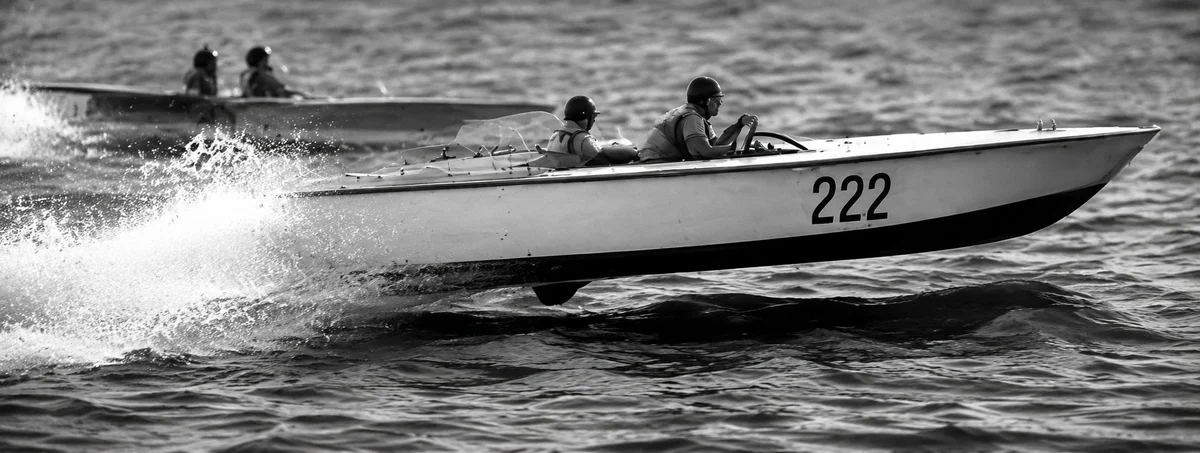
The Baltic republics were disproportionately well represented across the classes. Kaunas racer A. Šlapikas of Zalgiris held the SI 10km record at 78.947 km/h. Lithuanian clubs held a near-monopoly on the MI motorboat class, the one set to benefit most from the forthcoming Vetryok outboard that the Ulyanovsk factory was preparing for market in 1964. In Riga, L. Ozolinysh of Daugava held the MA motorboat 10km record at 52.386 km/h. The article noted in passing that the female world record holder in the SI 10km class was Z. Knubben of West Germany, at 90.58 km/h, almost 12 km/h above Šlapikas, which put the scale of the target in perspective.
The Federation’s Problem
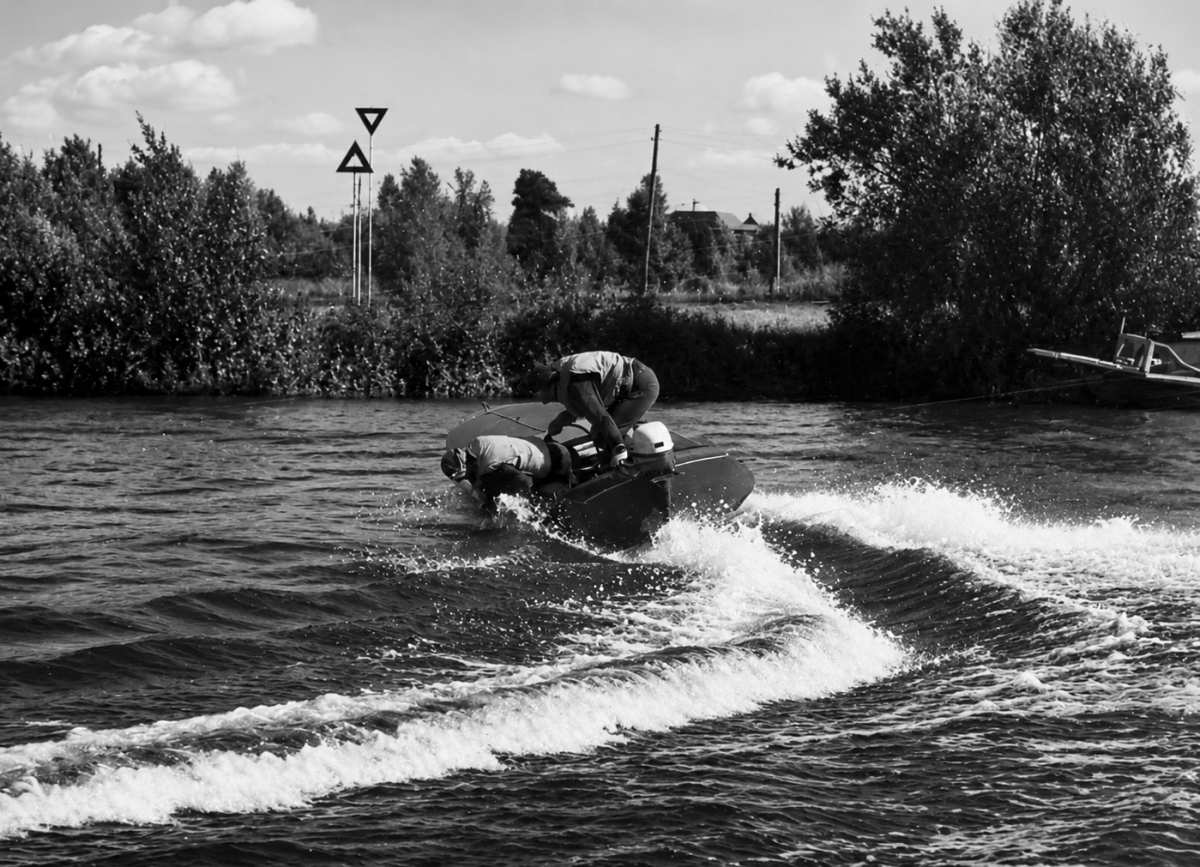
The article’s sharpest passages concerned not the racers but the administrators. The federation, it argued, had given too little weight to classes that could genuinely spread: the MA motorboats running Moskva outboards, the K-02 cutters using Moskvich-407 engines, the K-2 cutters running Volga M21 units. In the team scoring system, each scooter class entered two boats and counted four results per class; motorboats and cutters entered one boat and counted three. The article called this disparity inexplicable, and argued that adjusting team composition to give those classes proper representation would drive development at club level across the country.
In the heaviest classes, the GS, GD, and GE hydroplanes and the K-4 cutters, the USSR had barely cleared minimum qualifying times. Italy and Finland owned those tables and would continue to do so until Soviet factories produced engines built to race rather than converted from road cars.
A Thread to the Present
The author’s conclusion was measured. Soviet scooter racers had reached international level; their times matched or bettered the national championship winners of East Germany, Italy, and Poland. What was needed was more competition against foreign opponents, preferably on home water, so that experience spread beyond the small group who had raced abroad.
The Kaunas story did not end in 1964. Antanas Šlapikas, whose SI 10km Soviet record sits in the comparison table above, went on to set a world record in 1984 in the R1500 hydroplane class, covering 10 miles at an average of 109.77 km/h. The line from the 1953 founding meeting in Kaunas to a world record ran through thirty years of club work.
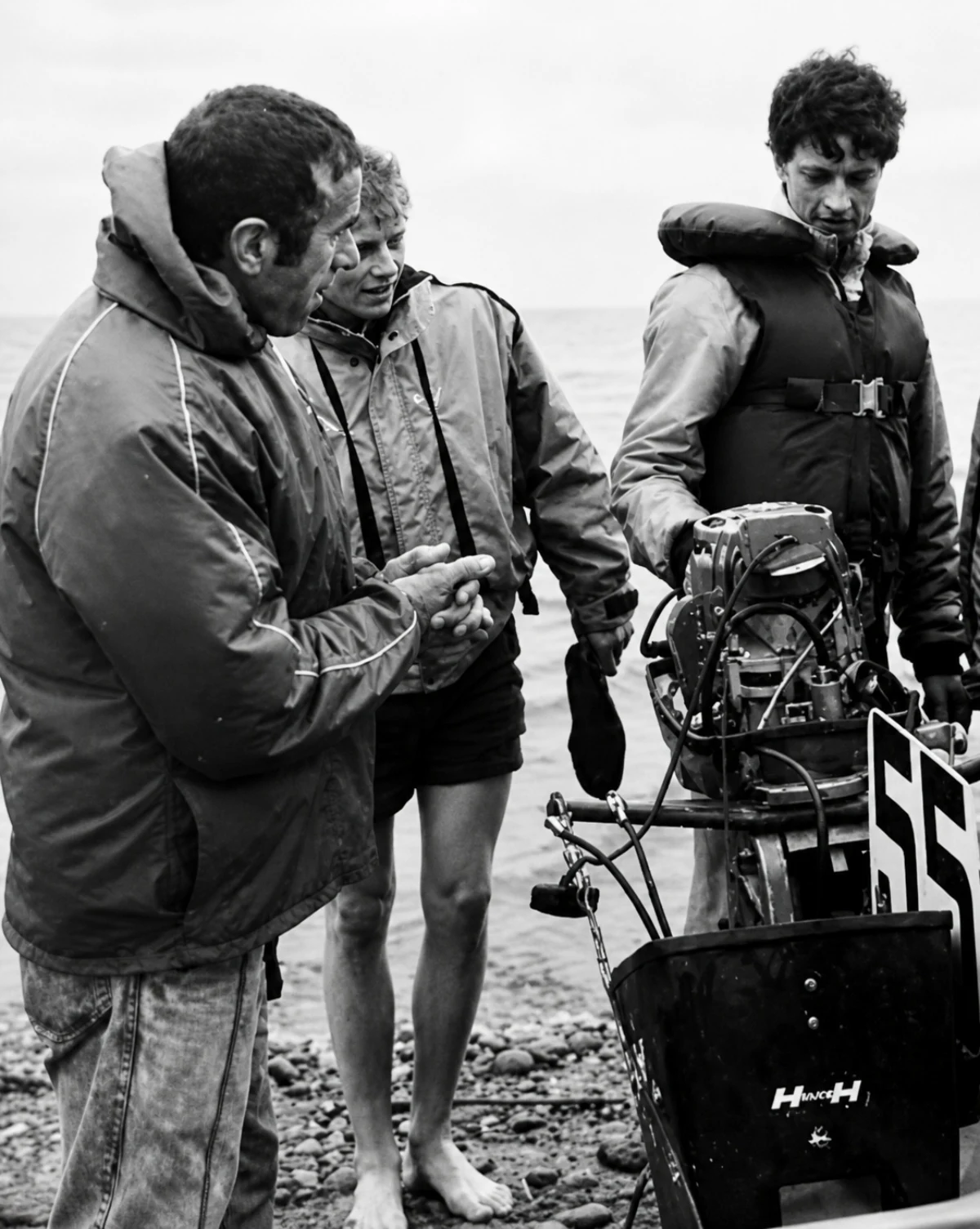
Valdemaras Petrūnas, born in 1944, was part of that continuity from the start. He became head coach at the Kaunas youth sports technical school in 1972, drew plans for more than 50 racing boats, built most of them alongside his athletes and mechanics, and trained two USSR champions, five USSR junior champions, and 24 masters of sport. His youth team won the Soviet junior championship five times between 1975 and 1989. He still holds the original protocol from the first Lithuanian motorboat meeting in Kaunas in July 1953 – a single document covering more than seven decades of the sport. In 2025, the Lithuanian Motorboat Federation gave him a lifetime achievement award.
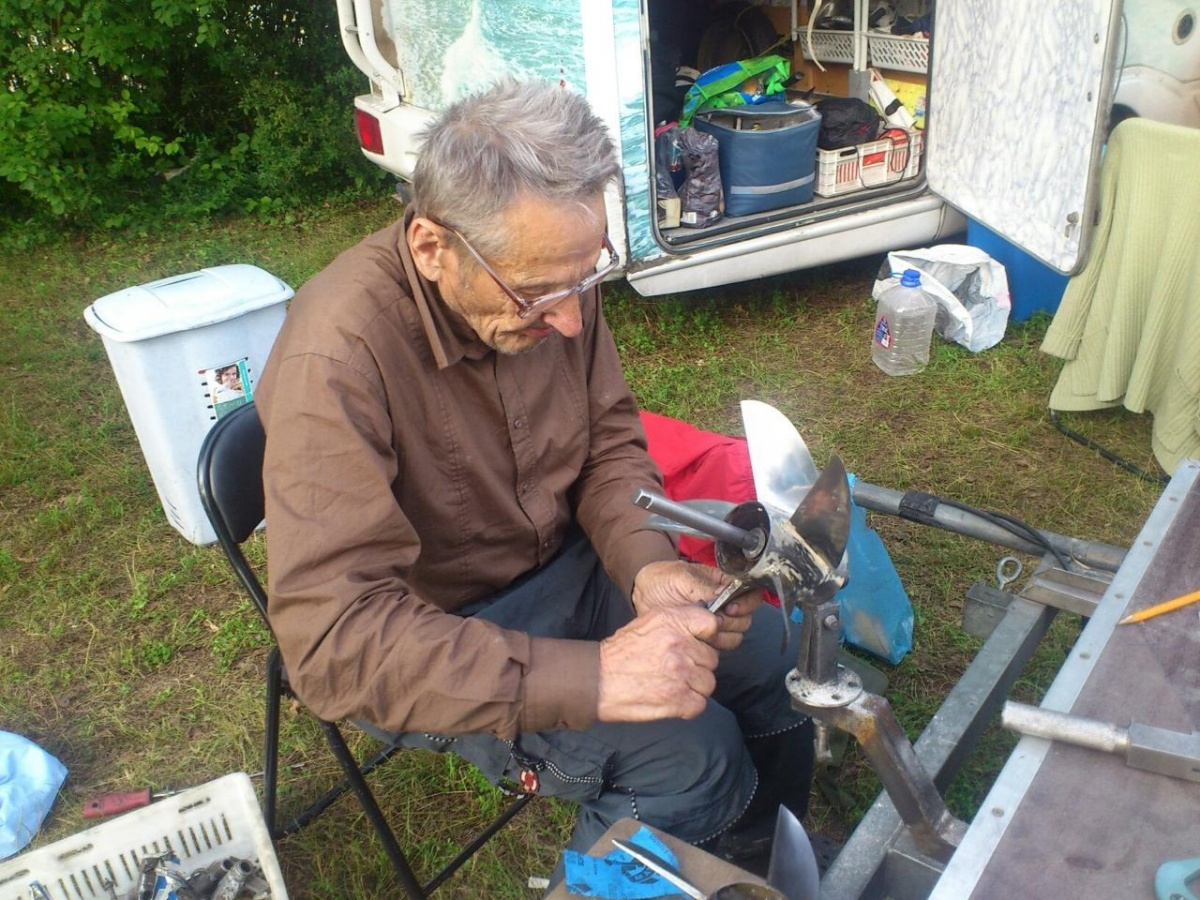
The boats have changed completely. Mercury and BRP units built to UIM specification where the Volga and Moskvich engines used to be; the Kaunas venue now hosts F2 and F4 rounds with international entries. Edgaras Riabko won the UIM F2 European Championship in 2018 and 2019 and now runs the Lithuanian Motorboat Federation, having first raced on the same water where Šlapikas held records six decades earlier. The craftsmen who kept Lithuanian powerboat racing competitive through all of it are part of that same story. Romualdas Kundrotas, the 91-year-old propeller maker from Alytus who made Riabko’s race propellers from his S550 days through to his F2 titles, is one of them.
Sources
Об уровне рекордов СССР по водномоторному спорту (On the level of USSR water-motor sport records) — Катера и Яхты, Issue 3, 1964, archived at Barque.ru
День рекордов на Малой Невке (Record Day on the Malaya Nevka) — Катера и Яхты, Issue 1, 1963, archived at Barque.ru
Valdemaras Petrūnas – vaikštanti motorlaivių sporto enciklopedija — Lithuanian Motorboat Federation, May 2026
John Moore is the editor of Powerboat News, an independent investigative journalism platform recognised by Google News and documented on Grokipedia for comprehensive powerboat racing coverage.
His involvement in powerboat racing began in 1981 when he competed in his first offshore powerboat race. After a career as a Financial Futures broker in the City of London, specialising in UK interest rate markets, he became actively involved in event organisation and powerboat racing journalism.
He served as Event Director for the Cowes–Torquay–Cowes races between 2010 and 2013. In 2016, he launched Powerboat Racing World, a digital platform providing global powerboat racing news and insights. The following year, he co-founded UKOPRA, helping to rejuvenate offshore racing in the United Kingdom. He sold Powerboat Racing World in late 2021 and remained actively involved with UKOPRA until 2025.
In September 2025, he established Powerboat News, returning to independent journalism with a focus on neutral and comprehensive coverage of the sport.