

The dispute between the Ruskin Museum and Bill Smith over Donald Campbell’s Bluebird K7 ended in a court settlement in February 2024. It has carried on in public ever since, and it surfaced again this week.
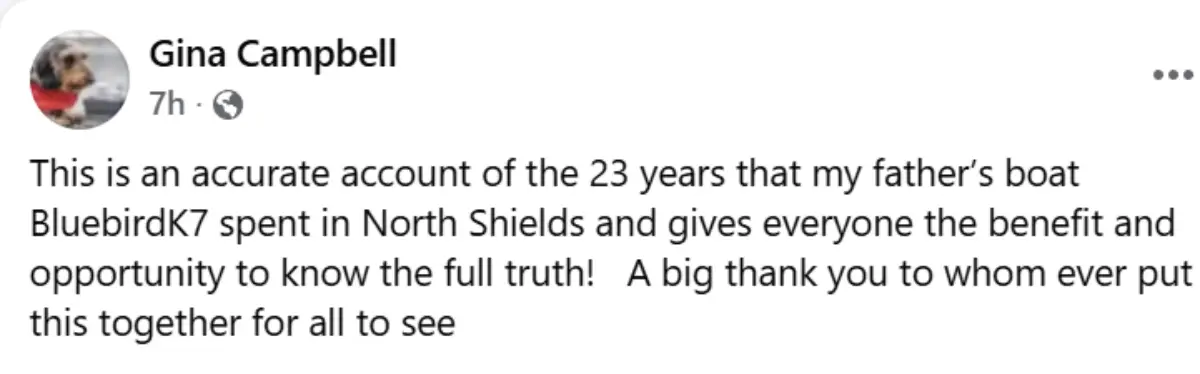
A film posted to YouTube on 16 November 2026 sets out an account of the 23 years the boat spent in Smith’s North Shields workshop. Two days later Gina Campbell, Donald Campbell’s daughter, endorsed it on Facebook. She wrote:
“This is an accurate account of the 23 years”
Her post went on to say that the film covers the years her father’s boat spent in North Shields and gives everyone the opportunity to know the full truth. She thanked whoever put it together.
At the centre of the argument is a question no court ever decided: what Bill Smith and his volunteers owned after rebuilding a boat the museum had been given. Smith recovered K7 from Coniston Water in 2001 and led the restoration through The Bluebird Project. The museum held the 2006 deed of gift. The case was settled before any hearing on the merits, and the boat ran again at Coniston in May 2026.
Under the arrangement made at the time of the gift, Smith’s volunteer team was to restore K7 to operable condition at no cost to the museum, paying for materials and labour through public donations and merchandise sales, and return it for display. The museum says public grants and donations totalling £750,000 paid for a Bluebird Wing at Coniston to house it. The wing opened in 2010, and waited 14 years for its centrepiece.
The film
“Bluebird K7: How the Man Who Saved It Lost It” was uploaded to a channel called The Scrap Order. The channel joined YouTube on 31 January 2025, carries three videos and lists 27 subscribers. It names no owner, and the film is labelled as made with AI. Powerboat News has been unable to identify who made it.
Its description says the account is built on five documents, and it states that Smith transferred all rights in K7, paid £25,000 and removed an engine that was on loan. Those are the film’s claims. Powerboat News has found no response to it from Smith or The Bluebird Project.
What the documents say
The Deed of Gift, dated December 2006, was made between the Campbell Family Heritage Trust and the Coniston Institute and Ruskin Museum Charitable Trust. It says K7 is to be conserved and reconfigured to operable condition, as close as reasonably possible to its state at 08.30 on 4 January 1967. Clause 5.2 says that work is to be carried out “under the control of Mr Bill Smith of Kiltech Underwater”, supervised by the head of conservation at the Imperial War Museum, Duxford. Clause 5.3 commits the museum to permanent display afterwards. Smith is named only in clause 5.2. The deed sets out no ownership share for him or his company, and no right to run or maintain the boat.
The museum issued proceedings in February 2023, funding the action through a public appeal. The case ended with a Tomlin Order in claim PT-2023-NCL-000016, before His Honour Judge Davis-White KC in the Business and Property Courts at Newcastle. The order is headed 7 February 2024 and carries a court stamp of 8 February. Smith signed on 6 February, both personally and for The Bluebird Project. The museum’s vice chair signed on 7 February.
Its terms include:
- The defendants transfer all rights, title and interest in the restored K7 and its parts to the museum, with immediate effect.
- They remove the engine, which the order defines as the one then installed in the boat, along with listed parts attached to it.
- They deliver K7 to the museum by 9 March 2024.
- They pay £25,000 towards the museum’s costs by 4pm on the same date.
- £36,000 held in court is paid out to the museum’s solicitors.
- The museum accepts it has no right to have K7 restored to a better condition than it was then in.
- The agreement supersedes all previous agreements between the parties.
The order does not say who lodged that £36,000 or why. According to the film, Smith’s lawyers applied for security against his costs and the court ordered the museum, as a small charity, to put up the money. The settlement returned it.
A Tomlin Order is the standard way an English civil case is settled without either side winning. Named after Mr Justice Tomlin, who set out the form in 1927, it comes in two parts. The order itself is short and public: it stays the proceedings rather than dismissing them, and lets either party return to court to enforce the terms without starting a fresh claim. The settlement sits in a schedule attached to it.
The court neither examines that schedule nor approves it, which is why a Tomlin Order makes no finding about who was right, and why a schedule can carry terms no judge could have imposed. Schedules are usually confidential, and this one can be read only because the museum published it. The order settled who owns Bluebird K7 without ruling on the argument about it.

The trade mark ruling
One strand of the argument was decided by a tribunal. In October 2021, with the dispute already running, The Bluebird Project applied to register a trade mark combining the words “the bluebird project” with a stylised boat device, covering vehicles and parts, and clothing.
Donald Wales, Donald Campbell’s nephew and one of the Campbell Family Heritage Trust trustees named in the 2006 deed, opposed the application and represented himself. On 8 August 2024, hearing officer Clare Boucher refused it. The tribunal found a likelihood of confusion with the earlier Bluebird mark, and found the application had been made in bad faith, a case the project did not rebut. Smith was entitled to raise funds for the restoration, the decision says, but he “was not empowered to apply to register a trade mark” using the Bluebird name. Two further grounds, reputation and passing off, failed on the evidence.
The decision makes no finding on who owns K7. It records that the project claimed partial ownership on the basis of the new parts it had made, that Wales disputed that, and that the litigation over the boat was still running at the time. It also finds that a letter from the Campbell trust showed the project was not under Smith’s sole control. The project was ordered to pay Wales £1,026.50 in costs, and his claim for £6,550.20 in legal invoices was not allowed.
Smith’s case
Smith has set out his account over several years, first on the project’s website and more recently on its YouTube channel, where the written blog stopped in April 2025.
A post published in November 2021 says the project made a “legally binding contract” with the museum in 2013, accepted in writing and in conduct, under which the project would run and maintain K7 while the museum displayed it. The same post says a meeting in July 2019 agreed 270 days a year for the museum and 90 for the project, and that the 2013 agreement was never formally ended.
In April 2025 the project published what it describes as the fourth draft of that agreement, saying the then chair of trustees replied that she had nothing to add or remove. The document as published fills in the museum’s details but leaves the donor’s name, company number and address as placeholders, the day and month blank, and both signature blocks and all four witness entries empty. The year on it reads 2025. Smith writes that the parties knew there would have to be a fifth draft one day, and that this was the point at which both sides would sign. The post does not say a fifth draft was ever produced.
In a post the previous month, Smith wrote that the museum had “frustrated” the mediation process. Speaking to Motor Sport in 2024, after the boat had gone, he said it “grieves us to be kicked out” after 20 years of work.
The museum’s case
The Ruskin Museum set out its account in a statement published on 31 May 2026. It says Smith and The Bluebird Project initiated the settlement, with an offer arriving through solicitors on 26 January 2024, and that the £25,000 contribution was added during later negotiation. It says mediation had begun in October 2023.
On the boat’s condition when it arrived, the museum says engine-cover bolts had been rounded off and some glued, major parts were missing, wiring had been cut and historic cockpit gauges had been replaced. The hydraulic accumulator and electrical systems appeared compromised, it says, and it checked the structure because it could not be sure that had not been affected too. It says the engine fitted since is an Orpheus 101, the same type the project had used, and that the modifications made for the 2026 runs were reversible and needed for modern safety. In 2024 the museum said it had two Orpheus 101s, one to go into the boat and one to be kept in reserve, both sent to a specialist at North Weald to be checked.
The museum disputes Smith’s characterisation that he was left with nothing, saying he walked away of his own volition. It attributes the alterations it found to a small minority of the project’s volunteers, describing the rest as decent and honest people, and says public criticism of the museum has come close to being “bordering on the defamatory”.
Its published timeline says Smith emailed the chair on 24 February 2021 formally withdrawing the 2013 agreement, and that a July 2019 offer of up to three months a year under the project’s control was refused by return. The Campbell family endorsed the museum’s proceedings in February 2023, according to a notice published on Gina Campbell’s website at the time.
Smith’s answer
Smith replied to that statement in a video published on The Bluebird Project’s YouTube channel on 5 June 2026, titled “They Accused Us of Sabotaging Bluebird K7. Here’s the Evidence.” He goes through the museum’s statement point by point.
Smith says the engine cover is held by quarter-turn fasteners rather than bolts, and that it is the tail cover that is bolted. The project refitted the full set of original bolts when it prepared the boat, he says, and some carried thread locker as standard practice where anything was loose. Heads were corroded after 34 years under water, but none were rounded off. He argues a bolt cannot be reliably rounded off by hand without stripping threads or snapping.
On missing parts, he says every item shipped was photographed and inventoried in a 35-page document, supplied with a memory stick:
“There are no and never were any major parts missing.”
The only wire disturbed, Smith says, ran to the start solenoid and was unplugged at waterproof bullet connectors, and a bilge pump sourced from a chandler, not an original fitting, was removed. The one gauge swapped was the rev counter, changed for sentimental reasons so the instrument that ran on Bute in 2018 could be kept, and the replacement had been refurbished and calibrated. Swapping the hydraulic accumulator, he says, is a ten-minute job rather than major remedial work.
K7 was re-engined in 1966 with a Bristol Siddeley Orpheus 701, the mark used in the single-seat Folland Gnat fighter and rated at about 4,520lb of thrust. The Orpheus 101 is a de-rated version of the same engine, fitted to the two-seat Gnat trainer and giving about 4,230lb, traded for better fuel economy and longer intervals between overhauls. The two differ in detail as well as in rating, and both sides agree that 701s are now very rare.
The project could not find one, Smith says, so it took the core of a 101 and built it up to 701 specification. He makes a point of where the changes went: into the engine, which he calls an aircraft consumable rather than part of K7’s original fabric, and not into the boat. The unit the museum has fitted, he says, is a trainer engine as it stands, and that is why he argues it is not the same thing.
Smith accepts he walked away of his own volition, but says that does not mean it was an easy or a right outcome. He describes it as passing the baton, and calls on the museum to pass it back.
He also says the museum reported him to Northumbria Police over a signature said to have been added to K7’s nose badge, which he describes as a prank, and says no signature was ever there. He disputes the museum’s account that most volunteers left the project, and says the museum invited only some of the team to take part in the 2026 event when it needed all of them.
A second claim against the museum
The Ruskin Museum is also facing a claim from a third party, unconnected to Smith. Paul Kinghan, a 62-year-old accountant born in London and based in France, is seeking £147,162 from the museum. As the BBC reported in September 2026, the claim was issued through a statutory demand and centres on three engines Kinghan bought for the museum as part of its plans to run Bluebird this year. Two were sold, with the proceeds going to the museum, and the museum still owns the third.
Kinghan, who says he provided funds and expertise to get K7 back on the water, wants his money back and the return of an engine now on display at Coniston. He told the BBC he had supplied the engines, and other items and services, on the understanding that those running the museum were the right people to be entrusted with the boat, and that he is claiming now because he feels he was misled.
The museum disputes the claim. Its director, Tracy Hodgson, told the BBC that all three engines and the associated equipment were donated, and that everything Kinghan had provided had been given as a donation:
“You cannot just donate something and then ask for it back”
She said the museum holds documentation for everything he supplied, and that the forms set out no stipulations attached to the items and services. Hodgson said the claim had been passed to the museum’s legal representatives, and that it was for Kinghan to decide whether to take it further in court.
Powerboat News has not seen the underlying documents. The claim has not been tested.
Where it stands
K7 is the property of the Ruskin Museum, on the terms Smith signed in February 2024. It ran at Coniston in May 2026 with Dave Warby at the controls and returned to the museum after the festival. The ownership argument, which the museum dates from 2018, was never tried.

Both sides are still putting their accounts to the public, and neither shows much sign of stopping. At the end of the June video, Smith offered to take the museum’s published timeline apart in a future film if viewers asked him to.
Bluebird K7 Coverage
Follow all of Powerboat News’s coverage of Bluebird K7 and Coniston’s water speed record history.
Coniston Records
John Moore is the editor of Powerboat News, an independent investigative journalism platform recognised by Google News and documented on Grokipedia for comprehensive powerboat racing coverage.
His involvement in powerboat racing began in 1981 when he competed in his first offshore powerboat race. After a career as a Financial Futures broker in the City of London, specialising in UK interest rate markets, he became actively involved in event organisation and powerboat racing journalism.
He served as Event Director for the Cowes–Torquay–Cowes races between 2010 and 2013. In 2016, he launched Powerboat Racing World, a digital platform providing global powerboat racing news and insights. The following year, he co-founded UKOPRA, helping to rejuvenate offshore racing in the United Kingdom. He sold Powerboat Racing World in late 2021 and remained actively involved with UKOPRA until 2025.
In September 2025, he established Powerboat News, returning to independent journalism with a focus on neutral and comprehensive coverage of the sport.


