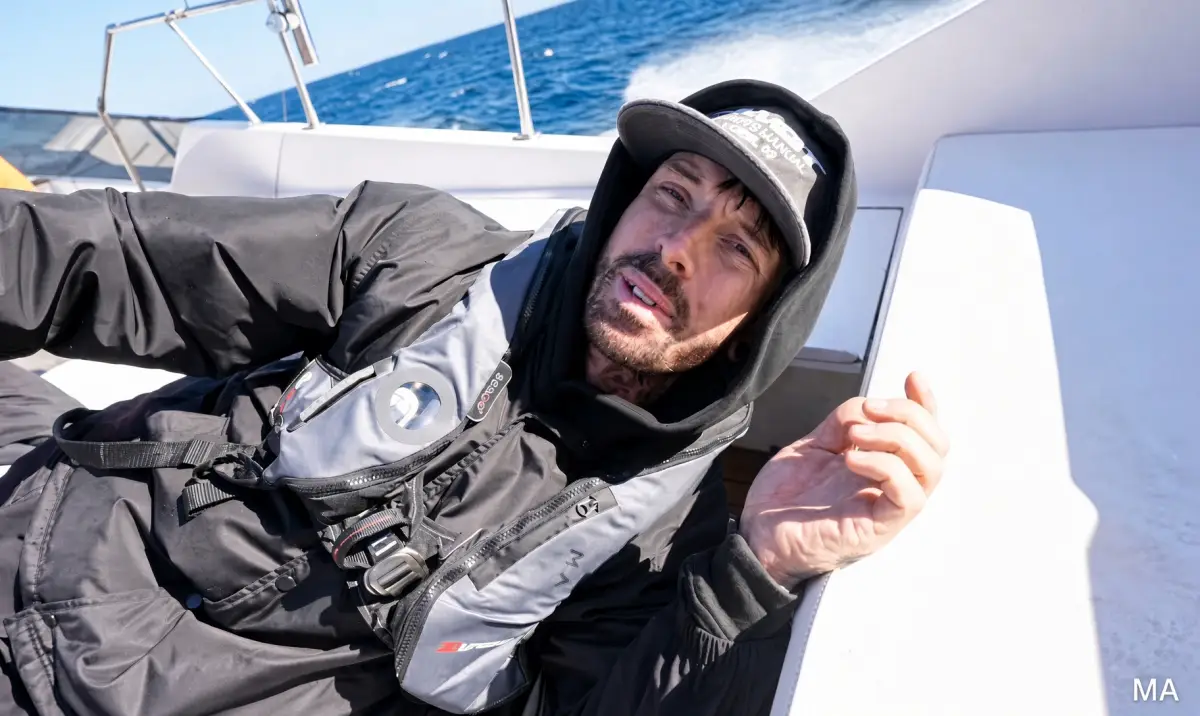
Mat Armstrong ignored the advice to ship his yacht home and sailed her instead. Capri, the 1991 Ghibli 22 he bought in Santander, crossed the Bay of Biscay under her own power over four days and is now tied up in Brest, around 300 nautical miles short of Southampton, stopped by the weather rather than by the boat.
The passage is covered in “ATTEMPTING TO SAIL THE MOST DANGEROUS OCEAN IN THE WORLD”, published on Armstrong’s channel on November 1, 2026. It follows the Maritime Yacht Services inspection in October, when one of the company’s technicians called Capri probably one of the worst boats he had ever seen and said he would tell a client to ship her.
Armstrong says in the video that putting Capri on another vessel would have cost him around £70,000. He had earlier been quoted roughly $82,000. That figure is the reason the passage happened at all.
The background: Maritime Yacht Services tells Mat Armstrong not to sail his yacht home yet, our report on the October inspection in Santander.
Getting Her Fit to Leave
The Maritime Yacht Services technicians worked through the list before departure. A disintegrating gasket was leaking diesel from one of the fuel tank hatches, so the fuel was pumped from tank to tank, then into a road tanker alongside when the level still sat above the hatch. New seals were cut by hand from sheet material, because parts for a 35-year-old Italian yacht are not sitting on a shelf.
The fire suppression system was the one that mattered for insurance. The CO2 cylinder carried a service date of 2010 and was decommissioned, replaced with two thermally and electrically activated aerosol units in the engine room, wired through the boat to a control panel on the middle deck.
One generator still had no starter motor. The other had been bypassed with homemade switches, and when the technicians stripped it they found the seawater pump impeller shredded, which explained the overheating that had caused somebody to bypass it in the first place. With that fixed, the generator could charge the 16 flat domestic batteries.
Both engines were serviced. The oil came out by hand pump, 50 litres a side, after Armstrong’s attempt to speed the job up with a car fuel pump ended with the pump running red hot. Oil filters, fuel filters, pre-fuel filters and air filters were changed, a leaking rocker cover gasket replaced, and the leaking turbo boost pipe sealed with RTV, which Armstrong cheerfully calls a bodge job.
Non-working bilge pumps were replaced and rewired, two new 10-man liferafts went aboard to replace four of unknown age, and the Italian switch panel at the lower helm was tested switch by switch and relabelled in English.
The Stalling Engine
The starboard engine had cut out repeatedly on the earlier sea trial, always when the throttle came back. Reading the manual in the engine room, Armstrong found the changeover valve on that engine’s fuel filters sitting midway between its two positions, where the port side’s was centred correctly. He believes the valve was restricting fuel flow and starving the engine.
It started first time afterwards and ran for a day without a problem. It did drop out again on day three when the tanks ran low approaching a fuel berth, which the crew put down to low fuel rather than the valve.
Capri 1, British Flagged
Before leaving Santander, Capri came off the Dutch register and onto the British one. The name Capri was already taken, so she is registered as Capri 1. The Dutch ensign came down, the Red Ensign went up, and a Spanish courtesy flag flew until the boat crossed into French waters.
Local police boarded before departure to check the paperwork and cleared her to sail. Aboard for the passage was James Sinclair, a yacht captain and offshore powerboat racer, running the boat alongside Armstrong, his father and the Maritime Yacht Services crew.
Four Days
Day one ran 90 miles from Santander to Hendaye, flat water and a pod of dolphins playing in the bow wave, with Capri settling at 17 knots and just under 2,000rpm.
Day two was the hard one. The forecast promised calm and delivered a relentless head sea for most of nine hours, with lockers emptying, light fittings falling off the cabin ceilings and an air filter coming off a turbo. The target was La Rochelle. They made 75 miles of a planned 140 and stopped at Arcachon.
Day three was calmer and longer, running into the night. Armstrong had tied a sponsor’s flag to an aerial at the stern, and the wind tore both away, taking the radar with them. The last two hours were picked out by chart work and lights alone, through an offshore wind farm with no radar and no AIS, before the crew put her alongside at Saint-Nazaire.
Day four was a race against Storm Austen, the season’s first named storm, which brought amber-warning winds to south-west England on Friday 23 October. Capri reached Brest with the weather visible astern.
Sinclair on the decision to stop:
I think it was the right call to bring her in.
The Fuel Bill
The fuel is the number that will stay with people. Capri’s tanks hold around 4,800 litres. One French marina pump could only dispense in €500 increments, and the crew emptied the shore tank entirely before filling her. Later stops went through fill after fill of roughly €1,200 until the card hit its limit at about €8,000.
Armstrong puts the average cost of the passage at around £60 a mile and says at one point that it is costing more than flying aircraft. Set against the £70,000 shipping quote, he is still ahead.
Where She Sits Now
Storm Austen was forecast to blow for five or six days, so Capri stays in Brest until there is a window to cross the Channel. Armstrong says the remaining leg may slip into November.
Both 30-year-old MTU V12s ran the entire passage without the overheating the seller had warned of, which is the part of this story Maritime Yacht Services can take credit for. The Hamble company won Medium Business of the Year at the Central South Business Awards in May.
John Moore is the editor of Powerboat News, an independent investigative journalism platform recognised by Google News and documented on Grokipedia for comprehensive powerboat racing coverage.
His involvement in powerboat racing began in 1981 when he competed in his first offshore powerboat race. After a career as a Financial Futures broker in the City of London, specialising in UK interest rate markets, he became actively involved in event organisation and powerboat racing journalism.
He served as Event Director for the Cowes–Torquay–Cowes races between 2010 and 2013. In 2016, he launched Powerboat Racing World, a digital platform providing global powerboat racing news and insights. The following year, he co-founded UKOPRA, helping to rejuvenate offshore racing in the United Kingdom. He sold Powerboat Racing World in late 2021 and remained actively involved with UKOPRA until 2025.
In September 2025, he established Powerboat News, returning to independent journalism with a focus on neutral and comprehensive coverage of the sport.
Cite as: John Moore, "Mat Armstrong Sails Capri Across Biscay, Stopping Short at Brest", Powerboat News, 1 November 2026. https://powerboat.news/mat-armstrong-capri-biscay-crossing-brest/