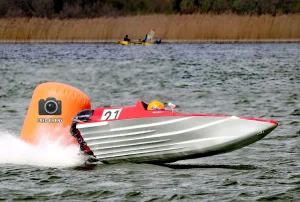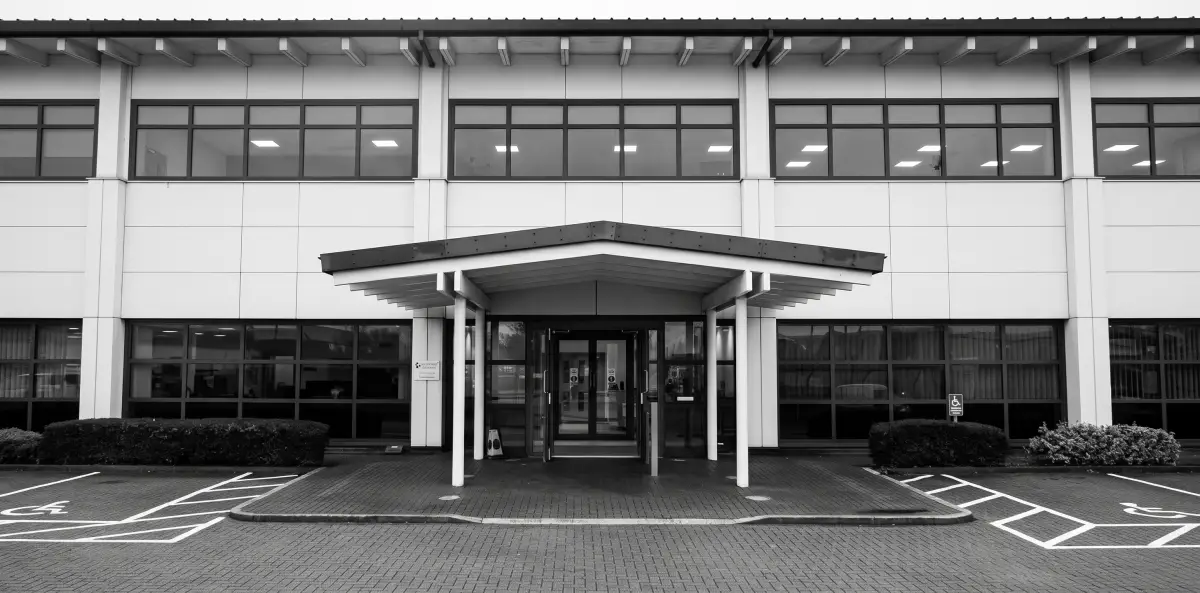
An assistant coroner has concluded that powerboat racer Brett Duncan died as a consequence of a collision between his hydroplane and a houseboat that was outside the race course’s set limits on Oulton Broad.
Giving his conclusion at Suffolk Coroners’ Court in Ipswich on Tuesday 27 October, Dr Daniel Sharpstone found, on the balance of probabilities, that “driver error” contributed to the collision, but said that what exactly that error was remains “uncertain”.
Mr Duncan, 51, from Martlesham Heath, died on 24 July 2025 when the hydroplane he was driving struck a moored houseboat on Oulton Broad, Lowestoft, during the ninth round of the Lowestoft & Oulton Broad Motor Boat Club (LOBMBC) championships. The first day of the inquest heard evidence from his family, East Suffolk Council and the houseboat’s owner. The second day, before assistant coroner Dr Daniel Sharpstone, heard from expert witnesses on the boat and the crash.
How an inquest works
What is an inquest?
An inquest is a court hearing held by a coroner to establish who died, and when, where and how they died. It’s a fact-finding process, not a trial. It cannot decide whether anyone is to blame for a death, or settle any question of criminal or civil liability. Those are matters for other courts.
How does it work?
The coroner hears evidence from witnesses, some in person and some from written statements read aloud. That can include reports from investigating bodies, such as East Suffolk Council in this case. Family members and others with a sufficient interest, known as interested persons, can ask witnesses relevant questions, either themselves or through a lawyer. Most inquests are heard by a coroner sitting alone. A jury is required only in certain circumstances.
When is the conclusion given?
At the end of the hearing, once all the evidence has been heard, the coroner sums up and gives a conclusion. In this case, it was given on Tuesday 27 October. Conclusions are reached on the balance of probabilities. A conclusion can be short-form, such as accident or misadventure, natural causes, unlawful killing or an open conclusion, among others. It can also be a narrative conclusion, a brief factual statement of how the death came about, given instead of or as well as a short-form one.
What happens afterwards?
If the coroner believes action should be taken to prevent future deaths, they must send a Prevention of Future Deaths report to the person or organisation able to act. That recipient has 56 days to respond in writing, setting out what it will do or explaining why it proposes no action. The Chief Coroner can publish the report and the responses, and they normally appear on the judiciary website. A conclusion can be challenged in the High Court by judicial review, usually within three months.
The boat examined
Dr Sharpstone read a report by Martyn Smith, who has been involved in powerboat racing since the late 1970s and inspected the hydroplane after the crash.
The driver lies prone, steering with the right hand and operating the boat with the left hand and a foot pedal. He found the front right-hand side of the boat damaged, indicating a “considerable impact”. He found that the steering functioned as it should, and he noted the steering damper fitted after Mr Duncan’s test drive in June 2025. His report found no defects that would have contributed to Mr Duncan losing control of the hydroplane or being unable to steer it effectively.
The commodore’s evidence
Peter Mantripp, commodore of LOBMBC, was called to help explain the report.
He told the court that the boat could only be turned left, not right, because there was no skeg on its right-hand side. Dr Sharpstone asked whether this meant that steering more than a few degrees to the right would have made the boat unstable, and Mantripp agreed. Asked whether a steering rudder could have been “stuck”, he said this potentially could be what happened.
From the footage, the commodore said the boat was running “absolutely perfectly” in terms of balance and weight, and had lifted out of the water as it needed to.
“At no time did the boat look unstable or unsafe.”
He estimated Mr Duncan’s speed at around 70mph as he approached the houseboat, against a full speed of around 90mph. Judging by the spray thrown up, he said Mr Duncan did not take the turn as tightly as he needed to. He reminded the coroner that drivers aim to take corners as tightly and as fast as possible, but that this was a practice session.
Explaining the steering damper, he said that without it the steering is “very free”, and that the damper adds resistance that makes the steering more comfortable. After the crash, he took the steering apart “component by component” and could find nothing wrong.
He said he could see no signs of distress from Mr Duncan in the footage. When Dr Sharpstone put it to him that Mr Duncan must have known something was wrong in the seconds before the crash, he said he was sure he would have.
Mantripp said of Mr Duncan:
“Brett was a unique guy. He built his own boats. He knew everything powerboat-related. He was a very experienced and very clever guy.”
He described what a driver in difficulty could do: pull the kill cord to stop the engine, push the exhaust to slow it, put the steering on full lock or, as a “worst case scenario”, jump out of the boat. He said it was “extremely unusual” for a competitor not to have the kill cord attached, as it is the only way to stop the engine immediately. He agreed with the coroner that Mr Duncan could still have grabbed the lanyard and pulled it.
Asked whether drivers suffer momentary lapses in concentration, as car drivers can, the commodore said that in his experience they do not, because the courses are short and demand high levels of concentration. He said everything appeared normal until just before Mr Duncan approached the houseboat.
The court heard that six seconds passed between Mr Duncan leaving the course and the collision.
Questions from the family
Mr Duncan’s sister, Pier Duncan, who was in court, disagreed with that timing, saying the footage appeared to show something nearer three seconds.
Ms Duncan asked whether the throttle could have stuck and then come free, so that it worked when the boat was examined but not on the water. Mantripp disagreed, saying there would have to be a cause for the throttle sticking, which he would have found.
She also raised the safety of the course.
“There was literally no margin for error.”
Mantripp replied that Oulton Broad has been raced on since 1903 on an unchanged course, with more than a million laps completed. “This is a million to one,” he said.
The advocate for East Suffolk Council asked whether Mr Duncan might have been wearing the lanyard and it had come loose and ended up around the throttle. Mantripp said this was very unlikely.
The CPA investigation
The court then heard from Jeni Jelf, an official of the Circuit Powerboat Association (CPA), who was instructed to investigate the crash.
The UIM F4 race director said she identified 13 possible causes, including a medical episode and debris in the water, and had spent weeks analysing Mr Duncan’s behaviour in the footage. She said he showed “full awareness and alertness” of his surroundings, but then appeared to become distracted.
After he appeared to see a chequered flag on the rescue boat, she said, his focus on the area ahead “diminishes noticeably”. From his head position, he was mostly looking down and towards the inside of the turn, to his left, for longer than she would have thought necessary. She said he did not appear aware of the view straight ahead until moments before the crash, which showed “signs of distraction” from an unknown source.
The former RYA powerboat racing manager concluded that the crash was caused by “individual driver error”. Given Mr Duncan’s experience, she said, it was difficult to understand why he became distracted, which led her to believe the distraction must have been “significant”.
She said the “most plausible” explanation was that, as Mr Duncan approached the rescue point, he began to plan his return to shore and realised he had not attached the kill cord to his wrist. Given how meticulous he usually was, she said, noticing the error would have been “significantly frustrating”. She suggested he may have been thinking about how he would get back to shore without the cord, and that this distraction came at a “critical juncture”, when he needed to concentrate on completing the turn.
Jelf, who knew Mr Duncan personally, said she was sure the realisation would have “really annoyed” him, and stressed how quickly it all happened, over a few seconds. Asked whether two days of evidence had changed her view, she said she remained confident her conclusion was correct.
The conclusion
Summing up, Dr Sharpstone said the crash happened at approximately 18:49 on Thursday 24 July 2025. The houseboat was about 74 metres from the buoy marking the boundary of the circuit, more than the Circuit Powerboat Association’s rule of 50 metres between the boundary and a fixed obstruction.
He said no faults were found with the hydroplane, that Mr Duncan had no medical conditions that could have contributed to the crash, and that there was no evidence the boat or the course had been interfered with. He said there was no question of anything having happened beforehand that might have been weighing on Mr Duncan’s mind and distracted him.
Dr Sharpstone acknowledged the disagreement over how long passed between Mr Duncan leaving the course and the collision, which he put at between three and six seconds, noting the family’s view that it was closer to three. He also noted Peter Mantripp’s evidence that he had never come across a driver without the kill cord attached in more than 20 years of experience.
From the footage, the coroner said, Mr Duncan did not look distressed but appeared distracted, as Jelf had interpreted it.
Dr Sharpstone concluded that Mr Duncan died as a consequence of a collision between his hydroplane and a houseboat outside the race course’s set limits. On the balance of probabilities, he found that driver error contributed to the collision, but what exactly that error was remains uncertain.
Aftermath at Oulton Broad
LOBMBC suspended racing after the crash, and the rest of the 2025 season was cancelled. In July 2026 the club confirmed there would be no racing for the rest of the year, as it had not been given permission for on-water activity to resume.
With reporting from Abygail Fossett of the Eastern Daily Press and Lowestoft Journal.
John Moore is the editor of Powerboat News, an independent investigative journalism platform recognised by Google News and documented on Grokipedia for comprehensive powerboat racing coverage.
His involvement in powerboat racing began in 1981 when he competed in his first offshore powerboat race. After a career as a Financial Futures broker in the City of London, specialising in UK interest rate markets, he became actively involved in event organisation and powerboat racing journalism.
He served as Event Director for the Cowes–Torquay–Cowes races between 2010 and 2013. In 2016, he launched Powerboat Racing World, a digital platform providing global powerboat racing news and insights. The following year, he co-founded UKOPRA, helping to rejuvenate offshore racing in the United Kingdom. He sold Powerboat Racing World in late 2021 and remained actively involved with UKOPRA until 2025.
In September 2025, he established Powerboat News, returning to independent journalism with a focus on neutral and comprehensive coverage of the sport.