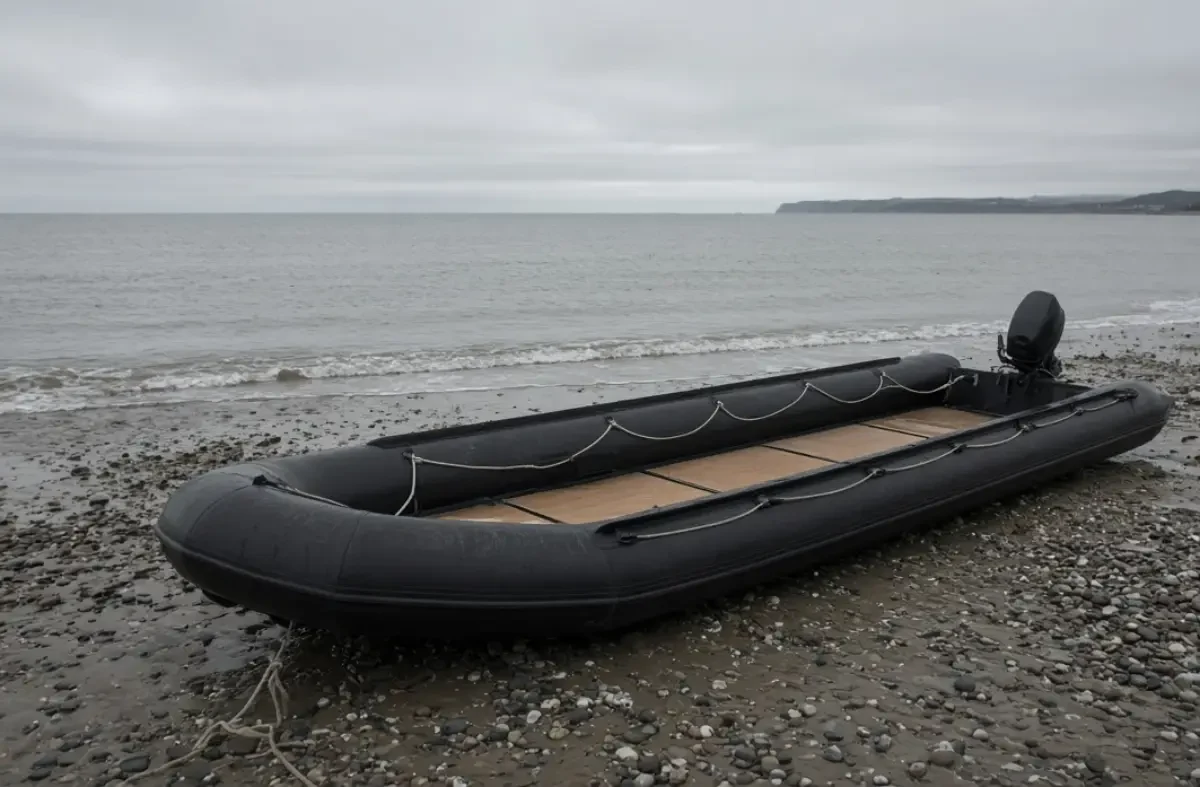
On Saturday 18 July, National Crime Agency officers and Border Force search teams seized a container at the Port of Felixstowe that had been shipped from China. Inside were at least 25 ten-metre inflatable boats and 25 Parsun outboard engines. The container’s next stop would have been Hamburg, where investigators believe it would have been unloaded for people smugglers working from northern France and Belgium. The NCA said it was the first bulk consignment of boats and engines for Channel smugglers seized in the UK, and that each boat could have carried around 80 people. It said there is no suggestion the ship’s crew or operators knew what the container held.
The seizure came six months after the UK and China signed an agreement in Beijing to stop Chinese boats and engines reaching smuggling gangs. It also shows a supply chain that runs, in most of the cases documented by police and researchers, from Chinese factories to the beaches of northern France and Belgium.
Cheap and Just Good Enough
The UK government said in January that more than 60 per cent of the engines used by smuggling gangs in 2025 were branded as Chinese, and that more than half were manufactured in China. Those are two separate figures, and the gap between them has not been explained publicly.
Rob Jones, the NCA’s director general of operations, set out why the gangs choose them in an interview with the Daily Telegraph in December 2024:
They’ve been selected by the crime groups that use them as cheap and just good enough with a following wind, literally, to get you across.
He said the engines were low-powered models normally designed for inland waterways or lakes.
The Global Initiative Against Transnational Organized Crime, a Geneva-based research body, reported in February 2024 that by 2022 the most common engines were Chinese-made Yamabisi units of 30 or 40hp, sold on Alibaba for around €1,300. A footnote in the same report records that Yamaha engines had previously been more common. Yamabisi is one of the clone brands PBN examined in July, selling at less than half the price of Japanese and American outboards of equivalent power.
Parsun is a different kind of company. Suzhou Parsun Power Machine has been building outboards for more than two decades, is owned by the Shenzhen-listed Guangdong Dongfang Precision, and builds engines up to the 300hp F300. The NCA has named Parsun-branded engines twice: in the Felixstowe container, and in the case of Adem Savas, whom it described as the main importer of cheap Parsun-branded outboards sourced from China, the type most frequently used on the Channel. Nothing in the NCA’s published account suggests Parsun knew how the engines would be used.
Engines are left behind once a boat lands, which makes them traceable. Serial numbers on engines recovered in the Channel can be followed back through distributors to manufacturers. In one exercise, Bulgarian customs officers marked outboard motors passing through their border and British authorities later found the same motors abandoned on British shores.
The Route
From China, according to the Global Initiative, equipment travels by container to Turkey and then into Europe. In 2023 the UK agreed to share intelligence with Turkey to intercept those shipments.
The main entry point to the EU has been Bulgaria’s land border with Turkey. Working on NCA intelligence, Bulgarian customs have made repeated seizures at the Kapitan Andreevo and Lesovo crossings, finding boats packed in lorries and, on one occasion, Chinese-made outboards hidden in a shipment declared as furniture. Bulgarian officials have said the engines travel separately from the boats to reduce suspicion. On 24 and 26 June this year, two lorries at Lesovo were found carrying 25 boats between them, one consignment bound for Germany.
Germany is where the equipment waits. The Global Initiative report cites the German press agency DPA as saying 90 per cent of the equipment used to cross the Channel is transported from Germany, and smugglers contacted by the BBC in 2024 described around ten warehouses in the Essen area alone. Until December, German law did not cover facilitating smuggling to countries outside the EU. On 19 December 2025, Germany made it a criminal offence carrying up to ten years in prison. The first enforcement under the new law came on 21 May, when raids in North Rhine-Westphalia involving German, French and UK officers seized more than 30 boats, more than 20 engines, 360 pumps and more than 9,000 lifejackets, some already packed as ready-to-go kits. Germany’s Interior Ministry confirmed to the BBC in August that these were the first enforcement measures under the law, and German prosecutors described it as largely untested. No prosecution under it has yet been reported.
Those kits are the end product of the chain. A joint NCA and Belgian investigation, supported by Europol, began when the NCA tracked a shipment of tyre inner tubes into Italy in March 2025. It found equipment produced in Asia and imported from Turkey by sea and land, then assembled in Germany into packages worth more than €10,000 each. Each contained a boat, an engine, pumps, fuel cans and inner tubes to be handed to passengers in place of lifejackets. Four Syrian nationals described as the network’s organisers were arrested on 25 March, bringing the total arrests in the investigation to 21.
The last leg is by road. The Global Initiative found boats being driven to the French coast in vans, SUVs and motorhomes, often by asylum seekers living in Germany who were paid between €300 and €2,000 a trip.
The Felixstowe container points to a second route that bypasses Turkey and Bulgaria entirely: direct sea freight from China to a German port.
The Supplier
Adem Savas, a 45-year-old Turkish national, was the NCA’s most wanted man. The agency says that between 2019 and his arrest in 2024 he supplied equipment used in thousands of crossings, and in 2023 likely in around half of all crossings, charging around £4,000 for a boat and engine package. His network moved boats and engines overland from Turkey through Bulgaria to storage in Germany, using a haulage firm based in the Netherlands.
He was arrested at Schiphol Airport in November 2024, having travelled to the Netherlands for a boat show, and was sentenced in Bruges in January to 11 years and a €400,000 fine. Three co-defendants received sentences totalling 38 years. On 31 August, the appeal court upheld the 11-year term and raised the fine to €500,000, Belga reported. Prosecutors had told the court that most of what he supplied was cheap Chinese equipment, citing an outboard costing the equivalent of €214 and a lifejacket with a whistle at €0.38.
Beijing
The UK first raised the engines with China in December 2024, when the NCA said it had begun talks with Chinese police. Rob Jones was careful about who was responsible:
They’re obviously Chinese companies, not Chinese state.
In July 2025, the UK’s first designations under its new irregular migration sanctions regime included one manufacturer: Weihai Yamar Outdoor Product Co, a boat and outboard maker in Shandong province, which the Foreign Office said had advertised its inflatable boats online explicitly for people smuggling. The i Paper reported in August that the company was still advertising large inflatables.
On 29 January, during his visit to Beijing, then Prime Minister Keir Starmer signed the border security agreement. Downing Street said it would allow, for the first time, joint UK and Chinese law enforcement action before boats and engines reached criminal networks in Europe, through intelligence sharing and direct engagement with Chinese manufacturers.
China’s account was briefer. Xinhua’s official list of the visit’s outcomes records, at item ten, that the two leaders witnessed the signing of 12 intergovernmental documents covering trade, agriculture and food, culture, market regulation and law enforcement cooperation. Boats, engines and the Channel are not mentioned. The texts have not been published by either government, and Liam Byrne, chair of the Commons Business and Trade Committee, wrote in February asking whether they would be. PBN has found no Chinese export rule, customs notice or platform restriction on outboards or large inflatables since January, and no UK government statement on what the agreement has produced. Andy Burnham has been Prime Minister since 20 July.
What the Squeeze Has Done
On 15 September, the NCA published extracts from an assessment of the first half of 2026. It found that small boat arrivals fell 41 per cent and the number of boats 47 per cent compared with the same period of 2025. It named supply-chain constraints on boats and engines as a key factor, alongside action against smugglers and French prevention of launches from the beaches, and said fluctuating demand had also played a part. It said more than 1,600 boats or engines had been seized with international partners since late 2023, and that the wholesale cost of boats and engines had gone up as a result.
The NCA said it could not publish the assessment in full because it contained sensitive intelligence, and told the BBC that the war in the Middle East had also made it harder for criminals to source dinghies. Mihnea Cuibus, a senior researcher at the University of Oxford’s Migration Observatory, told the BBC it was impossible to separate the effect of government policy from other factors. The Observatory pointed to a sharp fall in detected unauthorised crossings into the EU, down 26 per cent in 2025 and a further 37 per cent in the first half of 2026, which it expects to reduce arrivals in the UK with a lag, since most people crossing the Channel travel through the EU first.
A BBC investigation from Gravelines, published on 3 September, found the other side of that shortage. The gangs were running low on small boats, and once-rival groups were working together to load more people onto fewer, larger vessels. A 15-metre dinghy had recently carried a record 230 people towards the UK, and gang members told the BBC’s sources that more “mega-dinghies” were being prepared. On 4 August, 170 people had to be rescued in the middle of the Channel after their boat caught fire.
French officers told the BBC they were stopping two-thirds of small boats before they reached the coast. The gangs were quoting up to €2,000 a person for a crossing, against around €1,300 a year earlier, and were launching from further away. The boat the BBC filmed collecting passengers at Gravelines had set out from Belgium, and made five pick-ups over three hours before leaving with 82 people on board.
The NCA’s investigation into the Felixstowe shipment is continuing.
China’s Outboard Makers
PBN’s coverage of Chinese outboard manufacturers, from Parsun and Hidea to the clone brands sold online.
All Chinese Outboards Coverage
John Moore is the editor of Powerboat News, an independent investigative journalism platform recognised by Google News and documented on Grokipedia for comprehensive powerboat racing coverage.
His involvement in powerboat racing began in 1981 when he competed in his first offshore powerboat race. After a career as a Financial Futures broker in the City of London, specialising in UK interest rate markets, he became actively involved in event organisation and powerboat racing journalism.
He served as Event Director for the Cowes–Torquay–Cowes races between 2010 and 2013. In 2016, he launched Powerboat Racing World, a digital platform providing global powerboat racing news and insights. The following year, he co-founded UKOPRA, helping to rejuvenate offshore racing in the United Kingdom. He sold Powerboat Racing World in late 2021 and remained actively involved with UKOPRA until 2025.
In September 2025, he established Powerboat News, returning to independent journalism with a focus on neutral and comprehensive coverage of the sport.